Allen-Bradley
RFQ Ready
Allen-Bradley 80190-520-01-R Soft Starter Component – SMC-Flex
SMC-Flex
Origin US
Soft Starter Component
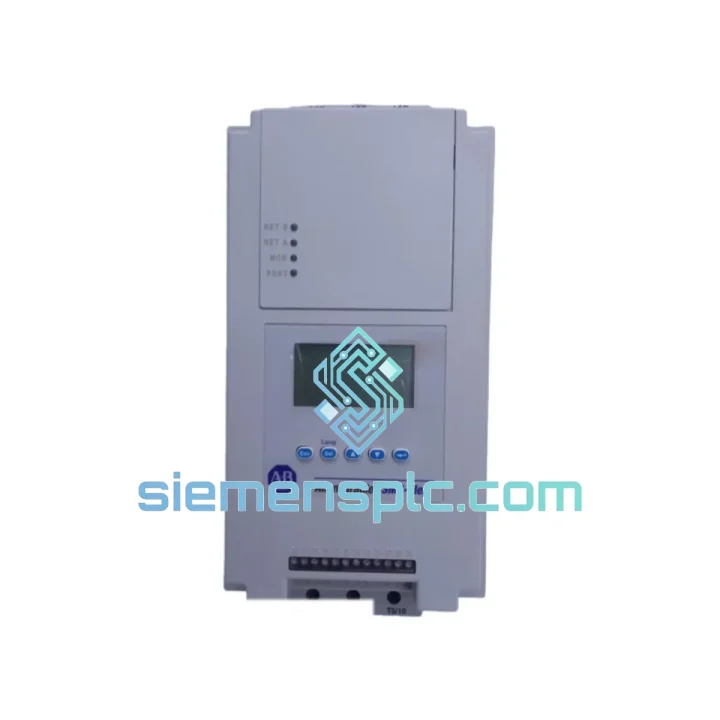
Request verified availability, condition, replacement risk review, packing options and courier lead time for 150-F60NBD.
Click Request Quote and the part number is inserted into the inquiry form automatically.
Core fields for model confirmation and RFQ routing. Detailed product narrative remains below.
The Allen-Bradley 150-F60NBD is a 60 A three-phase solid-state soft starter with an integrated bypass contactor, belonging to Rockwell Automation’s SMC Flex series. Within a motor control loop, this unit performs a specific and measurable function: it regulates the RMS voltage applied to the motor stator during the acceleration transient, limiting inrush current and torque impulse to values that the mechanical drivetrain and upstream distribution network can absorb without fault. Once the motor reaches synchronous speed, the internal bypass contactor (suffix “B”) closes across the SCR power section, transferring the full-load current path to a low-impedance copper bus and eliminating the thermal dissipation penalty that would otherwise accumulate in the thyristor stack during continuous operation.
The “N” suffix designates the standard control voltage input range of 100–240 V AC, 50/60 Hz, making the 150-F60NBD compatible with both North American 120 V control circuits and European 230 V panel standards without transformer intervention. The “D” suffix confirms the unit is configured for DeviceNet-ready operation, with the communication module slot pre-populated for optional 150-SM2 network card installation. This architecture allows the soft starter to participate in a DeviceNet segment as a Group 2 Only slave device, exposing start/stop commands, speed reference, and fault status as explicit messaging objects accessible from any ControlLogix or CompactLogix scanner.
At 60 A continuous rating, the 150-F60NBD covers motor loads up to approximately 30 kW (40 HP) at 400 V AC or 22 kW (30 HP) at 230 V AC, positioning it for mid-range process equipment — centrifugal pumps, screw compressors, belt conveyors, and HVAC fan drives — where across-the-line starting would generate 600–700% full-load current spikes lasting 5–8 seconds. The SMC Flex’s current limit start mode caps inrush at a user-defined threshold (typically 300–400% FLA), reducing the mechanical shock index on flexible couplings and V-belt drives by a factor proportional to the square of the current reduction ratio.
Real-time Stock & RFQ: [email protected] | WhatsApp: +86 18359268345
| Parameter | Value |
|---|---|
| Part Number / SKU | 150-F60NBD |
| Series | SMC Flex (Allen-Bradley / Rockwell Automation) |
| Continuous Current Rating | 60 A (full-load motor current) |
| Phase Configuration | 3-Phase AC |
| Supply Voltage Range | 200–600 V AC, 50/60 Hz |
| Control Voltage (suffix N) | 100–240 V AC, 50/60 Hz |
| Bypass Contactor (suffix B) | Integrated; closes at end of acceleration ramp |
| Communication (suffix D) | DeviceNet-ready slot (optional 150-SM2 module) |
| Start Modes | Soft start, current limit start, full voltage start, preset slow speed (2-speed) |
| Stop Modes | Soft stop, coast-to-rest, SMC brake (optional 150-SB module) |
| Acceleration Ramp Time | 1–30 seconds (adjustable) |
| Deceleration Ramp Time | 1–30 seconds (adjustable) |
| Initial Torque Setting | 0–90% of full voltage torque |
| Current Limit Range | 50–600% of motor FLA |
| Overload Class | Class 5, 10, 15, 20, 30 (programmable) |
| Protection Functions | Overload, phase loss, phase imbalance, stall, jam, underload, thermistor input |
| Enclosure Type | Open type (IP00), panel mount |
| Ambient Temperature | 0–40°C operating; -40–70°C storage |
| Relative Humidity | 5–95% non-condensing |
| Altitude | Up to 1000 m without derating |
| Approx. Weight | 5.7 kg |
| Standards | UL Listed, CE Marked, IEC 60947-4-2, CSA |
| Warranty | 12 months from date of shipment |
The power section of the 150-F60NBD is built around three anti-parallel SCR (silicon-controlled rectifier) pairs, one per phase, arranged in a six-pulse topology. Each SCR pair is driven by a gate pulse generator synchronized to the supply frequency zero-crossing, with firing angle α modulated by the internal microprocessor to produce the desired output RMS voltage profile. During the acceleration ramp, α decreases from near 180° (minimum conduction) toward 0° (full conduction), progressively increasing the effective voltage applied to the motor terminals. The transition is governed by a closed-loop current feedback algorithm that samples line current at 1 ms intervals via Hall-effect sensors, comparing measured current against the programmed limit setpoint and adjusting α in real time to maintain the target envelope.
The integrated bypass contactor is mechanically and electrically interlocked with the SCR firing circuit. When the motor speed estimator — derived from the slip frequency calculation using stator current signature analysis — determines that the rotor has reached within 2–3% of synchronous speed, the bypass contactor coil is energized. A 50 ms delay is enforced before the SCR gate pulses are suppressed, ensuring the contactor has fully closed and current commutation is complete before the thyristors are taken out of conduction. This sequencing prevents current interruption arcing on the contactor contacts and eliminates the voltage transient that would otherwise appear on the motor terminals during bypass transition.
EMC performance is addressed at the hardware level through a combination of design measures. The SCR gate drive circuits are optically isolated from the control logic board, with a minimum isolation voltage of 2500 V RMS, preventing high-frequency switching noise on the power bus from coupling into the microprocessor domain. The control PCB uses a split ground plane topology: the analog current measurement circuitry occupies a dedicated copper pour separated from the digital logic ground by a single-point star connection at the ADC reference pin. Snubber networks (RC circuits, typically 47 Ω / 0.1 µF) are placed across each SCR to suppress dV/dt transients during commutation, limiting the rate of voltage rise to below 200 V/µs — well within the SCR’s rated dV/dt capability and below the threshold that would induce false triggering in adjacent control wiring.
The onboard parameter storage uses non-volatile EEPROM with a minimum 100,000 write-cycle endurance rating. All user-configured parameters — ramp times, current limits, overload class, protection thresholds — are retained through power loss without battery backup. The fault history buffer stores the last 10 fault events with timestamp, fault code, and pre-fault current value, accessible via the front-panel LCD or through the DeviceNet explicit messaging interface.
Every Allen-Bradley 150-F60NBD unit supplied through siemensplc.com is sourced from verified supply channels with full traceability to authorized Rockwell Automation distribution. Units are inspected upon receipt for label integrity (holographic authenticity markers, date code consistency), housing condition (no remanufacturing evidence, original fastener torque marks intact), and connector pin alignment. Serial numbers are logged against our procurement records and cross-referenced where manufacturer verification services are available.
Packaging for international shipment follows IEC 60068-2-27 shock and vibration handling guidelines: each unit is placed in an anti-static polyethylene bag, surrounded by 50 mm minimum closed-cell polyethylene foam on all six faces, and sealed in a double-wall corrugated carton rated for 32 ECT. For orders of 3 or more units, wooden crating with internal foam blocking is used for sea freight consignments. Moisture-barrier desiccant packs are included for shipments to high-humidity destinations.
Dispatch from our Xiamen, China warehouse is executed within 1–3 business days of purchase order confirmation. Express courier options (DHL Express, FedEx International Priority, UPS Worldwide Express) deliver to most destinations in Europe, North America, Southeast Asia, and the Middle East within 3–5 business days from dispatch. Sea freight LCL consolidation is available for bulk orders where lead time permits. All shipments include commercial invoice, packing list, and certificate of origin. HS code 8537.10 applies for customs classification in most jurisdictions. A 12-month warranty from shipment date covers manufacturing defects under normal operating conditions.
Email: [email protected]
WhatsApp: +86 18359268345
Web: siemensplc.com
Location: Xiamen, China
© 2026 siemensplc.com. All rights reserved.
We check the full part number, brand, series and visible nameplate information before quotation.
Sales confirms stock path, condition option, quantity and realistic lead time for export dispatch.
DHL, FedEx, UPS or buyer courier arrangements can be reviewed with packing requirements.
Similar brand or category products for fast comparison and multi-item RFQ lists.