Allen-Bradley
RFQ Ready
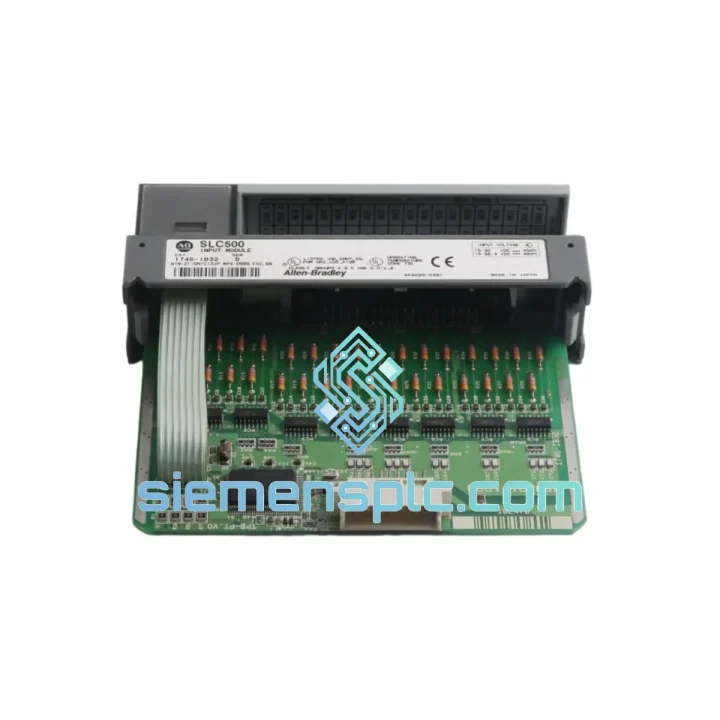
Allen-Bradley AIM16 PLC Input Module – SLC 500 Series
SLC 500
Origin US
PLC Input Module
Request verified availability, condition, replacement risk review, packing options and courier lead time for 1746-FIO4V.
Click Request Quote and the part number is inserted into the inquiry form automatically.
Core fields for model confirmation and RFQ routing. Detailed product narrative remains below.
The 1746-FIO4V occupies a specific and non-substitutable position in the SLC 500 I/O hierarchy: it is the only single-slot module in the 1746 series that combines two voltage analog inputs and two voltage analog outputs with a scan-synchronous update mechanism. Where standard analog modules such as the 1746-NI4 or 1746-NO4V operate on a dedicated background conversion cycle decoupled from the processor scan, the 1746-FIO4V refreshes all four channels — inputs and outputs — within every SLC 500 program scan. This architectural distinction is not cosmetic. In closed-loop control applications where the output command must reflect the most recent input measurement without an inter-scan latency penalty, the 1746-FIO4V eliminates the phase lag that accumulates in conventional analog module designs.
The module accepts and drives voltage signals across three configurable ranges: ±10 V DC, 0–5 V DC, and 0–10 V DC. Its 12-bit successive-approximation ADC delivers 4,096 discrete counts per channel, translating to a resolution of approximately 4.88 mV per count on the ±10 V range. The DAC output section maintains the same 12-bit linearity, with a settling time sufficient to drive resistive loads ≥1 kΩ without output droop. Channel-to-backplane isolation is rated at 500 V AC, achieved through transformer-coupled power isolation and optocoupler signal paths — a design that prevents ground-loop currents from the field wiring layer from reaching the SLC 500 backplane bus.
In process control loops where a PID algorithm executes in the SLC ladder program, the 1746-FIO4V ensures that the process variable (PV) read by the PID instruction and the control variable (CV) written to the output are both current within the same scan boundary. This eliminates the one-scan-cycle stale-data condition inherent in background-conversion modules, which can introduce measurable phase error in fast-responding loops — particularly those with setpoint step changes or derivative action enabled.
Real-time Stock & RFQ: [email protected] | WhatsApp: +86 18359268345
| Catalog Number | 1746-FIO4V |
| Manufacturer | Allen-Bradley / Rockwell Automation |
| Platform | SLC 500 (1746 series modular and fixed chassis) |
| Module Function | Fast Analog Combination: 2 Voltage Inputs + 2 Voltage Outputs |
| Input Voltage Ranges | ±10 V DC | 0–5 V DC | 0–10 V DC (software-selectable per channel) |
| Output Voltage Ranges | ±10 V DC | 0–5 V DC | 0–10 V DC (software-selectable per channel) |
| ADC / DAC Resolution | 12-bit (4,096 counts); ±10 V range → ~4.88 mV/count |
| Update Mechanism | Scan-synchronous — all channels updated every SLC 500 program scan |
| Input Impedance | ≥10 MΩ (voltage input, high-impedance buffer stage) |
| Output Load Impedance | ≥1 kΩ (resistive); capacitive loads may require series resistance |
| Channel-to-Backplane Isolation | 500 V AC (transformer + optocoupler isolation topology) |
| Backplane Current Draw | 120 mA @ 5 V DC |
| Operating Temperature | 0°C to +60°C (32°F to 140°F) |
| Storage Temperature | −40°C to +85°C |
| Relative Humidity | 5%–95% non-condensing |
| Chassis Slot Occupancy | 1 slot (SLC 500 single-width) |
| Wiring Interface | Removable terminal block (RTB), 22–14 AWG |
| Module Keying | Hardware keying (prevents incorrect slot insertion) |
| Weight | Approx. 300 g |
| Certifications | UL Listed | CE Marked (LVD 2014/35/EU + EMC 2014/30/EU) | CSA Certified |
| Warranty | 12 months from shipment date — covers defects in materials and workmanship |
| Reference Publication | Rockwell Automation 1746-UM009 (SLC 500 Analog I/O Modules User Manual) |
Scan-Synchronous Conversion Architecture
Conventional SLC 500 analog modules (e.g., 1746-NI4, 1746-NO4V) use an autonomous background conversion cycle that runs independently of the processor scan. The module’s internal microcontroller samples inputs and updates outputs on its own timer, which may or may not align with the SLC scan boundary. The result is a data latency of up to one full background conversion period — typically 5–20 ms depending on channel count and configuration. The 1746-FIO4V eliminates this by tying its conversion trigger directly to the SLC 500 backplane I/O update cycle. When the processor writes output image data to the module at the end of each scan, the module simultaneously latches input data into the input image table. Both operations complete within the backplane transfer window, ensuring zero inter-scan stale data on any channel.
Transformer-Coupled Power Isolation and Optocoupler Signal Path
The 500 V AC channel-to-backplane isolation is implemented through two distinct mechanisms. Field-side power is derived from a DC-DC converter with transformer isolation, creating a floating field-side supply rail that shares no common reference with the SLC 500 backplane 5 V bus. Signal paths between the field-side ADC/DAC circuitry and the backplane interface logic cross through optocouplers, which provide galvanic separation while maintaining the digital data integrity required for 12-bit accuracy. This dual-barrier design means that a field-side ground fault — such as a shorted sensor shield or a wiring error that connects field common to earth at a different potential — cannot inject common-mode current into the backplane bus or corrupt data in adjacent modules.
High-Impedance Differential Input Stage
Each voltage input channel uses a high-impedance instrumentation amplifier front end (≥10 MΩ input impedance) with differential sensing. This configuration rejects common-mode noise — 50/60 Hz interference from adjacent power cables, VFD switching noise, and ground potential differences between sensor and controller — before the signal reaches the ADC. In installations where sensor cables run parallel to motor power conduits for distances exceeding 10 metres, the differential rejection capability of the input stage is the primary defence against measurement error without requiring shielded cable routing changes.
EMC Design Compliance
The module meets EN 61131-2 electromagnetic compatibility requirements, including immunity to electrostatic discharge (ESD) per IEC 61000-4-2, radiated immunity per IEC 61000-4-3, and fast transient/burst immunity per IEC 61000-4-4. The PCB layout uses a split ground plane strategy — field-side and backplane-side grounds are separated at the isolation barrier — and all signal traces crossing the isolation boundary are routed through the optocoupler footprints with guard rings to minimise capacitive coupling at high frequencies.
Every 1746-FIO4V unit supplied through siemensplc.com is sourced as genuine Allen-Bradley / Rockwell Automation product. Units are procured through documented supply channels with traceable chain-of-custody records. Before shipment, each module undergoes a structured inspection protocol: visual authentication of housing, label, and hardware keying against OEM reference specifications; functional bench test across all four analog channels using calibrated voltage sources and measurement equipment; isolation resistance verification at 500 V DC between field terminals and backplane connector; and series/revision documentation matched to Rockwell Automation product compatibility records.
Shipments originate from Xiamen, China. Standard export packaging consists of an anti-static ESD bag, foam-lined inner carton, and outer corrugated shipping box with desiccant for humidity-sensitive transit routes. Express delivery via DHL Express or FedEx International Priority reaches most destinations in North America and Europe within 3–5 business days, and Southeast Asia within 1–3 business days. Sea freight consolidation is available for bulk orders. Export documentation — commercial invoice, packing list, certificate of conformance, and HS code classification — is issued as standard with every shipment. Additional documentation including pre-shipment test reports and country-of-origin declarations is available upon request.
Email: [email protected]
WhatsApp: +86 18359268345
Web: siemensplc.com
Location: Xiamen, China
© 2026 siemensplc.com. All rights reserved.
We check the full part number, brand, series and visible nameplate information before quotation.
Sales confirms stock path, condition option, quantity and realistic lead time for export dispatch.
DHL, FedEx, UPS or buyer courier arrangements can be reviewed with packing requirements.
Similar brand or category products for fast comparison and multi-item RFQ lists.