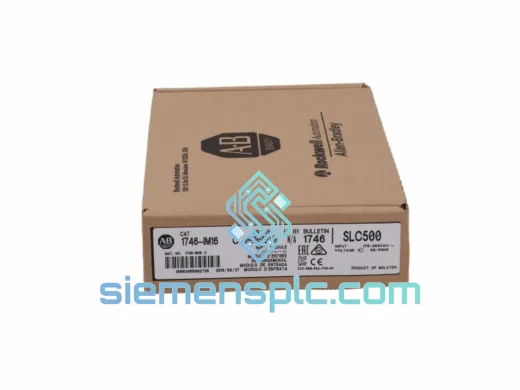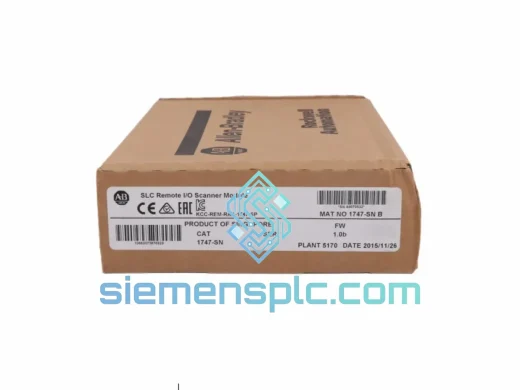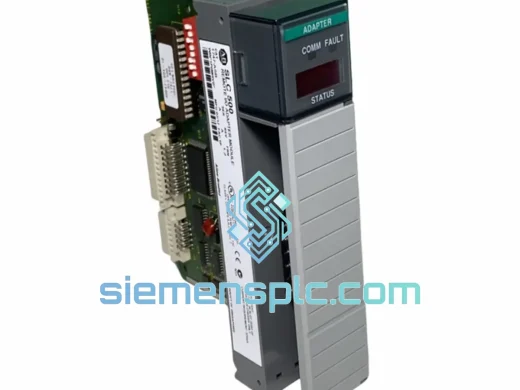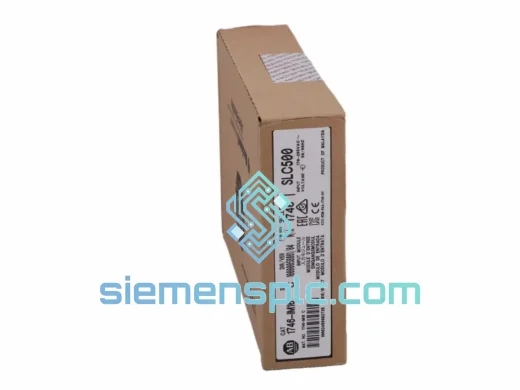
Allen-Bradley
RFQ Ready
Allen-Bradley DIM16 Discrete Input Module
SLC 500
Origin US
Discrete Input Module
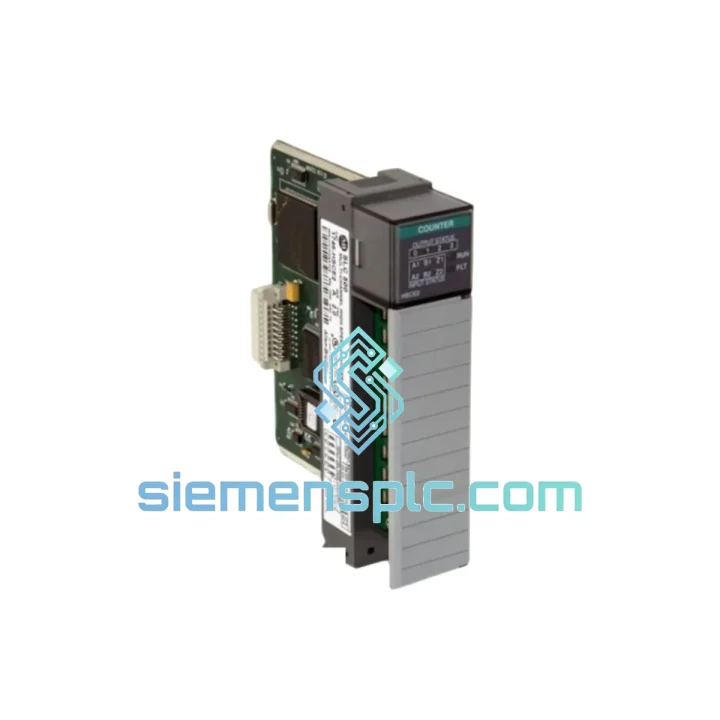
Request verified availability, condition, replacement risk review, packing options and courier lead time for 1746-HSCE2.
Click Request Quote and the part number is inserted into the inquiry form automatically.
Core fields for model confirmation and RFQ routing. Detailed product narrative remains below.
The Allen-Bradley 1746-HSCE2 is a purpose-engineered, dual-channel high-speed counter and encoder input module designed for installation within the SLC 500 1746 I/O chassis family. Its core function is to accept incremental encoder quadrature signals and high-frequency pulse trains at rates that fundamentally exceed the deterministic scan cycle of the SLC 500 processor — capturing motion and position data in hardware, independent of ladder logic execution time. This architectural separation between signal capture and program scan is the defining characteristic that makes the 1746-HSCE2 indispensable in applications where count accuracy at speed is non-negotiable.
In discrete manufacturing environments — automotive transfer lines, packaging machinery, web-fed printing presses, and precision cut-to-length systems — the encoder interface is the primary feedback path between mechanical motion and the control system. A standard digital input module, constrained by the PLC scan cycle (typically 5–20 ms for a loaded SLC 500 processor), will miss pulses from encoders operating above a few hundred Hz. The 1746-HSCE2 eliminates this constraint by processing encoder signals at up to 1 MHz per channel in dedicated onboard counter hardware, storing accumulated counts in a 32-bit register that the processor reads asynchronously during its normal I/O scan.
Each of the two independent counter channels supports single-ended (5–24 VDC) and differential RS-422 encoder inputs, accommodating the full range of incremental encoder output standards found in industrial field devices. Quadrature decoding is selectable at x1, x2, or x4 resolution, allowing the system integrator to trade off position resolution against maximum trackable velocity depending on application requirements. Pulse/direction and up/down counting modes extend the module’s applicability to stepper motor feedback and bidirectional flow metering.
The 32-bit signed integer counter register provides a count range of ±2,147,483,647, which eliminates rollover concerns in long-duration or high-count-rate applications such as odometry systems, batch totalizers, and length measurement on continuous material webs. Programmable preset and reset functions, combined with onboard output control logic, allow the module to assert discrete outputs at defined count thresholds without waiting for the processor scan to complete — a hardware-level response mechanism that reduces output latency to microseconds rather than milliseconds.
The 1746-HSCE2 draws its operating power directly from the SLC 500 backplane, requiring no external auxiliary supply for module logic. It occupies a single slot in any standard 1746 chassis (A4, A7, A10, or A13) and is configured via the HSC instruction set in RSLogix 500, using the module’s assigned input and output image table words. Configuration data — including operating mode, preset values, and output enable logic — is written to the module’s output image during processor initialization and can be modified dynamically during runtime.
Genuine Allen-Bradley 1746-HSCE2 modules are available from our Xiamen, China facility with verified part traceability, pre-shipment inspection, and 12-month warranty coverage. We serve OEM machine builders, system integrators, and MRO procurement teams across Asia-Pacific, Europe, the Middle East, and the Americas.
Real-time Stock & RFQ: [email protected] | WhatsApp: +86 18359268345
| Parameter | Specification |
|---|---|
| Catalog Number | 1746-HSCE2 |
| Module Family | Allen-Bradley SLC 500 / 1746 I/O |
| Module Type | High-Speed Counter / Encoder Input |
| Number of Counter Channels | 2 (fully independent) |
| Maximum Input Frequency | 1 MHz per channel |
| Counter Register Width | 32-bit signed integer (±2,147,483,647) |
| Quadrature Decoding Modes | x1, x2, x4 (selectable per channel) |
| Additional Count Modes | Pulse/Direction, Up/Down |
| Single-Ended Input Voltage | 5 VDC to 24 VDC |
| Differential Input Standard | RS-422 (balanced differential) |
| Onboard Outputs | Programmable discrete outputs with preset/reset control |
| Power Source | SLC 500 backplane (no external supply required) |
| Compatible Chassis | 1746-A4, 1746-A7, 1746-A10, 1746-A13 |
| Compatible Processors | SLC 5/01 through SLC 5/05 (all 1747-Lxxx variants) |
| Configuration Software | RSLogix 500 (HSC instruction set) |
| Operating Temperature | 0°C to 60°C (32°F to 140°F) |
| Storage Temperature | −40°C to +85°C |
| Relative Humidity | 5% to 95%, non-condensing |
| Certifications | UL Listed, CE Marked, CSA Certified |
| Reference Publication | Rockwell Automation 1746-UM006 |
| Warranty | 12 months from date of shipment |
Scan-Independent Counter Architecture
The fundamental hardware design principle of the 1746-HSCE2 is the physical separation of signal acquisition from processor execution. The module contains dedicated counter ASICs (application-specific integrated circuits) that operate asynchronously from the SLC 500 backplane bus. Encoder pulses are latched and accumulated in hardware registers at the full 1 MHz rate regardless of whether the processor is executing ladder logic, performing I/O scans, or servicing communication requests. The processor reads the accumulated count value from the module’s input image table during its normal I/O update phase — a read operation that takes a snapshot of the hardware register without interrupting the counting process. This architecture guarantees zero pulse loss at rated input frequency, a property that cannot be achieved with software-based counting on standard digital input modules.
RS-422 Differential Input and EMC Design
The differential RS-422 input path on the 1746-HSCE2 provides common-mode noise rejection that is essential in industrial panel environments. RS-422 transmits each signal as a complementary pair (A+ / A−, B+ / B−, Z+ / Z−), and the receiver computes the difference between the two conductors. Common-mode interference — induced by VFD switching transients, contactor coil suppression, or ground potential differences across long cable runs — appears equally on both conductors and is cancelled at the differential receiver input. The module’s input circuitry is designed to maintain signal integrity with common-mode voltages up to ±7 V relative to the module’s signal ground, consistent with the RS-422 standard. For single-ended encoder inputs operating at 5–24 VDC, the input threshold hysteresis prevents false triggering from slow signal edges or noise-induced ringing on unshielded cable runs.
Quadrature Decoding Logic
The x1, x2, and x4 quadrature decoding modes are implemented in hardware state machines within the counter ASIC. In x4 mode, the decoder counts both rising and falling edges of both the A and B channels, yielding four counts per encoder line — the maximum resolution achievable from a standard incremental encoder. In x2 mode, both edges of one channel are counted. In x1 mode, only one edge of one channel is counted. Direction determination is derived from the phase relationship between the A and B channels: when A leads B, the counter increments; when B leads A, the counter decrements. This direction logic is implemented in combinational hardware and operates at the full 1 MHz input rate without software intervention.
Preset and Output Response Latency
The onboard output control logic compares the live counter register value against the programmed preset value in hardware, asserting the output when the count reaches the preset threshold. This comparison occurs within the counter ASIC clock cycle — typically sub-microsecond — rather than waiting for the PLC scan to detect the threshold condition and execute an output instruction. In applications such as flying shear control, dispensing systems, or registration mark detection, this hardware-level output response eliminates the scan-time jitter that would otherwise introduce positional error proportional to line speed.
Every Allen-Bradley 1746-HSCE2 module dispatched from our Xiamen, China facility undergoes a structured pre-shipment verification process. Physical inspection covers PCB condition, connector integrity, terminal block seating, and housing for any indicators of non-genuine or refurbished product. Catalog number, series letter, and date code markings are cross-referenced against Rockwell Automation documentation to confirm authenticity. Where stock condition permits, modules are bench-verified in a live SLC 500 chassis to confirm backplane communication and basic I/O response prior to packaging.
Packaging follows ESD-safe protocols: anti-static bags, foam-lined inner cartons, and double-wall outer cartons rated for international air freight handling. Each shipment is accompanied by a commercial invoice, packing list, and certificate of origin for customs clearance. Export documentation for regulated industries — including traceability records and inspection reports — is available upon request at the time of order.
Logistics options include DHL Express, FedEx International Priority, UPS Worldwide Express, and sea freight consolidation for volume orders. Transit times from Xiamen to major industrial hubs: 2–4 business days to Southeast Asia, 3–5 business days to Europe and the Middle East, 4–6 business days to North America. All shipments include full tracking from dispatch to delivery confirmation. A 12-month warranty against defects in materials and workmanship is provided on all units, with direct technical support available via email and WhatsApp throughout the warranty period.
Email: [email protected]
WhatsApp: +86 18359268345
Web: siemensplc.com
Location: Xiamen, China
© 2026 siemensplc.com. All rights reserved.
We check the full part number, brand, series and visible nameplate information before quotation.
Sales confirms stock path, condition option, quantity and realistic lead time for export dispatch.
DHL, FedEx, UPS or buyer courier arrangements can be reviewed with packing requirements.
Similar brand or category products for fast comparison and multi-item RFQ lists.