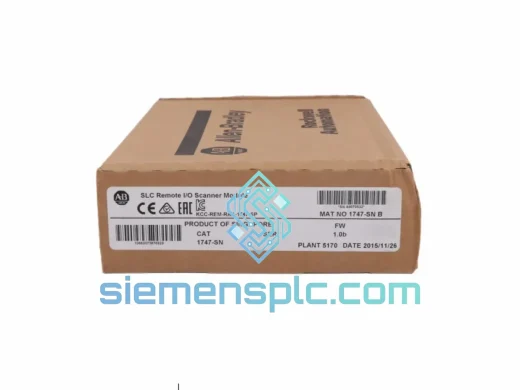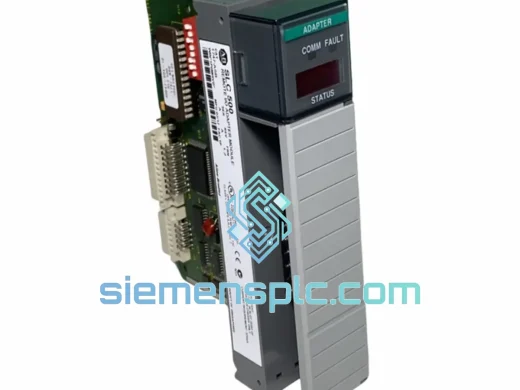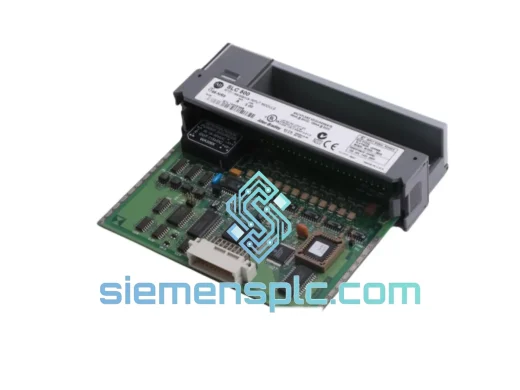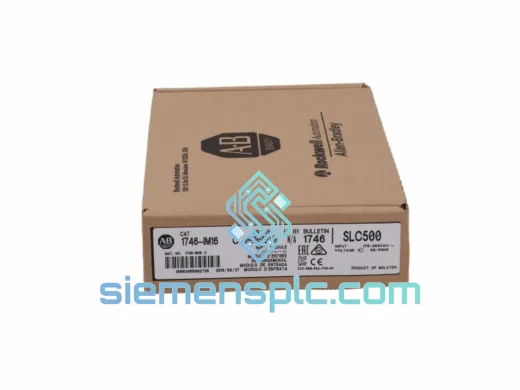
Allen-Bradley
RFQ Ready
Allen-Bradley AIM16 PLC Input Module – SLC 500 Series
SLC 500
Origin US
PLC Input Module
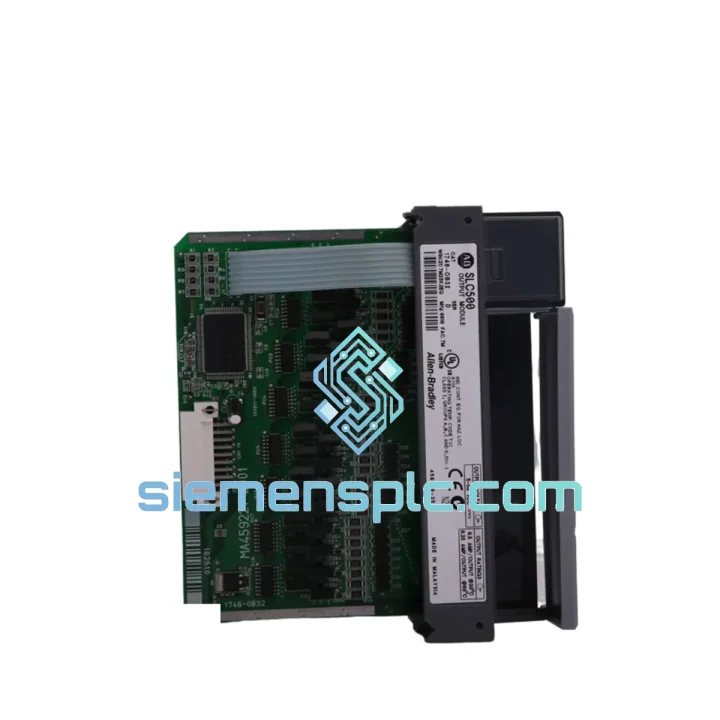
Request verified availability, condition, replacement risk review, packing options and courier lead time for 1746-OBP16.
Click Request Quote and the part number is inserted into the inquiry form automatically.
Core fields for model confirmation and RFQ routing. Detailed product narrative remains below.
The Allen-Bradley 1746-OBP16 occupies a well-defined position in the SLC 500 I/O architecture: it is the platform’s primary solution for driving high-inrush, high-current discrete field devices from a single-slot module. Where standard 0.5 A/point sourcing modules fail under solenoid coil inrush or contactor energization transients, the 1746-OBP16 sustains 2.0 A continuous per output point and tolerates 7.0 A inrush for 10 ms — parameters derived directly from Rockwell Automation’s published electrical specifications. This module is not a general-purpose I/O card; it is engineered for the specific load profile of inductive DC actuators in discrete manufacturing, process automation, and material handling environments.
In a typical SLC 500 control loop, the 1746-OBP16 sits between the processor’s output image table and the field wiring terminal block. The processor writes a bit state to the output image; the SLC 500 backplane transfers that state to the module’s output latch on each I/O scan; the module’s output driver then sources current from the field-side 24 VDC supply to the connected load. The optical isolation barrier — rated at 1,500 VAC — ensures that transient voltages induced by inductive load switching do not propagate back to the backplane logic circuitry. This isolation architecture is fundamental to the module’s EMC performance in electrically noisy panel environments.
Real-time Stock & RFQ: [email protected] | WhatsApp: +86 18359268345
| Part Number | 1746-OBP16 |
| Manufacturer | Allen-Bradley / Rockwell Automation |
| Platform | SLC 500 |
| Output Type | Sourcing (PNP), DC transistor |
| Number of Output Points | 16 |
| Output Voltage Range | 10 – 50 VDC |
| Continuous Output Current (per point) | 2.0 A |
| Maximum Module Output Current | 8.0 A |
| Inrush Current Tolerance | 7.0 A for 10 ms |
| Backplane Current Draw (5 VDC) | 185 mA |
| Backplane Current Draw (24 VDC) | 0 mA |
| Optical Isolation Rating | 1,500 VAC |
| Leakage Current (OFF state) | 1.0 mA max |
| Voltage Drop (ON state) | 1.0 V max |
| Turn-ON Response Time | 0.1 ms |
| Turn-OFF Response Time | 1.0 ms |
| Operating Temperature | 0 °C to +60 °C |
| Storage Temperature | -40 °C to +85 °C |
| Wiring Configuration | Screw terminal; 1 common per 8 outputs |
| Chassis Slot Width | Single slot, SLC 500 I/O chassis |
| Agency Certifications | UL, CSA, CE, C-Tick |
| Warranty | 12 months from date of shipment |
Output Driver Architecture and Inrush Handling
Each of the 16 output channels on the 1746-OBP16 uses a discrete power transistor output stage rather than a triac or relay. The transistor topology provides sub-millisecond switching response (0.1 ms turn-ON) and eliminates the contact wear mechanisms inherent to relay outputs. The 7.0 A / 10 ms inrush specification is not a soft limit — it reflects the transistor’s safe operating area (SOA) curve under repetitive inductive switching conditions. This rating accommodates the initial magnetizing inrush of solenoid coils, which typically peaks at 6–10× the steady-state holding current for 5–20 ms depending on coil inductance and supply impedance.
Optical Isolation and EMC Design
The 1,500 VAC optical isolation barrier between the backplane logic side and the field output side is implemented via phototransistor optocouplers on each channel. This architecture provides two measurable benefits in industrial panel environments: first, it prevents common-mode noise from inductive load switching from coupling into the SLC 500 backplane data bus; second, it allows the field-side supply voltage to float independently of the backplane 5 VDC rail, which is critical when field devices are powered from a separate, potentially unregulated 24 VDC source. The module draws 0 mA from the 24 VDC backplane rail, confirming that all field-side power is sourced externally — a design choice that reduces backplane power budget consumption and simplifies power supply sizing calculations.
Common-Per-Group Wiring Topology
The 16 output points are organized into two groups of 8, each sharing a single common terminal. This topology allows the two groups to be powered from different field supply circuits — for example, one group driving 24 VDC solenoids and the other driving 48 VDC actuators — within the same module slot. The shared common also simplifies wiring density calculations: a single 16 AWG common wire per group can carry the full 8.0 A module maximum, provided the per-group load distribution does not exceed the module’s thermal derating curve at elevated ambient temperatures.
Backplane Communication and I/O Scan Determinism
The 1746-OBP16 communicates with the SLC 500 processor via the SLC 500 parallel backplane bus. Output data is transferred from the processor’s output image table to the module’s output latch register on each program scan cycle. The module does not buffer or queue output commands — it presents the most recent output image state to the field devices on every scan. This deterministic, scan-synchronous behavior is essential for applications where output timing relative to input events must be predictable within one scan cycle, such as cam-synchronized solenoid firing on rotary indexing machines.
Every Allen-Bradley 1746-OBP16 unit dispatched from our Xiamen, China facility is sourced through verified supply channels with full manufacturer traceability. Units are inspected against a structured acceptance protocol before shipment:
Logistics from Xiamen, China are handled via DHL Express, FedEx International Priority, and UPS Worldwide Express, with typical transit times of 3–5 business days to Europe, 4–6 business days to North America, and 2–4 business days to Southeast Asia. Full tracking, commercial invoice, packing list, and HS code declaration (HS 8537.10) are provided with every shipment. Export documentation for customs clearance in the EU, US, and AU is prepared as standard. A 12-month warranty covers manufacturing defects; warranty claims are processed within 5 business days of receipt of the returned unit.
Email: [email protected]
WhatsApp: +86 18359268345
Web: siemensplc.com
Location: Xiamen, China
© 2026 siemensplc.com. All rights reserved.
We check the full part number, brand, series and visible nameplate information before quotation.
Sales confirms stock path, condition option, quantity and realistic lead time for export dispatch.
DHL, FedEx, UPS or buyer courier arrangements can be reviewed with packing requirements.
Similar brand or category products for fast comparison and multi-item RFQ lists.