Allen-Bradley
RFQ Ready
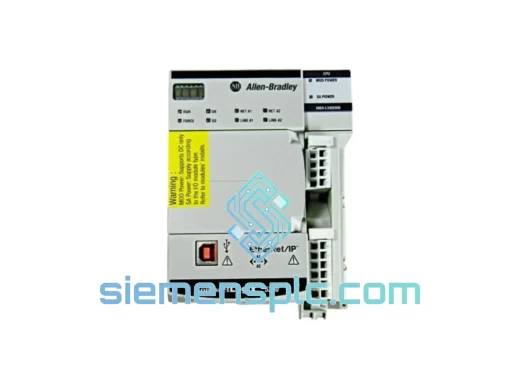
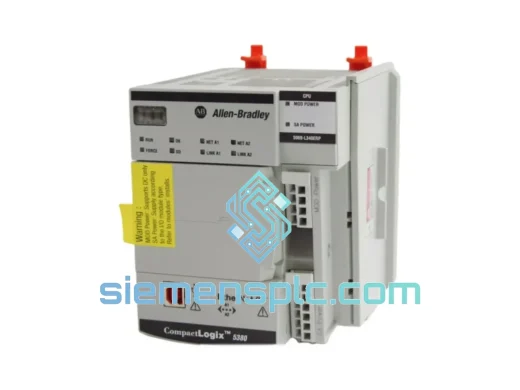
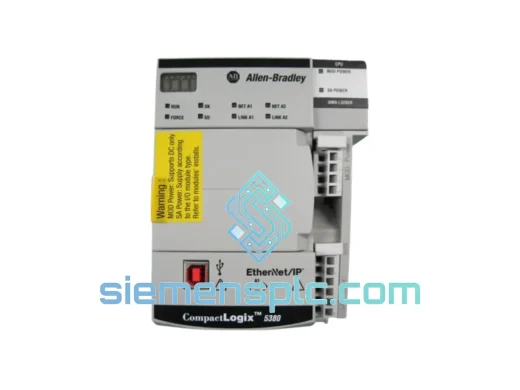
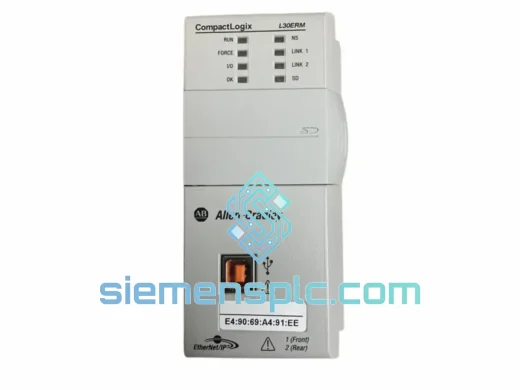
Allen-Bradley 1769-L30ERM PLC Motion Controller – CompactLogix 5370
CompactLogix
Origin US
PLC Motion Controller
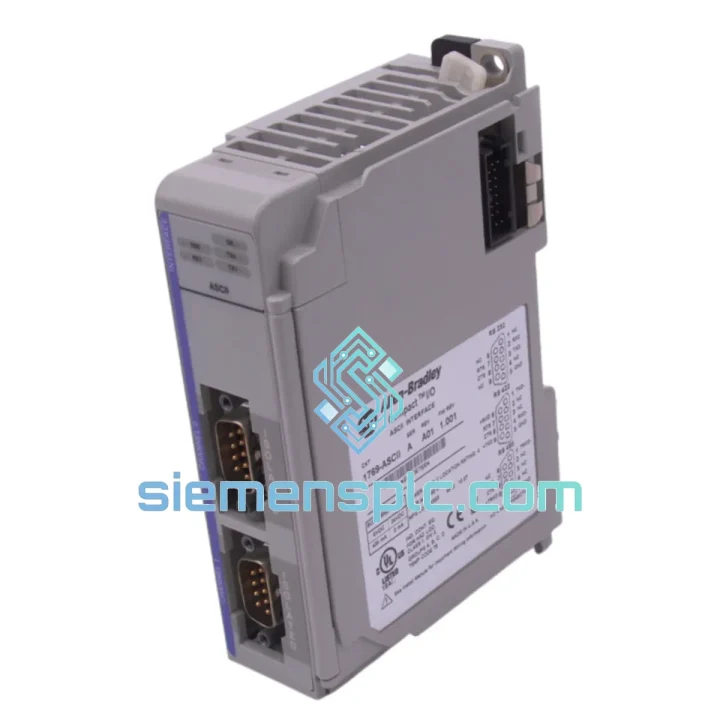
Request verified availability, condition, replacement risk review, packing options and courier lead time for 1769-ASCII.
Click Request Quote and the part number is inserted into the inquiry form automatically.
Core fields for model confirmation and RFQ routing. Detailed product narrative remains below.
The Allen-Bradley 1769-ASCII occupies a single slot in the CompactLogix 1769 modular expansion chassis and provides two independent, galvanically isolated RS-232C serial channels for ASCII-protocol peripheral integration. Within a control architecture, this module functions as a synchronous data acquisition node: it maps incoming ASCII strings from connected instruments directly into the CompactLogix processor’s tag database on each I/O scan cycle, and it transmits outgoing command strings from the processor to peripherals at the configured baud rate. The result is a bounded, predictable data path between the controller and any RS-232C-capable device—barcode scanners, analytical balances, vision inspection heads, label printers, gas analyzers, or third-party instrumentation—without the variable latency introduced by Ethernet-based serial server solutions.
In process control and discrete manufacturing environments, the determinism of this data path is not a convenience feature—it is an engineering requirement. Checkweigher applications, for example, must correlate a weight reading from a serial scale with a conveyor encoder position captured in the same scan cycle. A serial server that introduces 2–15 ms of TCP/IP stack jitter makes this correlation unreliable. The 1769-ASCII eliminates that jitter by coupling the serial buffer directly to the 1769 backplane bus, which operates under the processor’s deterministic scan schedule.
📩 Real-time Stock & RFQ: [email protected] | WhatsApp: +86 18359268345
| Parameter | Specification |
|---|---|
| Catalog Number | 1769-ASCII |
| Manufacturer | Allen-Bradley / Rockwell Automation |
| Compatible Platform | CompactLogix 1769 Modular I/O Expansion |
| Module Classification | Serial ASCII Communication Interface |
| Serial Ports | 2 × RS-232C, per-channel galvanic isolation |
| Communication Mode | Full-duplex ASCII, point-to-point |
| Baud Rate Range | 300 / 600 / 1,200 / 2,400 / 4,800 / 9,600 / 19,200 bps |
| Data Frame | 7 or 8 data bits; None / Odd / Even parity; 1 or 2 stop bits |
| Hardware Handshake | RTS/CTS, software-configurable per channel |
| Transmit Buffer Depth | 82 bytes per channel (circular FIFO) |
| Receive Buffer Depth | 82 bytes per channel (circular FIFO) |
| Backplane Current Consumption | 100 mA @ 5 VDC |
| Power Dissipation | 0.5 W typical |
| Chassis Slot Occupancy | 1 slot (1769 single-slot form factor) |
| Operating Temperature | 0 °C to +60 °C (IEC 60068-2-1 / IEC 60068-2-2) |
| Storage Temperature | −40 °C to +85 °C |
| Relative Humidity | 5 % to 95 % non-condensing |
| Vibration Rating | IEC 60068-2-6 |
| Shock Rating | IEC 60068-2-27 |
| Connector Interface | DB-9 male per channel |
| Configuration Software | Studio 5000 Logix Designer / RSLogix 5000 |
| Certifications | UL Listed, CE Marked, C-Tick (RCM) |
| Module Weight | Approx. 200 g |
| Warranty | 12 months from shipment date |
Each of the two serial channels on the 1769-ASCII is driven by a dedicated UART controller clocked from an onboard crystal oscillator. The independent clocking architecture means that channel 1 and channel 2 can operate at different baud rates simultaneously—for instance, 9,600 bps to a barcode reader on channel 1 and 19,200 bps to a weigh-scale on channel 2—without any cross-channel timing interference. Baud rate accuracy is maintained within ±0.5 % across the full 0–60 °C operating range, a tolerance that satisfies the framing requirements of instruments with inter-character timeout windows as tight as 1 ms.
Galvanic Isolation Architecture: The RS-232C signal lines on each channel pass through an optocoupler barrier rated at 500 V AC working voltage before reaching the backplane-side logic. This isolation topology serves two distinct functions in industrial installations. First, it eliminates ground loop currents that form when the PLC chassis and a remote instrument are bonded to separate structural grounds at different potentials—a condition that routinely causes burst errors in weigh-scale and flow-meter wiring. Second, it confines fault energy: a cable wiring fault or ESD transient on the serial connector cannot propagate destructive voltage onto the 1769 backplane bus or into the CompactLogix processor module.
EMC Filtering Stage: Before the isolation barrier, each TX and RX line passes through a common-mode choke network that suppresses conducted RF interference across the 150 kHz–30 MHz band, consistent with EN 55011 Class A industrial emission limits. The DB-9 connector shell is mechanically and electrically bonded to the module’s steel faceplate, which connects to the 1769 chassis ground rail. This arrangement provides a low-impedance return path for shield currents from screened RS-232C cables, preventing shield current from flowing through the signal conductors and degrading the signal-to-noise ratio at high baud rates.
Backplane Interface Logic: The backplane-side interface is implemented in a field-programmable gate array (FPGA) that executes a deterministic state machine for address decoding, data framing, and handshake arbitration with the CompactLogix processor. The FPGA guarantees that buffer read and write cycles complete within a fixed number of backplane clock periods, ensuring the module never introduces variable latency into the processor’s I/O scan. This is a structural advantage over Ethernet-based serial servers, where operating system scheduling and TCP/IP stack processing introduce millisecond-level jitter that cannot be bounded without real-time OS modifications.
Delimiter-Triggered Buffer Notification: The receive FIFO implements configurable end-of-string detection. When the module identifies the programmed delimiter character—CR, LF, or any user-defined hex value—it asserts a status bit in the backplane data image. The CompactLogix processor reads this bit as a BOOL tag and branches to the string-processing routine only when a complete message is present. This event-driven model eliminates unnecessary backplane read cycles on scans where no new data has arrived, reducing bus utilization in chassis configurations with multiple communication modules.
Every Allen-Bradley 1769-ASCII unit dispatched by siemensplc.com is sourced as genuine Rockwell Automation factory-original equipment. Each module carries the factory catalog label bearing the catalog number, series letter, firmware revision, production date code, and country of manufacture. Incoming inspection at our Xiamen facility follows a structured protocol: visual examination of the PCB assembly and DB-9 connectors for mechanical damage, verification of the holographic authenticity seal, date code cross-reference against Rockwell Automation production records, and a functional power-on test confirming correct backplane enumeration on a live 1769 chassis.
Modules are individually sealed in anti-static ESD bags with desiccant sachets, placed in foam-lined inner cartons, and double-boxed for international transit. This packaging specification meets ASTM D4169 Distribution Cycle 13 requirements for air courier shipment. Xiamen Gaoqi International Airport provides direct air freight connections to Frankfurt, Los Angeles, Dubai, Singapore, and Sydney, supporting express delivery to most destinations in Europe, North America, Southeast Asia, and the Middle East within 3–7 business days via DHL Express, FedEx International Priority, or UPS Worldwide Express. Standard dispatch lead time is 1–3 business days from payment confirmation. All shipments include a tracking number and a commercial invoice with accurate HS code declaration to facilitate customs clearance. A 12-month warranty against manufacturing defects is provided on all units, with advance replacement available for qualified accounts.
📧 Email: [email protected]
💬 WhatsApp: +86 18359268345
🌐 Web: siemensplc.com
📍 Location: Xiamen, China
© 2026 siemensplc.com. All rights reserved.
We check the full part number, brand, series and visible nameplate information before quotation.
Sales confirms stock path, condition option, quantity and realistic lead time for export dispatch.
DHL, FedEx, UPS or buyer courier arrangements can be reviewed with packing requirements.
Similar brand or category products for fast comparison and multi-item RFQ lists.