Allen-Bradley
RFQ Ready
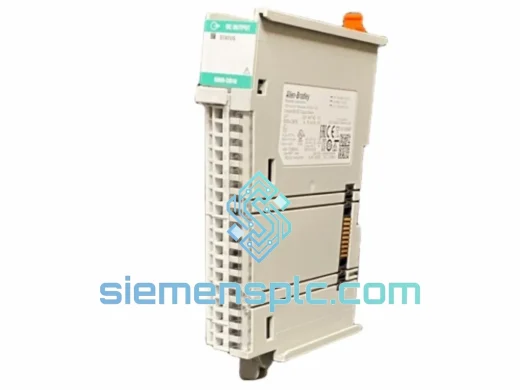
Allen-Bradley 5069-OW16 Relay Output Module
CompactLogix
Origin US
PLC Output Module
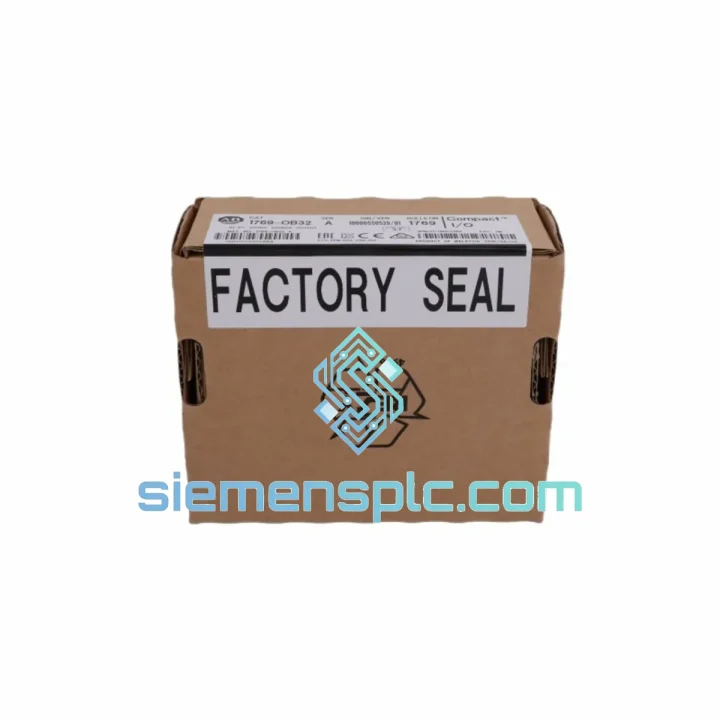
Request verified availability, condition, replacement risk review, packing options and courier lead time for 1769-OB32.
Click Request Quote and the part number is inserted into the inquiry form automatically.
Core fields for model confirmation and RFQ routing. Detailed product narrative remains below.
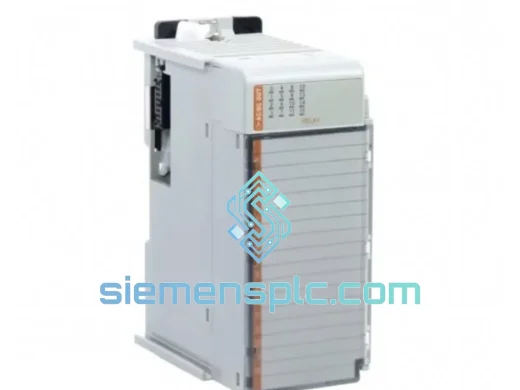
The Allen-Bradley 1769-OB32 is a 32-point, 24V DC sourcing (PNP) solid-state output module designed for the CompactLogix 1769 local I/O backplane. In a discrete control architecture, this module functions as the terminal actuator interface — it receives a resolved 32-bit output image from the CompactLogix controller and switches individual 24V DC field circuits to energize downstream devices: solenoid valves, motor starter coils, indicator lamps, and relay inputs. Each channel is implemented with an N-channel MOSFET switch, delivering sub-millisecond turn-on and turn-off times under resistive and inductive loads alike, a characteristic that directly supports high-frequency cycling applications such as pneumatic indexers, conveyor diverters, and press brake sequencers.
The module’s 32 outputs are partitioned into two independent 16-point banks, each with its own field common (COM) terminal. This bank architecture permits two separate 24V DC field supplies to power different output groups within a single module slot — a practical design choice when panel engineers must segregate safety-rated actuator circuits from general-purpose I/O on separate fused supplies. The module occupies one slot in the 1769 backplane and draws 120 mA from the 5V DC backplane bus, with zero draw from the 24V DC backplane rail, keeping the system power budget predictable in dense multi-module configurations.
Real-time Stock & RFQ: [email protected] | WhatsApp: +86 18359268345
| Parameter | Specification |
|---|---|
| Catalog Number | 1769-OB32 |
| Manufacturer | Allen-Bradley / Rockwell Automation |
| Product Series | CompactLogix 1769 Local I/O |
| Module Function | Digital Output, Sourcing (PNP), Solid-State |
| Number of Output Points | 32, organized as 2 × 16-point banks |
| Field Supply Voltage Range | 10–28.8V DC |
| Nominal Field Voltage | 24V DC |
| Continuous Output Current per Point | 0.5 A |
| Surge Current per Point (10 ms) | 2.0 A |
| Maximum Aggregate Module Current | 4.0 A (all 32 outputs simultaneously energized) |
| Output Switch Technology | N-channel MOSFET, sourcing configuration |
| ON-State Voltage Drop (at rated current) | ≤ 0.5V DC |
| OFF-State Leakage Current | ≤ 1.0 mA per channel |
| Output Switching Frequency (resistive load) | Up to 1 kHz |
| Backplane Current Consumption (5V DC) | 120 mA |
| Backplane Current Consumption (24V DC) | 0 mA |
| Short-Circuit Protection | Electronic, per individual output channel |
| Overload Protection | Thermal shutdown with automatic recovery |
| Operating Temperature | 0°C to +60°C (32°F to 140°F) |
| Storage Temperature | −40°C to +85°C (−40°F to +185°F) |
| Relative Humidity (non-condensing) | 5–95% |
| Vibration Resistance | 2 g @ 10–500 Hz per IEC 60068-2-6 |
| Shock Resistance | 15 g, 11 ms half-sine per IEC 60068-2-27 |
| Field Wiring Connector | 36-pin Removable Terminal Block (RTB) |
| Module Dimensions (H × W × D) | 118 mm × 35 mm × 87 mm |
| Approximate Weight | 320 g |
| Agency Certifications | UL 508, CE (EN 61131-2), CSA C22.2 No. 142, RCM, ATEX Zone 2 (with approved enclosure) |
| Warranty | 12 months from date of shipment |
Dual-Domain Power Architecture: The 1769-OB32 enforces a hard electrical boundary between the backplane logic domain and the field power domain. The 5V DC backplane supply powers the on-module ASIC, gate-drive circuitry, and diagnostic logic exclusively. The 24V DC field supply — connected at the RTB — feeds only the MOSFET drain-source conduction path. This separation means that a sustained field-side short circuit, including a bolted fault across a solenoid terminal, cannot inject voltage transients onto the 5V backplane bus. The backplane remains stable and the controller continues executing its task program while the affected output channel enters electronic current-limit mode.
Inductive Transient Suppression: Solenoid coils and relay coils are inductive loads; when the MOSFET switches off, the collapsing magnetic field generates a flyback voltage spike that can reach several hundred volts in microseconds. The 1769-OB32 integrates a transient voltage suppressor (TVS) diode on each output channel, clamped at 33V DC. The TVS conducts the flyback energy to the field common within nanoseconds, preventing the MOSFET from entering avalanche breakdown. This eliminates the need for external suppression diodes on individual solenoid terminals — a wiring simplification that reduces panel assembly time and eliminates a common field-wiring error source.
PCB Stackup and EMC Layout: The module PCB uses a four-layer construction with dedicated copper ground planes on the inner layers. This stackup reduces the loop area of high-frequency switching currents, attenuating radiated emissions from the MOSFET gate-drive signals. Inter-channel crosstalk is maintained below −60 dB across the 10 kHz to 1 MHz band, ensuring that a rapidly switching output channel does not induce false transitions on adjacent quiescent channels — a failure mode that can cause spurious actuator energization in high-density output arrays.
Gate-Drive Dead-Time Enforcement: Within each 16-point bank, the gate-drive IC enforces a minimum dead-time of 200 ns between successive switching events on any channel. This prevents shoot-through conditions during rapid output toggling, which would otherwise cause momentary cross-conduction between the MOSFET and the TVS clamp, generating localized heating and accelerating device aging.
Backplane Protocol and Output Latency: The module interfaces to the CompactLogix controller via the 1769 local I/O backplane serial protocol, operating at 200 Mbit/s. The on-module ASIC buffers the 32-bit output image register received from the controller and applies the gate-drive signals to the MOSFET array within one backplane scan cycle. At a standard Requested Packet Interval (RPI) of 5 ms, the worst-case output update latency from controller task execution to MOSFET gate assertion is bounded at approximately 5.25 ms — a deterministic window that satisfies the timing requirements of most discrete process control and machine safety interlock applications.
Per-Channel Fault Register: The module maintains a 32-bit fault status register that maps bit-for-bit to the output image. When the on-module diagnostic logic detects an overcurrent or thermal fault on a specific channel, it sets the corresponding bit in the fault register and simultaneously de-energizes that channel’s MOSFET gate. The controller reads the fault register via the input image table at every RPI cycle, enabling ladder logic or structured text routines to implement per-channel fault annunciation, automatic retry sequencing, or maintenance alarm generation — without any external fault detection hardware.
Local:3:O.Data.5), allowing structured text and function block programs to reference actuators by descriptive engineering names. This eliminates absolute address dependencies and simplifies program portability across projects with different I/O slot assignments.Every 1769-OB32 unit dispatched from siemensplc.com is genuine Allen-Bradley / Rockwell Automation product, sourced through verified procurement channels with full supply chain traceability. Each unit received into our Xiamen warehouse undergoes a structured incoming inspection protocol: visual examination of the RTB connector pin geometry and plating condition, backplane edge connector inspection for bent or oxidized contacts, label and date-code verification against Rockwell Automation packaging standards, and a functional power-on test confirming output image register response across all 32 channels. Units that fail any inspection criterion are quarantined and excluded from customer shipments.
Our distribution facility is located in Xiamen, China, a southeastern coastal city with direct access to major international air and sea freight lanes. For in-stock units, standard order processing and dispatch is completed within 1–3 business days of order confirmation. Express air freight via DHL, FedEx, or UPS delivers to most destinations in North America, Europe, and Southeast Asia within 3–7 business days. Sea freight consolidation is available for bulk orders, with lead times coordinated at the time of order placement. Export packaging uses anti-static foam-lined cartons with silica gel desiccant packs, maintaining the module within Rockwell Automation’s specified storage temperature and humidity envelope throughout transit.
Standard shipment documentation includes a commercial invoice, packing list, and certificate of conformance. Customers requiring supplementary documentation — country-of-origin certificates, material declarations, or third-party inspection reports — should specify requirements at order placement. Export classification is ECCN EAR99 for most destination countries. A 12-month warranty covers all units against manufacturing defects and functional failure under normal operating conditions as defined in Rockwell Automation publication 1769-TD006. Warranty claims are acknowledged within 48 business hours of receipt of the defective unit at our Xiamen facility.
Email: [email protected]
WhatsApp: +86 18359268345
Web: siemensplc.com
Location: Xiamen, China
© 2026 siemensplc.com. All rights reserved.
We check the full part number, brand, series and visible nameplate information before quotation.
Sales confirms stock path, condition option, quantity and realistic lead time for export dispatch.
DHL, FedEx, UPS or buyer courier arrangements can be reviewed with packing requirements.
Similar brand or category products for fast comparison and multi-item RFQ lists.