Bently Nevada
RFQ Ready
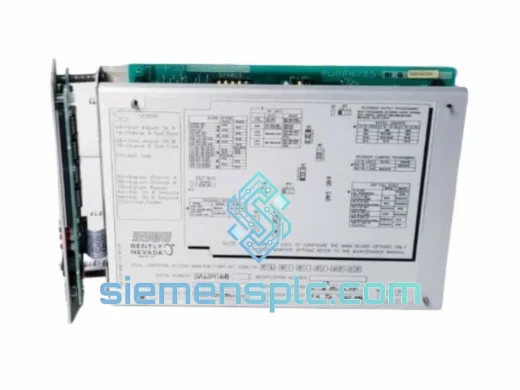
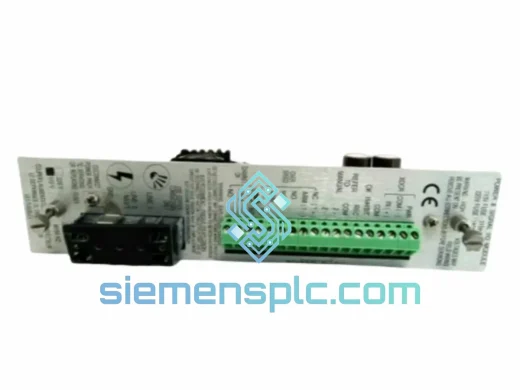
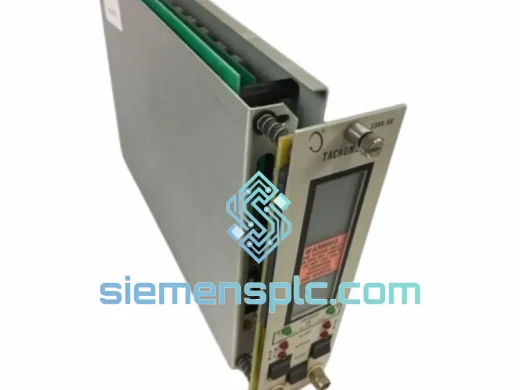
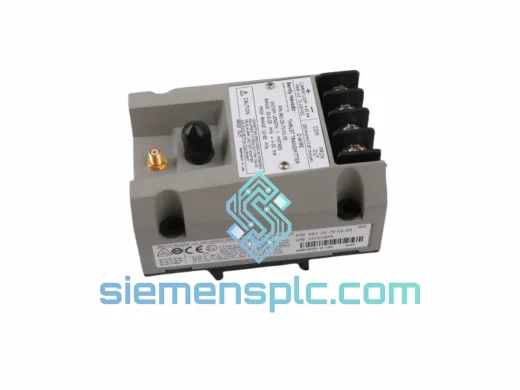
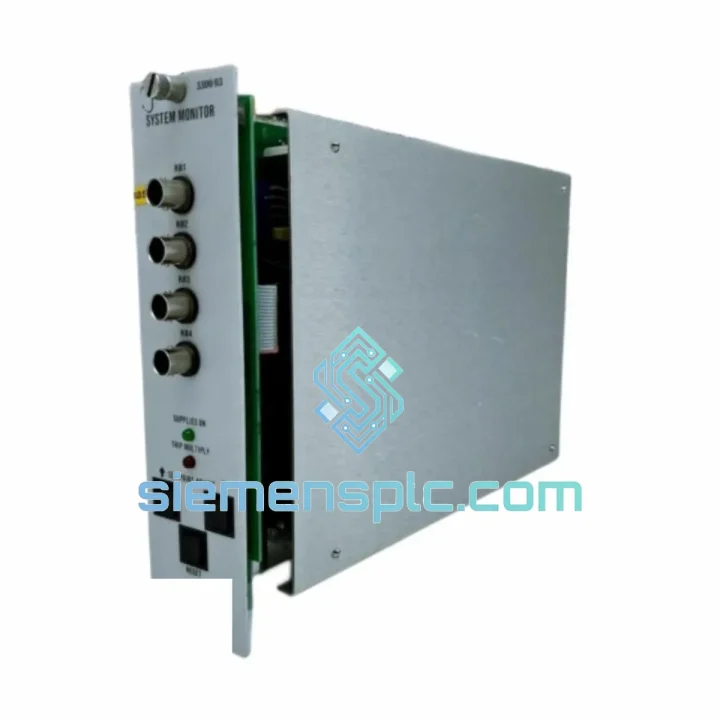
Bently Nevada 991-25-70-01-05 Thrust Position Transmitter
3300 Series
Origin US
Thrust Position Transmitter
Request verified availability, condition, replacement risk review, packing options and courier lead time for 3300/03.
Click Request Quote and the part number is inserted into the inquiry form automatically.
Core fields for model confirmation and RFQ routing. Detailed product narrative remains below.
Within the 3300 Series protection rack, individual monitor modules handle transducer signal conditioning and threshold comparison. The 3300/03 operates one architectural tier above that: it aggregates the status outputs of all installed monitor modules across the backplane, applies the configured voting logic, and drives the rack-level relay outputs that connect directly to plant trip solenoids and DCS discrete inputs. This supervisory role means the 3300/03 is the final decision node in the protection chain — the module that translates a collection of per-channel alarm states into a single, unambiguous machine-level protective action.
The 3300/03 is deployed in steam turbine-generator sets, gas compressor trains, centrifugal pumps, and large rotating machinery across oil & gas upstream and midstream, power generation, and petrochemical processing. Its field record spans decades of continuous service in environments characterized by high ambient temperature, mechanical vibration, and dense electromagnetic interference from variable-frequency drives, switchgear, and high-current bus bars.
Real-time Stock & RFQ: [email protected] | WhatsApp: +86 18359268345
| Parameter | Specification |
|---|---|
| Manufacturer | Bently Nevada (Baker Hughes) |
| Part Number | 3300/03 |
| Product Series | 3300 Series Machinery Protection System |
| Module Function | Rack System Monitor — backplane status aggregation and relay output arbitration |
| Form Factor | Single-slot plug-in module for 3300 Series rack chassis |
| Backplane Interface | Proprietary 3300 Series parallel backplane bus; reads OK/Alert/Danger status from all installed monitor modules |
| Relay Output Configuration | Configurable OK, Alert, and Danger relay contacts; normally-energized fail-safe topology |
| Relay Contact Rating | Rated for 24 VDC and 120 VAC plant control circuits |
| Voting Logic | Configurable 1-of-N or 2-of-N relay assertion schemes |
| Power Supply | Sourced from 3300 rack power bus (3300/20 PSU or equivalent) |
| Operating Temperature | 0 °C to +65 °C |
| Storage Temperature | −40 °C to +85 °C |
| Relative Humidity | 5% to 95% RH, non-condensing |
| EMC Compliance | CE marked; designed to IEC 61000 series industrial EMC requirements |
| Safety Approvals | FM, CSA hazardous location ratings (verify nameplate for specific Class/Division) |
| Applicable Standard | API 670 Machinery Protection Systems |
| System 1 Compatibility | Communicates rack health data to Baker Hughes System 1 condition monitoring platform |
| Module Weight | Approx. 300 g (module only) |
| Warranty | 12 months from shipment date, covering defects in materials and workmanship |
The 3300/03’s internal design is governed by a single engineering constraint: the module must never introduce ambiguity or latency into the protection decision path. Every hardware choice traces back to that requirement.
Normally-Energized Relay Topology: Output relays are held in the energized state under all normal operating conditions. A rack power loss, module internal fault, or a Danger-level condition from the backplane causes relay de-energization, which drives the downstream trip circuit. This topology eliminates the silent-failure mode inherent in normally-open relay designs — a welded contact or open coil in a normally-open system produces no protective action; in the 3300/03’s normally-energized design, the same fault produces a trip, which is the safe-state outcome. This is a foundational requirement of API 670 Section 5.3 relay output specifications.
Backplane Status Arbitration: The 3300/03 continuously polls the status bus of the 3300 Series backplane, reading the OK/Alert/Danger state broadcast by each installed monitor module on a fixed hardware scan cycle. The arbitration logic evaluates these states against the configured voting scheme before asserting any rack-level relay output. A single-channel transducer fault that produces a Danger state on one module does not automatically assert the rack trip relay if the voting scheme requires 2-of-N confirmation — preventing nuisance trips on sensor failures while preserving protection against genuine multi-channel exceedances.
Optical Isolation at I/O Boundaries: All signal paths crossing the module boundary — relay coil drive circuits, external communication interfaces, and backplane signal lines — are optically isolated. This prevents ground loop currents and common-mode transients originating in plant wiring from coupling into the module’s internal logic. In installations adjacent to motor control centers, large transformer banks, or VFD panels, this isolation is the primary defense against spurious relay actuation caused by conducted EMI.
PCB-Level EMC Architecture: The board layout uses segmented ground planes to separate analog signal return paths from digital logic returns, preventing high-frequency digital switching noise from modulating the analog status signal paths. Ferrite beads on inter-board signal lines suppress conducted emissions above 1 MHz. Bulk and high-frequency decoupling capacitors are placed at each IC power pin. The combined effect is a module that maintains relay state integrity in environments with VFD switching transients at frequencies up to several hundred kilohertz.
Hardware Watchdog Supervision: An independent hardware watchdog timer monitors the module processor’s execution cycle. If the processor fails to service the watchdog within the configured timeout interval — indicating a software hang, stack overflow, or hardware fault — the watchdog asserts a module-fault signal on the backplane. The 3300/03 processes this self-reported fault as a rack-level fault condition, driving the relay outputs to the de-energized (safe) state. This self-monitoring loop ensures that a silent processor failure does not leave the rack in an indeterminate protection state.
Front-Panel Diagnostic Indicators: LED indicators on the module face provide real-time visual confirmation of module power status, relay energization state, and active fault conditions. Field technicians can assess rack health at a glance without connecting diagnostic software — a practical advantage during plant walkdowns and post-trip investigations where rapid status assessment reduces mean time to diagnosis.
Each Bently Nevada 3300/03 unit dispatched from our Xiamen, China facility undergoes a structured pre-shipment verification protocol before release. Visual inspection covers PCB surface condition, connector pin alignment and plating integrity, front-panel label legibility, and absence of counterfeit indicators including irregular silkscreen, non-standard component markings, and anomalous solder joint profiles. Functional verification includes power-on sequencing confirmation, relay output actuation testing against a reference rack, and backplane signal continuity checks.
Units that do not pass all verification steps are quarantined and removed from available inventory. Serialized inspection records are maintained per unit and provided to customers on request — a requirement for plant maintenance management systems operating under ISO 55000-aligned asset management frameworks. Packaging is ESD-safe anti-static bag with desiccant, enclosed in a foam-lined rigid carton rated for international air freight handling per ISTA 2A drop and vibration profiles.
From Xiamen, express air freight reaches major industrial hubs in Southeast Asia within 3–5 business days, Europe within 5–8 business days, and North America within 5–7 business days. Sea freight consolidation is available for volume orders. Full export documentation — commercial invoice, packing list, certificate of origin — is prepared to destination country customs requirements. HS code classification support is available for customers requiring import duty pre-calculation. All units carry a 12-month warranty from shipment date, with a target replacement dispatch of 5 business days from confirmed fault diagnosis.
Email: [email protected]
WhatsApp: +86 18359268345
Web: siemensplc.com
Location: Xiamen, China
© 2026. All rights reserved.
We check the full part number, brand, series and visible nameplate information before quotation.
Sales confirms stock path, condition option, quantity and realistic lead time for export dispatch.
DHL, FedEx, UPS or buyer courier arrangements can be reviewed with packing requirements.
Similar brand or category products for fast comparison and multi-item RFQ lists.