Bently Nevada
RFQ Ready
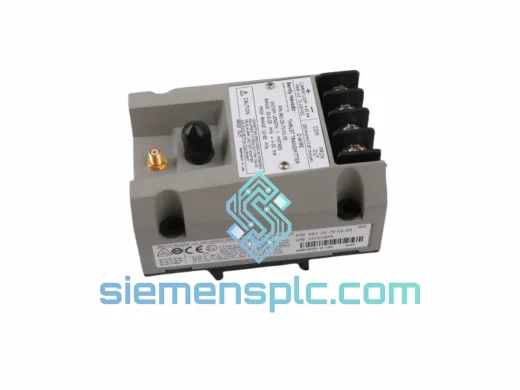
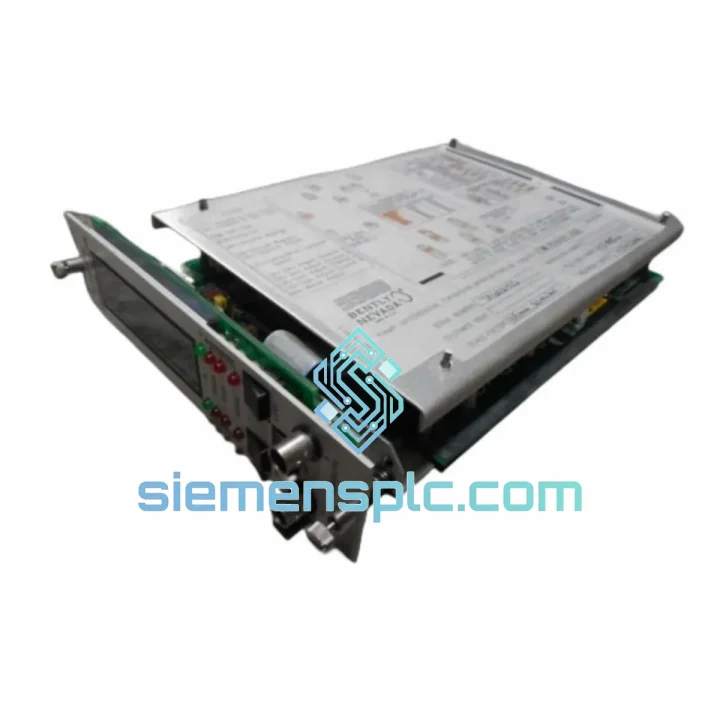
Bently Nevada 991-25-70-01-05 Thrust Position Transmitter
3300 Series
Origin US
Thrust Position Transmitter
Request verified availability, condition, replacement risk review, packing options and courier lead time for 3300/46.
Click Request Quote and the part number is inserted into the inquiry form automatically.
Core fields for model confirmation and RFQ routing. Detailed product narrative remains below.
In rotating machinery protection architecture, the measurement of differential expansion — the relative axial displacement between a turbine rotor and its stationary casing — is not a secondary diagnostic function. It is a primary protection variable. During startup transients, the rotor heats faster than the casing due to its lower thermal mass, causing it to elongate axially at a rate that can exceed casing growth by several millimeters within minutes. If this delta exceeds the designed blade-tip clearance, the result is direct mechanical contact: blade fracture, labyrinth seal destruction, and catastrophic unplanned outage.
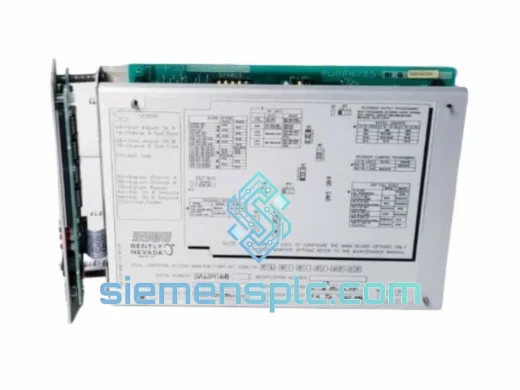
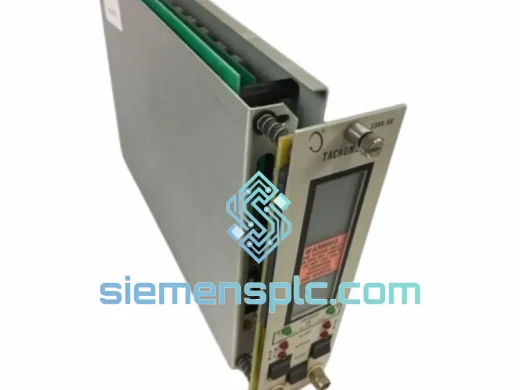
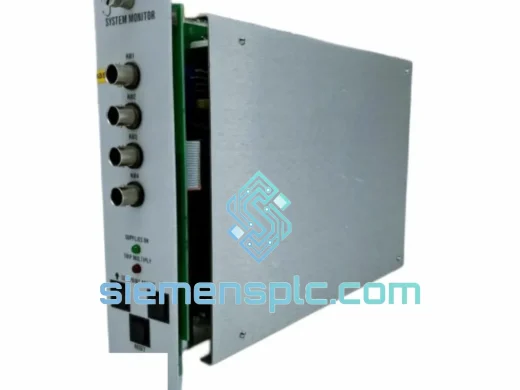
The BENTLY NEVADA 3300/46 is a dedicated Differential Expansion Monitor module within the 3300 Series Machinery Protection System. Its measurement chain begins at the eddy-current proximity transducer mounted on the turbine casing, tracking a target surface machined onto the rotor shaft. The transducer’s output — a DC voltage proportional to gap distance — is conditioned by the 3300/46’s internal signal processing circuitry, which applies the appropriate scale factor for the transducer type and gap range in use. The module then computes the differential displacement value, compares it against independently configurable Alert and Danger setpoints, and drives relay outputs and a 4–20 mA analog signal simultaneously.
This architecture ensures that the protection relay response is hardware-latched and independent of any software polling cycle — a critical design requirement for API 670-compliant machinery protection systems where relay response time must be deterministic and not subject to processor scheduling latency. The 3300/46 is not a general-purpose I/O module repurposed for vibration measurement; it is a purpose-engineered measurement instrument with fixed signal conditioning optimized for the physical characteristics of differential expansion transducer systems.
Deployed across steam turbines in combined-cycle power plants, gas turbine compressor trains in LNG facilities, and large centrifugal compressors in petrochemical complexes, the 3300/46 has accumulated decades of operational history in the most demanding rotating machinery environments on earth. Its continued presence in legacy plant installations — long after the introduction of the 3500 Series — reflects both the reliability of its hardware design and the practical reality that plant operators do not replace functioning protection systems without compelling cause.
📩 Real-time Stock & RFQ: [email protected] | WhatsApp: +86 18359268345
| Parameter | Specification |
|---|---|
| Model Number | 3300/46 |
| Brand | BENTLY NEVADA (Baker Hughes) |
| Series | 3300 Machinery Protection System |
| Module Function | Ramp Differential Expansion Monitor |
| Measurement Variable | Relative axial displacement, rotor vs. casing (mm or mil) |
| Transducer Interface | 3300 Series eddy-current proximity transducer (8 mm or 11 mm) |
| Measurement Range | Configurable per transducer gap range (typically ±5 mm to ±25 mm) |
| Analog Output | 4–20 mA, isolated, for DCS/SCADA/historian integration |
| Relay Outputs | 2 × configurable (Alert, Danger); normally energized, fail-safe de-energization |
| Setpoint Configuration | Independent Alert and Danger thresholds, positive and negative directions |
| Power Supply | 24 VDC nominal, supplied via 3300 Series rack backplane |
| Form Factor | Standard 3300 Series single-slot rack module |
| Operating Temperature | 0°C to +65°C (32°F to 149°F) |
| Storage Temperature | -40°C to +85°C |
| Compliance Standard | API 670 (Machinery Protection Systems) |
| Country of Origin | United States |
| Warranty | 12 months from date of shipment |
The 3300/46’s internal signal path is structured around three discrete functional stages, each with design choices that reflect the specific measurement physics of differential expansion monitoring.
Stage 1 — Transducer Signal Conditioning: The eddy-current proximity transducer produces a DC output voltage with a sensitivity of approximately −7.87 V/mm (−200 mV/mil) for standard 3300 Series 8 mm transducers. The 3300/46 accepts this signal directly from the proximitor driver and applies a precision resistor network to scale the voltage to the configured engineering unit range. The scaling network is hardware-selected, not software-programmed, which eliminates the possibility of a firmware fault corrupting the measurement scale factor — a failure mode that has caused protection system misoperation in software-configurable platforms.
Stage 2 — Ramp Detection and Setpoint Comparison: The module’s comparator circuit evaluates the conditioned displacement signal against two independently set voltage thresholds corresponding to the Alert and Danger setpoints. The comparator uses hysteresis to prevent relay chatter at the setpoint boundary — a common source of nuisance trips in high-vibration environments. The hysteresis band is fixed at the hardware level, providing consistent behavior regardless of operating conditions. Relay output response time from threshold crossing to contact state change is specified in milliseconds, meeting the API 670 requirement for protection-grade response.
Stage 3 — Output Drive and Isolation: The 4–20 mA output circuit uses an isolated current loop driver, providing galvanic isolation between the measurement ground reference and the DCS input card. This isolation is essential in large turbine installations where ground potential differences between the turbine pedestal and the control room can reach several volts — sufficient to introduce significant measurement error in non-isolated analog circuits. The relay output contacts are rated for the inductive loads typical of solenoid valve and trip relay coils, eliminating the need for external interposing relays in most applications.
EMC Design: The 3300/46 PCB layout incorporates ground plane partitioning between the analog measurement section and the relay drive section, reducing conducted noise coupling from relay switching transients into the measurement circuit. The module housing provides shielding against radiated electromagnetic interference from adjacent variable-frequency drives and high-current bus bars — a practical necessity in turbine hall environments where EMC conditions are severe.
Every BENTLY NEVADA 3300/46 unit offered through siemensplc.com is sourced from verified supply channels including authorized distributors, decommissioned plant inventories with full traceability documentation, and certified surplus suppliers. Each unit undergoes a structured pre-shipment inspection protocol covering physical condition assessment (PCB, connectors, front panel labeling), model number and revision verification against BENTLY NEVADA published documentation, and functional continuity checks on relay output contacts and analog output terminals.
Units are packed in anti-static ESD-safe bags, placed in foam-lined rigid cartons, and sealed with tamper-evident tape. Export documentation — commercial invoice, packing list, and certificate of origin — is prepared for every international shipment. Shipping is executed from Xiamen, China via DHL Express, FedEx International Priority, UPS Worldwide Express, or freight forwarder consolidation depending on order volume and destination. Transit times to major industrial hubs in Europe, the Middle East, Southeast Asia, and the Americas typically range from 3 to 7 business days for express courier shipments.
All units are covered by a 12-month warranty from the date of shipment. Warranty claims are handled directly by our technical team, with replacement unit dispatch or credit note issued within 5 business days of confirmed fault verification. We do not route warranty claims through third-party intermediaries.
Email: [email protected]
WhatsApp: +86 18359268345
Web: siemensplc.com
Location: Xiamen, China
© 2026 siemensplc.com. All rights reserved.
We check the full part number, brand, series and visible nameplate information before quotation.
Sales confirms stock path, condition option, quantity and realistic lead time for export dispatch.
DHL, FedEx, UPS or buyer courier arrangements can be reviewed with packing requirements.
Similar brand or category products for fast comparison and multi-item RFQ lists.