Bently Nevada
RFQ Ready
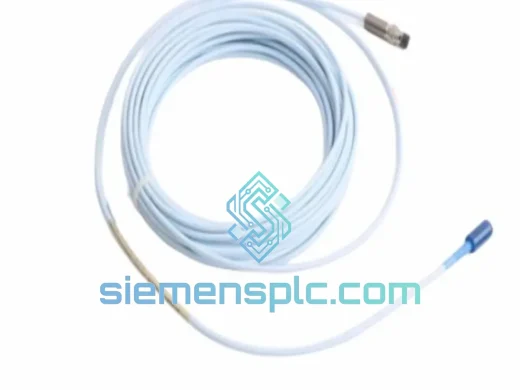
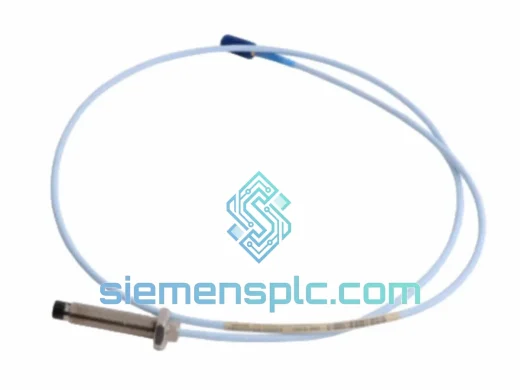
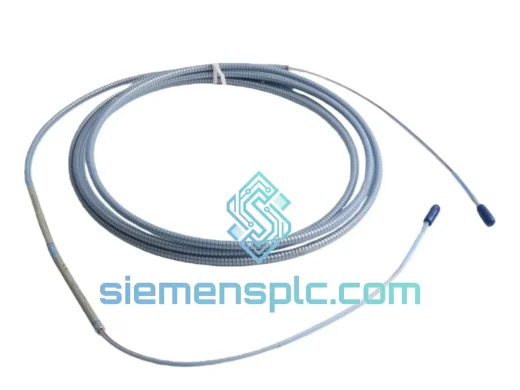
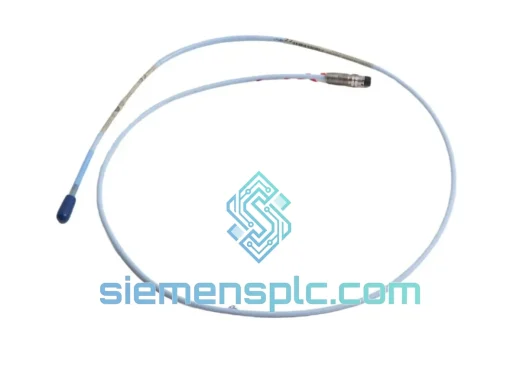
Bently Nevada 330196-05-30-10-00 Proximity Probe – 3300 XL ETR
3301
Origin US
Proximity Probe
Request verified availability, condition, replacement risk review, packing options and courier lead time for 330103-00-03-50-02-00.
Click Request Quote and the part number is inserted into the inquiry form automatically.
Core fields for model confirmation and RFQ routing. Detailed product narrative remains below.
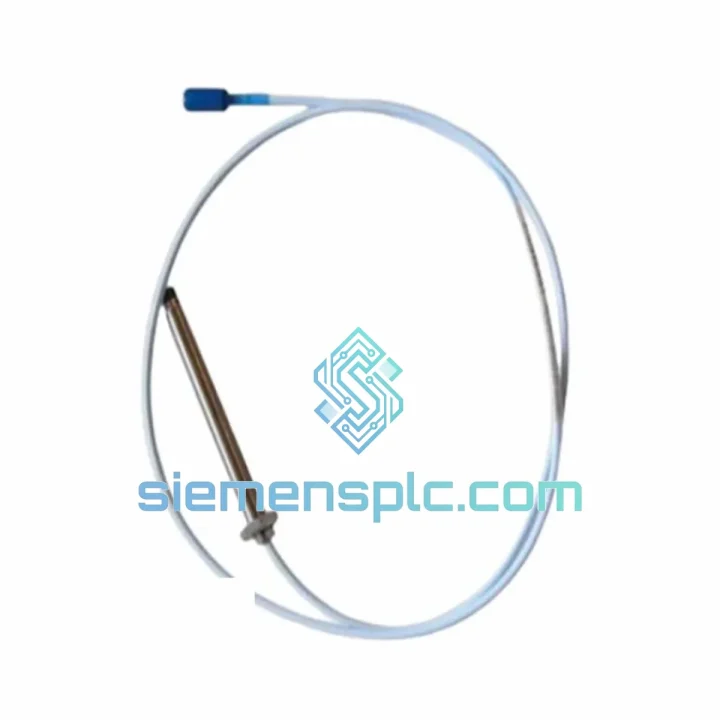
The 330103-00-03-50-02-00 is an 8 mm eddy-current proximity probe manufactured by Bently Nevada as part of the 3300 XL Proximity Transducer System. It performs non-contact, continuous measurement of shaft radial vibration, axial position displacement, and differential thermal expansion on critical rotating machinery. The probe operates on the eddy-current induction principle: a high-frequency oscillator (typically 1.0 MHz) drives an electromagnetic field from the probe tip coil; as a conductive target shaft approaches, induced eddy currents load the oscillator circuit, producing a DC-proportional output voltage at the driver/oscillator module. This architecture delivers a flat frequency response from DC to 10,000 Hz (–3 dB), making it equally suited to slow-roll runout acquisition at 1–2 RPM and high-frequency sub-synchronous instability detection at 10 kHz.
The integral cable length of this variant is 3.0 m, paired with a 5.0 m extension cable (total system cable length: 8 m). Total cable length is a calibration-critical parameter: the driver/oscillator is factory-trimmed to a specific cable capacitance, and mismatching cable length shifts the scale factor from the nominal 7.87 V/mm (200 mV/mil), introducing systematic measurement error that cannot be corrected in software alone. Procurement engineers must verify the existing system cable length before specifying a replacement probe.
Real-time Stock & RFQ: [email protected] | WhatsApp: +86 18359268345
| Parameter | Specification |
|---|---|
| Part Number | 330103-00-03-50-02-00 |
| Series | 3300 XL 8mm Proximity Transducer System |
| Sensing Principle | Eddy-current induction (non-contact) |
| Probe Tip Diameter | 8 mm |
| Integral Cable Length | 3.0 m |
| Extension Cable Length | 5.0 m (total system: 8 m) |
| Linear Measurement Range | 0.25 mm – 2.26 mm (10 – 89 mil) |
| Nominal Scale Factor | 7.87 V/mm (200 mV/mil) |
| Frequency Response | DC – 10,000 Hz (–3 dB) |
| Supply Voltage | –24 VDC nominal (via driver/oscillator) |
| Output Voltage Range | –2 VDC to –18 VDC (gap-dependent) |
| Probe Body Operating Temperature | –35 °C to +177 °C |
| Standard Target Material | AISI 4140 steel; other alloys require material-specific calibration |
| Probe Housing Material | 316 stainless steel |
| Cable Construction | Armored coaxial, integral to probe body |
| Connector Type | Coaxial, field-mateable to extension cable |
| Approvals / Certifications | CE, FM (Div. 1/2), CSA, ATEX Zone 1/2 (IEC 60079) |
| Applicable Standard | API 670 (5th Edition) — Machinery Protection Systems |
| Approximate Weight | 260 g (probe body + integral cable) |
| Warranty | 12 months against manufacturing defects |
The 3300 XL system architecture separates the sensing element (probe), signal transmission (extension cable), and signal conditioning (driver/oscillator) into three discrete, matched components. This partitioned design has two principal engineering advantages: first, the probe body — the component most exposed to heat, vibration, and chemical contamination — can be replaced without disturbing the driver electronics or the rack-level monitor card; second, the matched-set calibration approach allows the driver to compensate for cable capacitance variation across the full –35 °C to +177 °C temperature range, maintaining scale factor accuracy within ±1% over the operating envelope.
EMC and Shielding Architecture: The armored coaxial cable construction provides continuous 360° electrostatic shielding from probe tip to driver input. The shield is grounded at the driver end only (single-point ground), preventing ground-loop currents that would appear as low-frequency noise on the vibration signal. In high-EMI environments — such as variable-frequency drive (VFD) motor rooms or switchgear enclosures — this single-point shield topology typically achieves 40–60 dB of common-mode rejection at frequencies below 1 kHz, which is the dominant interference band in industrial power systems.
Oscillator Frequency and Target Penetration Depth: The 3300 XL driver operates at approximately 1.0 MHz carrier frequency. At this frequency, the eddy-current skin depth in AISI 4140 steel is approximately 0.08 mm, meaning the induced currents are confined to a thin surface layer. This shallow penetration makes the measurement insensitive to shaft core microstructure variations but highly sensitive to surface finish and residual magnetism. API 670 Section 5.3 specifies a maximum shaft surface finish of 0.8 µm Ra and a residual magnetism limit of 0.5 mT to ensure measurement integrity — parameters that should be verified during commissioning and after any shaft repair or grinding operation.
Thermal Stability: The probe coil is wound on a ceramic bobbin with a low coefficient of thermal expansion (CTE ≈ 6 × 10⁻⁶/°C), matched to the 316 stainless steel housing (CTE ≈ 16 × 10⁻⁶/°C) through a mechanical compliance layer. This construction limits thermally induced dimensional change of the coil geometry to less than 2 µm across the full –35 °C to +177 °C range, preventing thermal drift from being misinterpreted as shaft position change. In hot-section turbine bearing housings where probe body temperatures routinely reach 150–170 °C, this thermal stability is a primary selection criterion.
Intrinsic Safety Barrier Compatibility: The ATEX Zone 1/2 and FM Division 1/2 approvals are achieved through the driver/oscillator’s intrinsic safety design, which limits maximum output energy to below the ignition threshold of Group IIC gases (hydrogen, acetylene). The probe itself is a passive inductive element; its approval status is contingent on pairing with an approved driver. Substituting a non-approved driver invalidates the hazardous-area certification of the entire transducer system.
Every 330103-00-03-50-02-00 unit supplied by siemensplc.com is sourced through verified industrial distribution channels with documented chain of custody. Pre-shipment inspection covers dimensional verification of probe tip geometry, coil impedance measurement at 1 MHz to confirm oscillator loading characteristics, cable continuity and shield integrity testing, and review of accompanying calibration certificate and country-of-origin documentation. Units exhibiting any evidence of rework, re-labeling, or non-original packaging are rejected and not offered for sale.
Logistics operations are managed from Xiamen, China, a major southeastern port city with direct access to DHL Express, FedEx International Priority, UPS Worldwide Express, and multiple ocean freight consolidators. Standard export documentation — commercial invoice, packing list, certificate of origin, and HS code declaration (HS 9031.80) — is prepared for every shipment. For time-critical plant shutdowns, same-day dispatch on orders confirmed before 14:00 CST is available for in-stock units. Typical transit times: 2–3 business days to Southeast Asia, 3–5 business days to Europe and the Middle East, 4–6 business days to North America. All shipments are fully insured and tracked door-to-door.
A 12-month warranty covers manufacturing defects under normal operating conditions. Warranty claims are processed with a target response time of 1 business day; replacement units are dispatched from Xiamen stock where available, minimizing plant downtime exposure.
Email: [email protected]
WhatsApp: +86 18359268345
Web: siemensplc.com
Location: Xiamen, China
© 2026 siemensplc.com. All rights reserved.
We check the full part number, brand, series and visible nameplate information before quotation.
Sales confirms stock path, condition option, quantity and realistic lead time for export dispatch.
DHL, FedEx, UPS or buyer courier arrangements can be reviewed with packing requirements.
Similar brand or category products for fast comparison and multi-item RFQ lists.