Bently Nevada
RFQ Ready
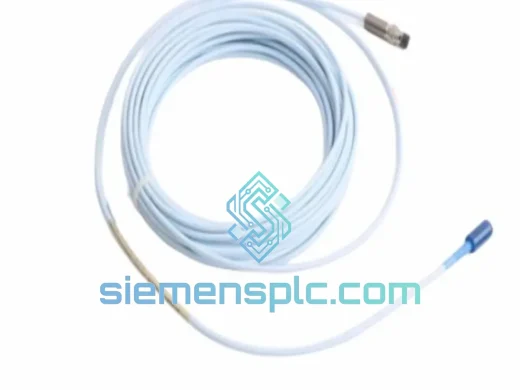
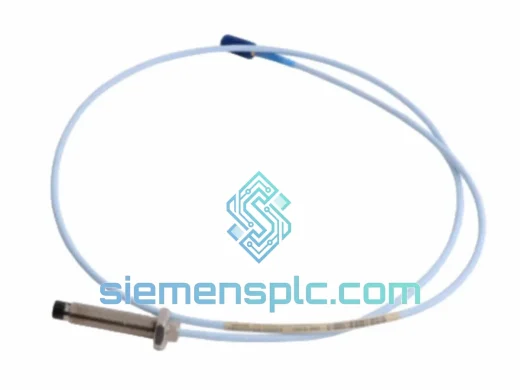
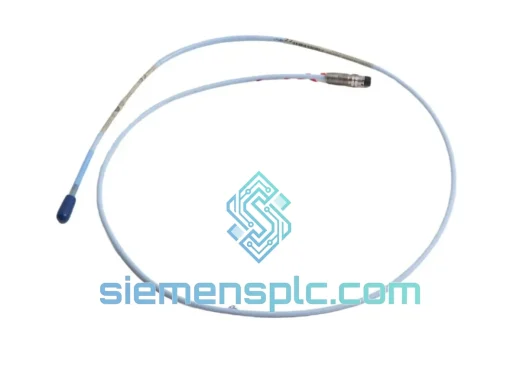
Bently Nevada 330196-05-30-10-00 Proximity Probe – 3300 XL ETR
3301
Origin US
Proximity Probe
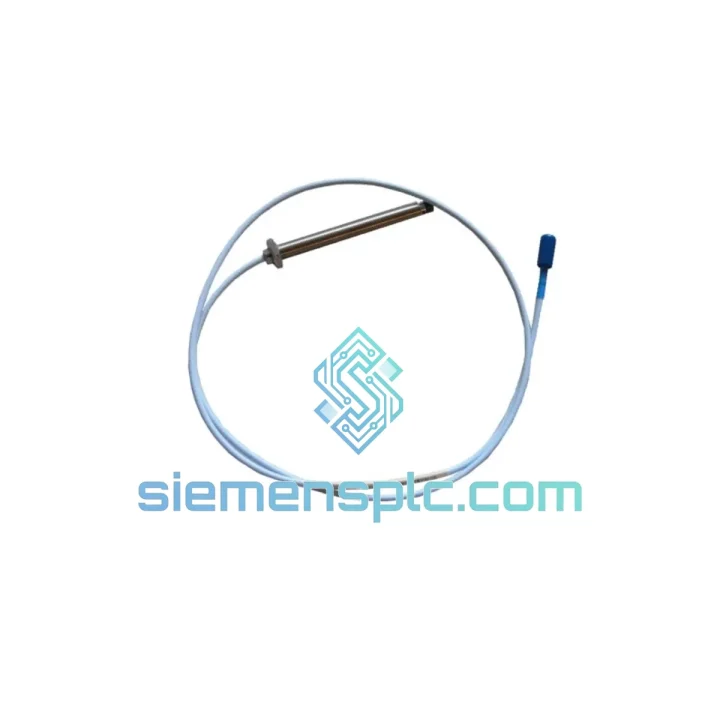
Request verified availability, condition, replacement risk review, packing options and courier lead time for 330103-00-04-20-02-05.
Click Request Quote and the part number is inserted into the inquiry form automatically.
Core fields for model confirmation and RFQ routing. Detailed product narrative remains below.
You already know what a tripped turbine costs per hour. You don’t need a sales pitch — you need the part. The Bently Nevada 330103-00-04-20-02-05 is on the shelf in our Xiamen bonded warehouse right now. Confirm before 14:00 CST and it moves today via DHL Express or FedEx International Priority. No back-order. No lead-time estimate. No waiting on a factory allocation queue.
This is the 8 mm eddy-current proximity probe from the 3300 XL Series — the standard shaft radial vibration sensor on API 670-protected steam turbines, gas turbines, centrifugal compressors, and large motor-driven trains worldwide. When your 3500 monitor throws a Transducer Not OK alarm and the unit trips, this is the component that puts you back in service.
URGENT REQUIREMENT? Contact: [email protected] | WhatsApp: +86 18359268345
| Parameter | Specification |
|---|---|
| Part Number | 330103-00-04-20-02-05 |
| Brand | Bently Nevada |
| Series | 3300 XL |
| Probe Diameter | 8 mm |
| Sensing Principle | Eddy Current, Non-contact |
| Integral Cable Length | 5 m armored coaxial |
| Probe Tip Temp. Range | -35 C to +177 C |
| Supply Voltage | -24 VDC via Proximitor driver |
| Output Voltage Range | -2 VDC to -18 VDC linear |
| Scale Factor | 7.87 V/mm (200 mV/mil) |
| Linear Range | 0.25 mm to 2.54 mm (10 to 100 mil) |
| Standard Target Material | AISI 4140 alloy steel |
| Thread | 3/8-24 UNF |
| Compliance | API 670 5th Ed., CE, RoHS |
| Country of Origin | United States |
| Stock Status | Ready to Ship — Xiamen Warehouse |
Ten years of field commissioning on rotating machinery teaches you that most probe replacements go wrong for the same handful of reasons. Here is what to check before you open the new probe box — and what to verify after installation before you authorize restart.
Step 1 — Isolate the fault to the probe, not the cable or driver. At the junction box, disconnect the probe from the extension cable and measure coil resistance tip-to-shield with a calibrated DMM. A healthy 330103-00-04-20-02-05 reads 7 to 9 ohms. Open circuit above 500 kilohms confirms a broken coil — probe is dead, replace it. A dead short below 0.5 ohms almost always means a crushed cable at the bearing housing exit, not a failed probe tip. Trace the cable before condemning the probe.
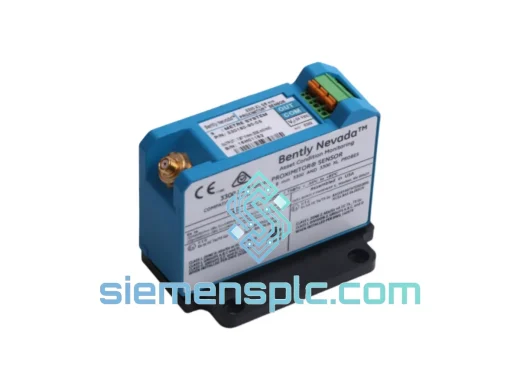
Step 2 — Verify Proximitor driver compatibility before ordering. The 330103-00-04-20-02-05 is calibrated as a matched system with the 330180-X1-05 Proximitor (3300 XL 8 mm driver). Swapping probe generations without matching the driver introduces scale factor error — in a protection application, that means either nuisance trips or missed trips. Check the driver part number on the terminal block label. If it does not match, flag it before installation.
Step 3 — Total cable length is a calibration parameter, not a detail. This probe ships with 5 m of integral cable. If your installation uses an extension cable such as 330130-080-00-00 for 8 m, total system length is 13 m. The Proximitor is factory-calibrated for a specific total length. Installing a different extension without recalibration shifts the linear range and scale factor — a common cause of unexplained vibration drift after a probe swap that takes hours to diagnose.
Step 4 — Set gap voltage, not gap distance. Thread the probe in until the tip is approximately 1.0 mm (40 mil) from the shaft. At -24 VDC supply, the Proximitor output should read -10 VDC plus or minus 0.5 V. If you are outside that window, the target material is non-standard or the driver is mismatched. Do not rely on a feeler gauge alone — always confirm with a calibrated voltmeter at operating supply voltage.
Step 5 — Torque correctly and use thread-lock. 3/8-24 UNF thread, torque to 1.1 to 1.4 N-m (10 to 12 in-lb) with Loctite 243 or equivalent medium-strength compound. Over-torque cracks the ceramic-filled epoxy probe body. Under-torque lets the probe back out under vibration — both failures are entirely preventable on-site.
Common alarm codes decoded:
The 3300 XL Series was engineered for the inside of a bearing housing on a 50 MW turbine running at 3,600 RPM in a tropical refinery — not a climate-controlled instrument room. The 330103-00-04-20-02-05 reflects that design intent at the component level.
Continuous probe tip operation at 177 degrees C means direct exposure to hot bearing oil mist is within spec. The armor-jacketed coaxial cable handles crush loads from cable clamps and abrasion from vibrating conduit runs without signal degradation. The MIL-spec connector at the junction box maintains impedance integrity at 95 percent RH with daily condensation cycles — conditions that corrode standard industrial connectors within months.
Eddy-current sensing is inherently immune to the contamination that disables optical and capacitive technologies. Oil film, water spray, and metallic debris between the probe face and the shaft target do not attenuate the electromagnetic field. Measurement accuracy is unaffected. This is precisely why API 670 mandates eddy-current probes for shaft radial vibration on critical machinery: the physics work when process conditions are at their worst.
Mechanically, the stainless steel probe body with ceramic-filled epoxy tip has a resonant frequency well above the measurement bandwidth. In installations where the probe bracket itself vibrates at blade-pass or gear-mesh frequency, the 330103-00-04-20-02-05 delivers clean shaft data without self-excitation artifacts contaminating the vibration spectrum. Field teams running continuous online monitoring on compressor trains have reported zero false trips attributable to probe self-resonance across multi-year service intervals.
Xiamen is one of Asia’s highest-throughput export ports. When your order is confirmed, the process is deterministic — not approximate.
Hour 0 — Order confirmed: The 330103-00-04-20-02-05 unit is pulled from bonded stock, inspected against the part number label and coil resistance specification, and packed in anti-static foam with a printed packing list and commercial invoice. Export documentation including HS Code 9031.80.9090, country of origin declaration, and dual-use screening is prepared in parallel.
Hour 4 to 8 — Dispatch: Shipment is handed to DHL Express or FedEx International Priority. For orders confirmed before 14:00 CST, same-day dispatch is standard. Both carriers provide real-time tracking from first scan. You receive the AWB number by email within 30 minutes of handover.
Typical door-to-door transit times: Southeast Asia 1 to 2 business days. South Asia and Middle East 2 to 3 business days. Europe 3 to 4 business days. North America 3 to 5 business days. South America and Africa 4 to 6 business days.
Documentation: Commercial invoice, packing list, and certificate of origin are standard with every shipment. For destinations requiring import permits for industrial instrumentation, we advise proactively before dispatch. DDP (Delivered Duty Paid) terms are available on request — contact us at order confirmation to arrange.
Plant-down emergency freight: For genuine unit-down situations where standard express timelines are unacceptable, we can arrange charter courier or hand-carry service to destinations not covered by standard networks. Call or WhatsApp directly — do not use the contact form for emergencies.
Email: [email protected]
WhatsApp: +86 18359268345
Web: siemensplc.com
2026 siemensplc.com. All rights reserved.
We check the full part number, brand, series and visible nameplate information before quotation.
Sales confirms stock path, condition option, quantity and realistic lead time for export dispatch.
DHL, FedEx, UPS or buyer courier arrangements can be reviewed with packing requirements.
Similar brand or category products for fast comparison and multi-item RFQ lists.