Bently Nevada
RFQ Ready
Bently Nevada 330196-05-30-10-00 Proximity Probe – 3300 XL ETR
3301
Origin US
Proximity Probe
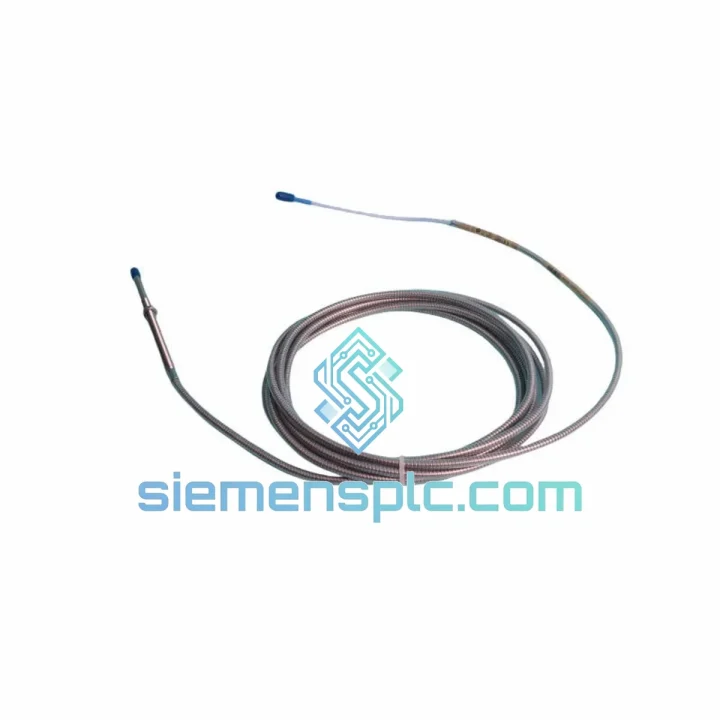
Request verified availability, condition, replacement risk review, packing options and courier lead time for 330104-00-05-20-12-CN.
Click Request Quote and the part number is inserted into the inquiry form automatically.
Core fields for model confirmation and RFQ routing. Detailed product narrative remains below.
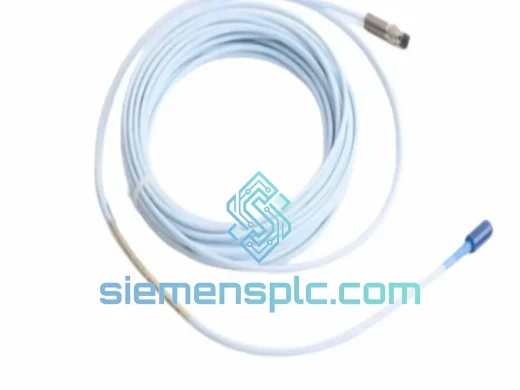
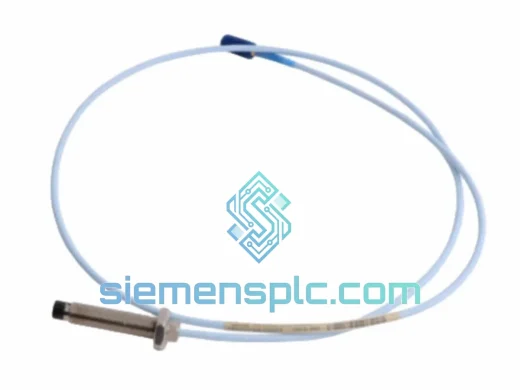
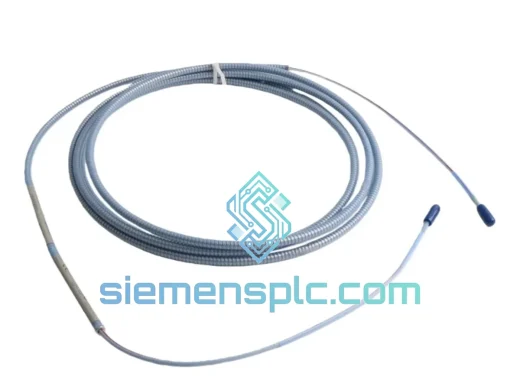
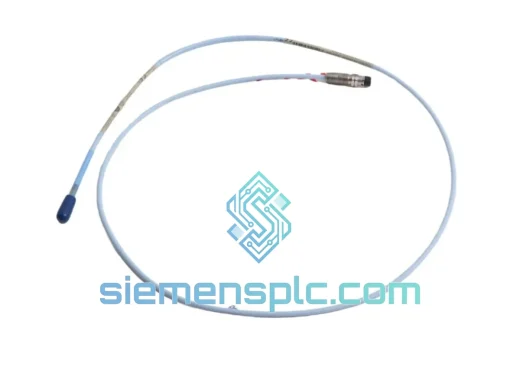
The Bently Nevada 330104-00-05-20-12-CN is a factory-matched, three-component eddy-current proximity transducer system from the 3300 XL Series, designed for continuous non-contact measurement of radial shaft vibration, axial position displacement, and differential thermal expansion in turbomachinery and critical rotating equipment. The system integrates an 8 mm diameter probe body (M12 × 1 thread), a 5-metre armored integral probe cable, and a 20-metre coaxial extension cable terminated with a CN-type connector. All three elements are calibrated as a matched set at the factory, locking the system scale factor to 7.87 V/mm (200 mV/mil) across the full measurement chain — a figure that cannot be reliably reproduced by mixing components from different part number configurations.
Within a machinery protection architecture, this transducer occupies the primary sensing node of the signal chain. The probe coil generates a high-frequency electromagnetic field at approximately 1.0 MHz. When the conductive shaft surface — typically AISI 4140 low-alloy steel or equivalent — enters the field, eddy currents are induced on the target surface, loading the oscillator circuit housed in the paired driver module. The driver converts the resulting impedance shift into a DC voltage proportional to the physical gap between probe tip and shaft surface. This DC output feeds directly into monitor modules such as the 3500/42M Proximitor I/O Module or the 3300/16 Dual Vibration Monitor, where alarm and trip thresholds are evaluated in real time. The linear measurement range spans 0.25 mm to 2.26 mm, corresponding to a DC output window of approximately −2.0 V to −18.0 V at the driver output terminal.
Real-time Stock & RFQ: [email protected] | WhatsApp: +86 18359268345
| Parameter | Specification |
|---|---|
| Part Number | 330104-00-05-20-12-CN |
| Brand | Bently Nevada (Baker Hughes) |
| Series | 3300 XL Proximity Transducer System |
| Probe Tip Diameter | 8 mm |
| Probe Thread | M12 × 1 |
| Integral Probe Cable Length | 5 m (armored, double-shielded coaxial) |
| Extension Cable Length | 20 m (coaxial, CN-terminated) |
| Connector Type | CN (precision coaxial) |
| Measurement Principle | Eddy-current inductive impedance modulation |
| Linear Measurement Range | 0.25 mm – 2.26 mm |
| Scale Factor | 7.87 V/mm (200 mV/mil) |
| Scale Factor Tolerance | ±0.5% of nominal |
| Carrier Frequency | ~1.0 MHz (oscillator, driver-dependent) |
| Frequency Response (−3 dB) | DC to 10,000 Hz |
| DC Output Range | −2.0 V to −18.0 V (gap-dependent) |
| Output Impedance | 100 Ω nominal |
| Supply Voltage | −24 VDC (via driver/oscillator module) |
| Operating Temperature — Probe Tip | −35 °C to +177 °C |
| Operating Temperature — Cable & Connector | −35 °C to +85 °C |
| Target Material (Nominal) | AISI 4140 steel or equivalent low-alloy |
| Probe Body Material | 316L stainless steel |
| IP Rating (Probe Body) | IP67 |
| Cross-Axis Sensitivity | <3% of primary axis sensitivity |
| Compliance Standards | API 670 (5th Ed.), CE, RoHS |
| System Weight (Complete) | ~210 g |
| Warranty | 12 months from date of shipment |
Oscillator Loading and Impedance Modulation: The 8 mm probe coil forms the inductive arm of an LC tank circuit within the driver module. At the nominal installation gap of 1.0 mm, the tank circuit operates at its design Q-factor, and the oscillator sustains a stable carrier at approximately 1.0 MHz. As the shaft surface displaces toward or away from the probe tip, the mutual coupling between the coil field and the conductive target changes the effective inductance seen by the oscillator. The driver’s demodulation stage — a precision envelope detector — extracts the amplitude modulation imposed by this impedance shift and converts it to a DC voltage with a group delay below 1 ms at 1 kHz. This sub-millisecond latency is essential for capturing high-speed transient events such as rub-impact at shaft speeds above 3,000 RPM, where a 1 ms delay corresponds to 18° of shaft rotation.
Cable Impedance Architecture and Matching: The 5 m probe cable and 20 m extension cable are impedance-matched as a pair to the driver input. The coaxial geometry maintains a controlled characteristic impedance throughout the signal path, preventing reflections that would manifest as standing-wave artifacts in the DC output — particularly relevant at high shaft speeds where the vibration signal contains frequency components above 5 kHz. Field substitution of either cable segment with an unmatched component introduces a systematic DC offset of up to 0.15 mm in the apparent gap reading, which can shift alarm thresholds by a corresponding margin. The factory-matched configuration of the 330104-00-05-20-12-CN eliminates this error source by design.
EMC Shielding Architecture: The probe cable employs a dual-layer shielding construction: an inner braid shield over the signal conductor and an outer foil-plus-braid shield bonded to the driver chassis ground. This arrangement provides greater than 60 dB of common-mode rejection against radiated interference from variable-frequency drives (VFDs), high-current bus bars, and RF sources prevalent in turbomachinery enclosures. The CN connector’s precision-machined body maintains shield continuity at the cable junction, preventing ground loop injection at the connection point — a failure mode that commonly introduces 50/60 Hz hum into proximity measurements in electrically noisy plant environments.
Thermal Compensation of Scale Factor: The probe coil is wound with a temperature-compensated alloy conductor, and the ferrite core material is selected for minimal permeability drift across the −35 °C to +177 °C probe tip operating range. This design holds the scale factor within ±1% across the full thermal envelope — a specification that matters in steam turbine bearing housings where probe tip temperatures routinely exceed 140 °C during sustained base-load operation. Without thermal compensation, a 100 °C rise in probe tip temperature would shift the scale factor by 3–5% in an uncompensated coil design, introducing a proportional error in the vibration amplitude reading.
Mechanical Sealing and Chemical Resistance: The 316L stainless steel probe body with IP67 sealing resists ingress of turbine oil, steam condensate, and hydrocarbon-based lubricants. The armored probe cable jacket withstands continuous mechanical flexing at the bearing housing entry port without cracking or shield degradation, eliminating the need for additional conduit protection in most standard installations. The M12 × 1 thread provides a secure, vibration-resistant mounting in standard proximity probe bosses machined per API 670 dimensional requirements.
Each 330104-00-05-20-12-CN unit dispatched from siemensplc.com is sourced through verified Bently Nevada (Baker Hughes) supply channels and passes a structured pre-shipment inspection before leaving our Xiamen warehouse:
International shipments are dispatched from Xiamen, China via DHL Express or FedEx International Priority, with standard transit times of 3–7 business days to most global destinations. Air freight consolidation is available for multi-unit procurement orders. All shipments include a commercial invoice, packing list, and certificate of origin to support customs clearance. In-stock units ordered before 14:00 CST are eligible for same-day dispatch.
Email: [email protected]
WhatsApp: +86 18359268345
Web: siemensplc.com
Location: Xiamen, China
© 2026 siemensplc.com. All rights reserved.
We check the full part number, brand, series and visible nameplate information before quotation.
Sales confirms stock path, condition option, quantity and realistic lead time for export dispatch.
DHL, FedEx, UPS or buyer courier arrangements can be reviewed with packing requirements.
Similar brand or category products for fast comparison and multi-item RFQ lists.