Bently Nevada
RFQ Ready
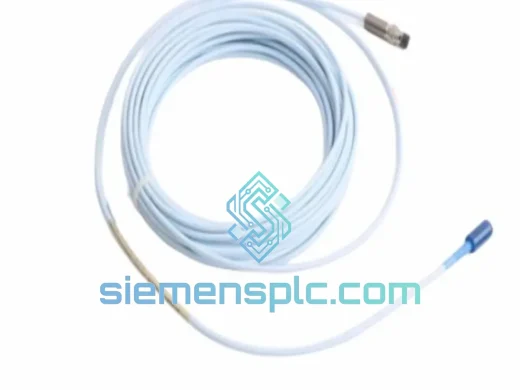
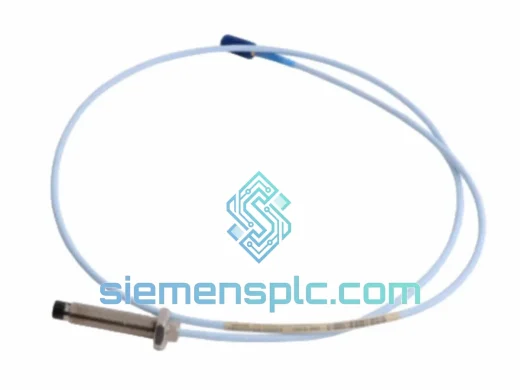
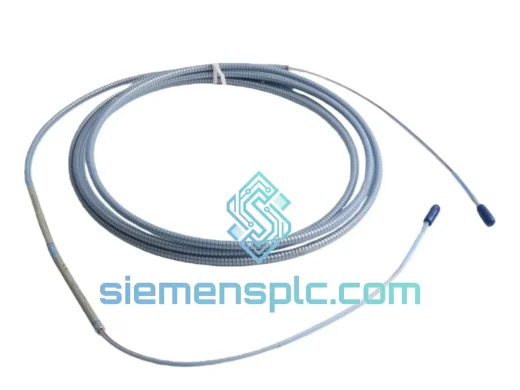
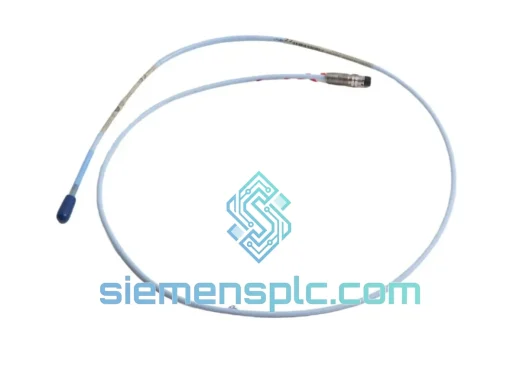
Bently Nevada 330196-05-30-10-00 Proximity Probe – 3300 XL ETR
3301
Origin US
Proximity Probe
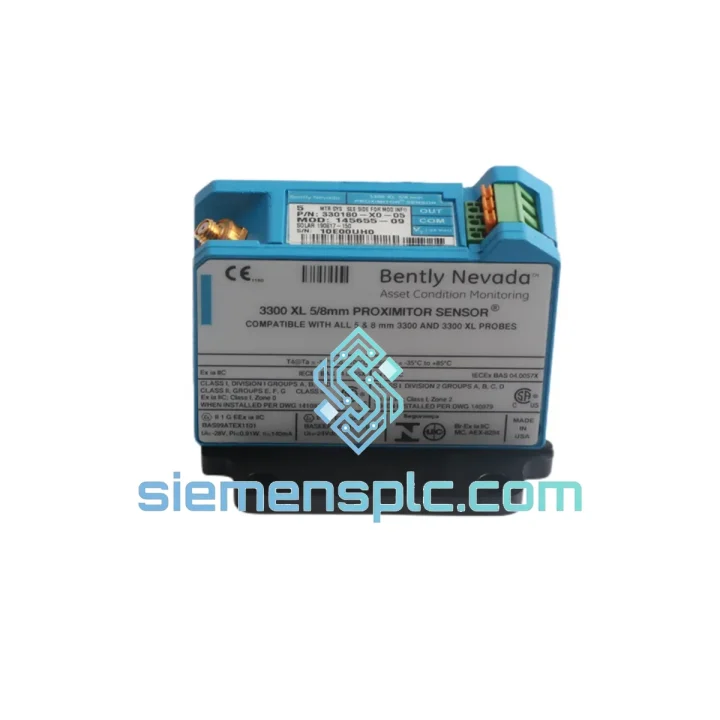
Request verified availability, condition, replacement risk review, packing options and courier lead time for 330180-X0-05.
Click Request Quote and the part number is inserted into the inquiry form automatically.
Core fields for model confirmation and RFQ routing. Detailed product narrative remains below.
The Bently Nevada 330180-X0-05 is an 8 mm diameter eddy-current proximity transducer within the 3300 XL Proximity System family, purpose-built for continuous, non-contact measurement of radial shaft vibration, axial position displacement, and differential thermal expansion in critical rotating machinery. Unlike contact-type displacement sensors, this transducer operates on the principle of electromagnetic induction: the probe coil generates a high-frequency oscillating magnetic field at approximately 1.0 MHz carrier frequency, inducing eddy currents in the conductive target surface. The resulting change in coil impedance is processed by the paired driver/oscillator into a DC-proportional voltage output with a calibrated sensitivity of 7.87 V/mm (200 mV/mil) across a usable linear range of 0.25 mm to 2.25 mm gap.
This transducer is engineered for direct integration with Bently Nevada 3300 XL and 3500 series monitoring racks, satisfying the transducer performance requirements of API 670 (5th Edition) — the industry standard governing machinery protection systems for compressors, steam turbines, gas turbines, and centrifugal pumps in oil & gas, petrochemical, and power generation facilities. The 5-metre integral coaxial cable terminates in a standard coaxial connector compatible with the 330130-XX-XX extension cable family, enabling installation flexibility across large machinery trains without signal degradation.
The probe body is machined from 316L stainless steel, selected for its corrosion resistance in hydrocarbon condensate, steam, and aggressive process atmospheres. The sensing tip housing is moulded from PEEK (polyether ether ketone), a semi-crystalline thermoplastic with a dielectric constant of approximately 3.2, a continuous service temperature exceeding 250 °C, and inherent resistance to hydraulic fluids, lubricating oils, and chlorinated solvents. Operating temperature at the probe tip spans −35 °C to +121 °C, with the integral cable rated to +105 °C continuous — parameters that accommodate bearing housing environments in high-pressure steam turbines and hot-section gas compressors.
Real-time Stock & RFQ: [email protected] | WhatsApp: +86 18359268345
| Parameter | Specification |
|---|---|
| Part Number | 330180-X0-05 |
| Series | Bently Nevada 3300 XL 8 mm Proximity System |
| Sensing Technology | Eddy-current (electromagnetic induction) |
| Carrier Frequency | ~1.0 MHz (nominal, driver-set) |
| Output Sensitivity | 7.87 V/mm ± 0.5% (200 mV/mil) |
| Linear Measurement Range | 0.25 mm – 2.25 mm (2.0 mm usable span) |
| Bias Voltage at Mid-Gap | −10.0 VDC ± 0.5 V |
| Supply Voltage | −24 VDC (sourced from driver/oscillator) |
| Integral Cable Length | 5.0 m coaxial |
| Probe Tip Diameter | 8 mm |
| Probe Body Material | 316L Stainless Steel |
| Tip Housing Material | PEEK |
| Connector Type | Standard coaxial (integral, driver-end) |
| Operating Temperature — Tip | −35 °C to +121 °C |
| Operating Temperature — Cable | Up to +105 °C continuous |
| Standard Target Material | AISI 4140 steel (factory calibration reference) |
| Bandwidth (−3 dB) | 10 kHz (per API 670 requirement) |
| Approvals | CE; ATEX (zone classification per product datasheet) |
| API Compliance | API 670, 5th Edition |
| Approximate Weight (with cable) | ~1,130 g |
| Country of Origin | United States |
| Warranty | 12 months from date of shipment |
The 330180-X0-05 employs a constant-current excitation architecture between the probe coil and the remote driver/oscillator. Unlike voltage-driven inductive sensors, the constant-current loop ensures that impedance variations introduced by cable routing — thermal expansion of the coaxial dielectric, mechanical flexing at conduit entry points, or connector contact resistance drift — do not alter the excitation amplitude seen at the coil. This decouples cable-path variability from measurement accuracy, a design requirement when cable runs exceed 3 metres in high-vibration machinery enclosures.
The probe coil is wound on a ferrite core and encapsulated within the PEEK tip housing under controlled vacuum-impregnation conditions. This process eliminates internal air voids that would otherwise undergo dielectric breakdown under repeated thermal cycling — a documented failure mechanism in proximity sensors deployed in steam turbine bearing housings where tip temperatures cycle between ambient and +110 °C during start-stop sequences. The PEEK encapsulant also provides a stable dielectric reference, preventing the coil’s self-capacitance from shifting with temperature and introducing a non-linear offset in the gap-to-voltage transfer function.
From an EMC standpoint, the coaxial cable construction provides continuous 360° shielding along the signal path. The shield is grounded at the driver/oscillator end only — a deliberate single-point grounding topology that prevents circulating ground-loop currents. In large generator halls and switchgear rooms, bus-bar switching events generate transient magnetic field intensities exceeding 10 A/m; a dual-grounded shield would allow these transients to drive common-mode currents that appear as low-frequency noise on the differential output. The driver’s output stage incorporates a low-pass filter with a −3 dB corner frequency at 10 kHz, consistent with API 670’s bandwidth specification, which simultaneously attenuates high-frequency switching harmonics from adjacent variable-frequency drives operating at 4–16 kHz carrier frequencies.
The gap-to-voltage transfer function is factory-trimmed against a certified AISI 4140 steel target at 25 °C, with sensitivity tolerance maintained at ±0.5%. This factory calibration eliminates field recalibration during commissioning for standard ferrous targets. For non-standard target materials — titanium alloy shafts in aerospace-derivative compressors, or Inconel 718 shafts in high-temperature gas turbines — a material correction factor must be applied per Bently Nevada Application Note AN-028, as the eddy-current penetration depth and resistivity of the target directly influence the effective sensitivity coefficient.
The bias voltage at mid-gap (−10.0 VDC ± 0.5 V) functions as a continuous self-diagnostic signal. Any deviation outside the ±0.5 V tolerance band during normal operation indicates one of three conditions: probe gap has drifted outside the linear range (mechanical misalignment), the coaxial cable has developed an open-circuit or high-resistance fault, or the driver/oscillator has failed. This single-parameter health check eliminates the need for a dedicated diagnostic channel in the monitoring rack, reducing I/O card count in large machinery protection panels.
Each Bently Nevada 330180-X0-05 unit supplied through siemensplc.com is sourced via verified distribution channels and undergoes structured incoming inspection at our Xiamen facility. Inspection procedures cover: coaxial connector seating torque and contact resistance measurement, cable insulation resistance verification (>100 MΩ at 500 VDC), probe tip dimensional check against the 8 mm nominal diameter tolerance, and full visual inspection for mechanical damage to the probe body, cable jacket, and connector shell. Units that do not meet acceptance criteria are quarantined and returned — no reworked or refurbished units are offered as new stock.
Accepted units are stored in climate-controlled warehousing maintained at 18–25 °C and 40–60% RH, packaged in conductive foam-lined enclosures with silica gel desiccant packs and humidity indicator cards. Serialized traceability records are maintained for each unit, with factory calibration data sheets and material certificates available on request for quality audit purposes.
The 12-month warranty covers manufacturing defects and performance deviation from published specifications under normal operating conditions, commencing from the date of shipment. Warranty claims are processed with replacement unit dispatch within 5 business days of fault confirmation.
International logistics from Xiamen, China is executed via DHL Express, FedEx International Priority, and UPS Worldwide Expedited, with typical transit times of 3–5 business days to European and North American destinations. For plant shutdown scenarios requiring same-day dispatch, air freight consolidation is available with cut-off times coordinated per order. All export documentation — commercial invoice, packing list, certificate of origin, and HS code 8543.70.90 classification — is prepared in-house to minimise customs clearance delays at destination ports.
Email: [email protected]
WhatsApp: +86 18359268345
Web: siemensplc.com
Location: Xiamen, China
© 2026 siemensplc.com. All rights reserved.
We check the full part number, brand, series and visible nameplate information before quotation.
Sales confirms stock path, condition option, quantity and realistic lead time for export dispatch.
DHL, FedEx, UPS or buyer courier arrangements can be reviewed with packing requirements.
Similar brand or category products for fast comparison and multi-item RFQ lists.