GE
RFQ Ready
GE IS210MVRBH1A I/O Interface Board – Mark VIe Series
Mark VI
Origin US
I/O Interface Board
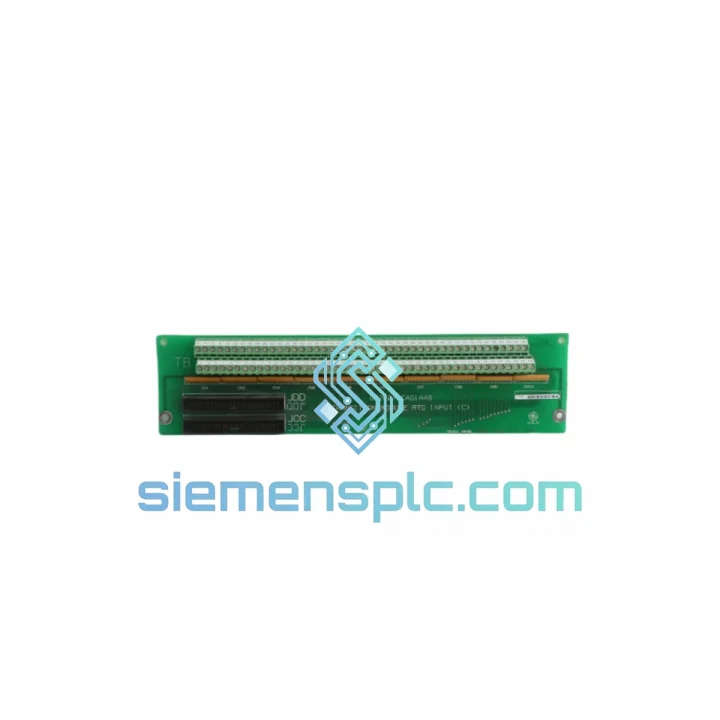
Request verified availability, condition, replacement risk review, packing options and courier lead time for DS200TBCAG1AAB.
Click Request Quote and the part number is inserted into the inquiry form automatically.
Core fields for model confirmation and RFQ routing. Detailed product narrative remains below.
The DS200TBCAG1AAB is a field-wiring termination board engineered for deployment within General Electric’s Mark VI distributed turbine control system. Its structural role is to establish a defined, low-impedance electrical boundary between multi-conductor field cable runs and the I/O pack layer of the Mark VI rack assembly. Unlike passive junction boxes, this board performs active signal marshalling: it enforces a controlled impedance transition, provides mechanical strain relief for field cables, and segments the field-side ground reference from the backplane reference plane — a design requirement in turbine hall environments where ground potential differentials between field instruments and control cabinets routinely reach 1–2 V DC across cable runs exceeding 80 m.
In the Mark VI signal chain, field transmitters, actuators, and discrete sensors terminate at the DS200TBCAG1AAB’s screw-terminal rows. A shielded, impedance-matched ribbon cable then carries conditioned signals to the paired I/O pack — VCMI for analog current inputs, VCRC for contact inputs, VTUR for magnetic speed pickups, or VDYN for dynamic vibration measurements. Analog-to-digital conversion and protocol encapsulation occur at the I/O pack before data traverses the VME-based backplane to the CPU module. The DS200TBCAG1AAB’s position upstream of the ADC input is deliberate: it absorbs field-side transients, cable capacitance effects, and common-mode noise before they can degrade the I/O pack’s conversion accuracy.
The terminal row layout is structured to mirror the I/O pack’s channel map in a one-to-one correspondence. This arrangement allows commissioning engineers to perform point-to-point continuity verification and loop calibration directly at the terminal board — without accessing the I/O pack or interrupting the backplane ribbon connection. On multi-turbine installations where 30 or more termination boards may be commissioned concurrently, this capability compresses commissioning schedules measurably.
The G1AAB hardware revision suffix carries functional significance within GE’s Mark VI revision control framework. PCB layout changes, component substitutions, and firmware-linked hardware register mappings are encoded in the suffix. Deploying a G1AAA-suffix unit in a system where the I/O pack firmware references G1AAB-specific register addresses will generate diagnostic fault codes at the HMI level and may prevent the I/O pack from entering normal operating mode. Revision suffix matching to the panel bill of materials is a mandatory procurement requirement, not a preference.
Real-time Stock & RFQ: [email protected] | WhatsApp: +86 18359268345
| Manufacturer | General Electric (GE) |
| Part Number | DS200TBCAG1AAB |
| Hardware Revision | G1AAB |
| Control Platform | Mark VI Turbine Control System |
| Module Classification | Field Wiring Termination / I/O Signal Marshalling Board |
| Mounting Method | Panel-mount; DIN-rail bracket compatible configurations available |
| Field Interface | Captive-screw cage-clamp terminal rows, multi-conductor field cable termination |
| Backplane Interface | Shielded impedance-matched ribbon cable to I/O pack (VCMI / VCRC / VTUR / VDYN) |
| Supported Signal Types | 4–20 mA analog, ±10 V DC, discrete contact I/O, RTD, thermocouple (dependent on paired I/O pack) |
| Terminal Conductor Range | 0.5 mm² – 2.5 mm² (AWG 20–14); ferrule-free termination supported |
| Operating Temperature | 0 °C to +60 °C |
| Storage Temperature | −40 °C to +85 °C |
| Relative Humidity | 5% – 95% RH, non-condensing |
| Power Source | Backplane-supplied via I/O pack ribbon interface; no independent power supply required |
| PCB Construction | Multi-layer FR4; conformal-coat eligible for Class 3C2/3C3 chemical environments |
| Approximate Unit Weight | 300 g |
| Compliance | CE, UL (per GE Mark VI platform certification scope) |
| Warranty | 12 months from confirmed shipment date |
| Available Condition | New OEM / Tested Surplus |
| Dispatch Origin | Xiamen, Fujian, China |
Ground Plane Segmentation and DC Offset Rejection: The DS200TBCAG1AAB implements a split ground architecture across its inner copper layers, maintaining a controlled impedance gap between the field-side reference plane and the backplane reference plane. In turbine hall cable environments, DC ground differentials of 0.5–2 V are common across runs exceeding 80 m. On a 4–20 mA loop, a 1 V differential introduces approximately 0.5 mA of offset — equivalent to 3.1% of full-scale span — directly at the I/O pack ADC input if no boundary exists. The board’s segmented ground architecture eliminates this error source at the hardware level, upstream of any software offset compensation routine in the Mark VI controller.
Cage-Clamp Terminal Mechanics and Long-Term Contact Resistance: The screw-terminal rows employ a captive-screw cage-clamp mechanism rated for 0.5–2.5 mm² conductors. This design maintains consistent contact force across the conductor cross-section without requiring ferrule preparation. In field environments where cable preparation quality varies between installation crews, eliminating the ferrule dependency reduces the incidence of high-resistance terminations that degrade signal accuracy progressively over multi-year service intervals. The cage-clamp geometry also resists vibration-induced loosening — a relevant consideration in turbine hall installations where structural vibration at 50–100 Hz is continuous during operation.
Ribbon Cable Impedance Continuity: The ribbon cable assembly linking the DS200TBCAG1AAB to the I/O pack is a controlled-impedance design. Impedance discontinuities at this interface generate reflections on discrete I/O channels, corrupting the timing of digital state transitions. This effect is amplified when the terminal board is installed at the maximum allowable cable distance from the I/O pack, where propagation delay increases the temporal separation between the incident signal edge and its reflection. The controlled-impedance ribbon design maintains signal integrity across the full allowable cable length range.
Conducted Transient Attenuation at the EMC Boundary: The board’s architecture positions it as the primary EMC boundary between the uncontrolled field cable environment and the controlled backplane environment. Conducted transients induced by nearby variable-frequency drives, transformer switching events, or lightning-coupled surges are attenuated at the terminal board before reaching the I/O pack’s analog front-end. This boundary function is consistent with IEC 61000-4-6 conducted immunity requirements and IEC 61000-4-4 electrical fast transient requirements applicable to the Mark VI platform’s industrial environment classification.
Conformal Coat Compatibility for Aggressive Environments: The PCB substrate and component selection support selective conformal coating per IEC 60721-3-3 Class 3C2 and 3C3 chemical environment specifications. This is a procurement-time specification for installations in offshore platforms, coastal power stations, and petrochemical facilities where salt-laden or chemically aggressive atmospheres accelerate PCB surface degradation. Conformal-coated units must be specified at order placement; post-shipment coating is not recommended due to connector masking requirements.
Each DS200TBCAG1AAB unit dispatched from our Xiamen facility undergoes a structured pre-shipment inspection covering five acceptance criteria: part number label authenticity verification against GE’s published label format, hardware revision suffix confirmation against the order specification, PCB surface condition assessment for mechanical damage and contamination, terminal block mechanical integrity check across all screw positions, and ribbon cable connector seating verification. Units that do not satisfy all five criteria are quarantined and excluded from available inventory without exception.
Xiamen Port — ranked among China’s top-five container ports by annual throughput — provides direct access to international shipping lanes serving Southeast Asia, the Middle East, Europe, and the Americas. Standard export documentation includes commercial invoice, packing list, and Certificate of Conformance. ECCN classification support and export licence assessment are available for orders subject to dual-use trade controls applicable to industrial control system components.
All units are packed to ESD-safe standards: anti-static bag with humidity indicator card, foam-lined inner carton, and outer corrugated carton rated for international air freight handling per IATA packing guidelines. Typical transit times via express courier are 3–5 business days to Southeast Asia and the Middle East, and 5–8 business days to Europe and North America. Sea freight consolidation is available for volume orders where cost-optimised logistics take priority over transit speed.
A 12-month warranty applies from the confirmed shipment date. Warranty claims are processed with a 48-hour target initial response. Replacement units are dispatched upon defect confirmation; failed units may be returned for root-cause analysis at the buyer’s request. Warranty coverage applies to manufacturing defects and component failures under normal operating conditions as defined in the GE Mark VI installation and maintenance documentation.
Email: [email protected]
WhatsApp: +86 18359268345
Web: siemensplc.com
Location: Xiamen, China
© 2026 siemensplc.com. All rights reserved.
We check the full part number, brand, series and visible nameplate information before quotation.
Sales confirms stock path, condition option, quantity and realistic lead time for export dispatch.
DHL, FedEx, UPS or buyer courier arrangements can be reviewed with packing requirements.
Similar brand or category products for fast comparison and multi-item RFQ lists.