GE
RFQ Ready
GE UR7HH Inter-Relay Communications Module
UR Series
Origin US
Inter-Relay Communications Module
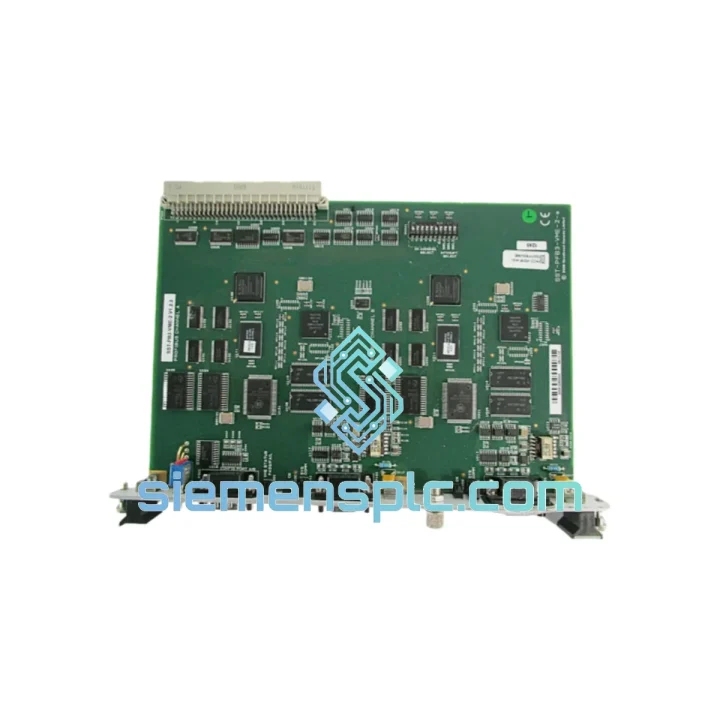
Request verified availability, condition, replacement risk review, packing options and courier lead time for SST-PFB3-VME2.
Click Request Quote and the part number is inserted into the inquiry form automatically.
Core fields for model confirmation and RFQ routing. Detailed product narrative remains below.
The SST-PFB3-VME2 is a single-slot, 6U VME bus interface card manufactured by GE (General Electric) under the SST (Smart Serial Technology) product line. It provides a dedicated PROFIBUS DP and PROFIBUS FMS communication channel for VME64/VME32 backplane systems, enabling deterministic fieldbus integration in process control, power generation, and factory automation environments. The card operates as both a Class 1 DP master and a DP slave, making it suitable for hierarchical network topologies where a VME-hosted controller must simultaneously manage field devices and report upstream to a supervisory system.
In a typical control loop, the SST-PFB3-VME2 sits between the VME-based real-time processor and the PROFIBUS field segment. The onboard microcontroller handles all PROFIBUS token-passing and timing autonomously, offloading the host CPU from protocol stack execution. This architecture ensures that PROFIBUS cycle times remain deterministic regardless of host CPU load — a critical requirement in closed-loop control applications where jitter in I/O refresh directly affects PID stability and process safety margins.
Real-time Stock & RFQ: [email protected] | WhatsApp: +86 18359268345
| Parameter | Value |
|---|---|
| Part Number / SKU | SST-PFB3-VME2 |
| Manufacturer | GE (General Electric) / SST |
| Series | SST Smart Serial Technology |
| Form Factor | 6U VME Bus (single slot) |
| Bus Compatibility | VME64, VME32 (backward compatible) |
| Protocol Support | PROFIBUS DP (EN 50170), PROFIBUS FMS |
| Operating Mode | DP Class 1 Master, DP Slave, FMS Master |
| PROFIBUS Channels | 1 (single-channel) |
| Max Baud Rate | 12 Mbit/s |
| Max Slave Nodes | 125 per channel |
| Onboard Processor | Dedicated embedded microcontroller (protocol offload) |
| Host Interface | Shared dual-port RAM via VME A24/D16 or A32/D32 |
| Interrupt Support | VME interrupt levels 1–7 (configurable) |
| Operating Temperature | 0 °C to +60 °C |
| Storage Temperature | -25 °C to +85 °C |
| Relative Humidity | 5 % to 95 % non-condensing |
| Power Supply | VME backplane +5 V DC (±5 %), +12 V DC |
| Typical Power Consumption | ≤ 8 W |
| Connector | DB-9 female (PROFIBUS standard pinout) |
| Compliance | CE, RoHS, PROFIBUS International certified |
| Weight | Approx. 1,000 g |
| Warranty | 12 months from date of shipment |
The SST-PFB3-VME2 implements a dual-port SRAM (DPRAM) architecture as the primary host-to-card communication mechanism. The VME host processor accesses a shared memory window mapped into the VME address space (A24/D16 or A32/D32 selectable via onboard DIP switches), while the card’s embedded microcontroller independently manages the PROFIBUS physical layer and data link layer (FDL). This strict separation of the host application layer from the fieldbus protocol stack eliminates protocol-induced latency from the host CPU’s execution timeline.
EMC and Signal Integrity: The card’s PROFIBUS transceiver section is galvanically isolated from the VME backplane power domain. Opto-coupler isolation on the RS-485 differential pair provides a minimum 500 V isolation barrier, suppressing common-mode transients that are common in industrial environments with long cable runs or mixed-voltage field panels. The RS-485 driver complies with IEC 61158-2 electrical specifications, supporting cable lengths up to 1,200 m at 93.75 kbit/s without repeaters.
Token-Ring Arbitration: PROFIBUS DP uses a token-passing bus access method among masters. The SST-PFB3-VME2’s onboard FDL controller manages token rotation autonomously, maintaining the target token rotation time (TTR) independent of host CPU scheduling. This is particularly significant in multi-master configurations where token loss or excessive GAP update cycles can degrade network throughput. The card’s firmware implements the full FDL state machine, including GAP maintenance, live-list management, and retry handling per IEC 61158-3.
Watchdog and Fault Detection: An independent hardware watchdog monitors the onboard microcontroller. If the protocol processor fails to reset the watchdog within the configured interval, the card asserts a VME SYSFAIL* signal and drives all DP slave outputs to their configured fail-safe states. This behavior is configurable per slave via the GSD (General Station Description) parameter set loaded during initialization.
Configuration and Diagnostics: The card exposes a structured mailbox interface in DPRAM for host-initiated commands: start/stop data exchange, read slave diagnostics (standard and extended), set slave parameters, and retrieve bus statistics (frame error count, retry count, token loss events). These counters are accessible without interrupting the active data exchange cycle, enabling non-intrusive runtime diagnostics.
Every SST-PFB3-VME2 unit supplied by siemensplc.com is sourced through verified industrial distribution channels with full traceability to the original GE manufacturing batch. Physical inspection covers PCB layer integrity, connector pin condition, date code authenticity, and label verification against OEM documentation. Where applicable, functional bench testing confirms PROFIBUS communication establishment and VME bus enumeration prior to dispatch.
Units are packed in anti-static ESD shielding bags, placed in foam-lined cartons rated for international air freight handling. Shipments originate from our warehouse in Xiamen, China, with typical dispatch within 1–3 business days for in-stock items. We ship via DHL Express, FedEx International Priority, and UPS Worldwide Expedited — all with door-to-door tracking and commercial invoice documentation for customs clearance. Export classification and HS code documentation are provided on request for import duty pre-calculation.
All units carry a 12-month warranty from the date of shipment. Warranty coverage includes functional failure under normal operating conditions. Advance replacement is available for qualified accounts. Bulk and blanket purchase orders are accommodated with scheduled delivery agreements.
Email: [email protected]
WhatsApp: +86 18359268345
Web: siemensplc.com
Location: Xiamen, China
© 2026 siemensplc.com. All rights reserved.
We check the full part number, brand, series and visible nameplate information before quotation.
Sales confirms stock path, condition option, quantity and realistic lead time for export dispatch.
DHL, FedEx, UPS or buyer courier arrangements can be reviewed with packing requirements.
Similar brand or category products for fast comparison and multi-item RFQ lists.