KUKA
RFQ Ready
KUKA KRC400-195-245 KPC400-255-229 Robot Controller PC Unit
00-211-996 KRC4 PC Unit
Origin DE
PLC Controller Module
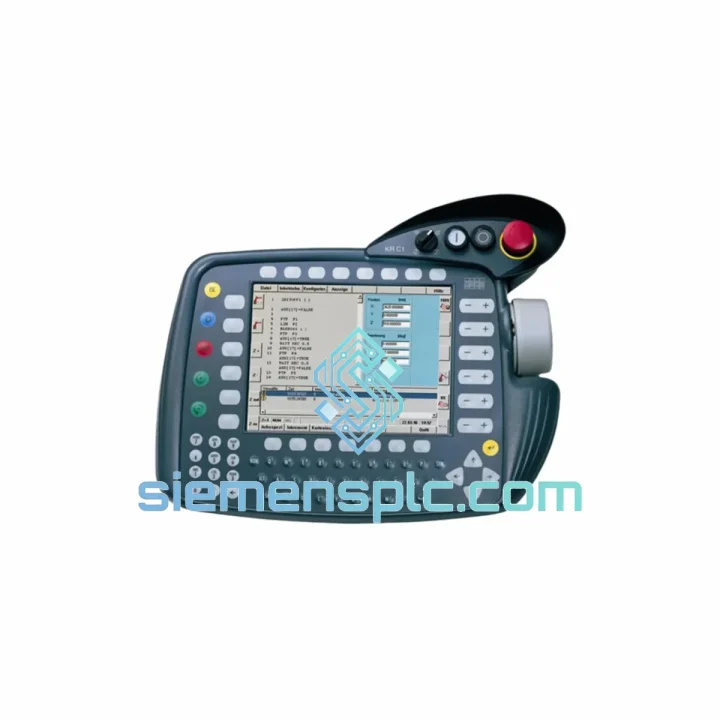
Request verified availability, condition, replacement risk review, packing options and courier lead time for KCP2-VKCP2.
Click Request Quote and the part number is inserted into the inquiry form automatically.
Core fields for model confirmation and RFQ routing. Detailed product narrative remains below.
Within the KR C2 robot controller architecture, the KCP2 (KUKA Control Panel 2) and its VKCP2 variant occupy a structurally non-negotiable position in the control hierarchy. Unlike passive HMI terminals found in PLC-based systems, the KCP2 is an active, safety-rated node embedded directly in the robot’s control chain. It carries two functionally independent signal domains: an application domain responsible for program navigation, axis jogging, and status display, and a safety domain that routes the 3-position enabling switch and dual-channel emergency stop through dedicated hardware circuits to the KR C2’s onboard safety PLC — entirely bypassing the main motion CPU.
The KR C2 platform was deployed at scale across automotive body-in-white lines, foundry transfer systems, arc welding cells, and palletizing installations from the late 1990s through the mid-2010s. A substantial global installed base continues to operate these controllers, making KCP2 and VKCP2 units a persistent MRO demand item for maintenance engineers who must restore pendant functionality without triggering a full controller replacement cycle. The VKCP2 variant integrates a 6D Space Mouse module into the pendant housing, enabling simultaneous translational and rotational Cartesian jogging — a hardware capability that measurably compresses teach time on complex spatial paths compared to sequential single-axis keypad input.
Real-time Stock & RFQ: [email protected] | WhatsApp: +86 18359268345
| Parameter | Specification |
|---|---|
| Part Number | KCP2 / VKCP2 |
| Manufacturer | KUKA Roboter GmbH |
| Compatible Controller | KUKA KR C2 (all variants) |
| Interface Classification | Teach Pendant / Operator Control Unit (OCU) |
| Display | Color TFT LCD with backlight; rated for continuous 24/7 operation |
| Keypad | Sealed membrane type; >1,000,000 actuation cycle rating |
| 6D Space Mouse | Integrated (VKCP2 only); USB interface to HMI subsystem |
| Enabling Switch | 3-position device; ISO 10218-1 compliant; SIL 2 / PLd rated |
| Emergency Stop | Dual-channel, IEC 60204-1 compliant; hardware-routed to safety PLC |
| Pendant Connection | Proprietary KCP connector; field-replaceable cable assembly |
| Standard Cable Length | 10 m |
| Operating Temperature | 0 °C to +45 °C |
| Storage Temperature | −25 °C to +70 °C |
| Ingress Protection | IP 54 |
| Weight | 2.19 kg |
| Compliance Standards | CE; EN ISO 10218-1; IEC 60204-1 |
| Country of Origin | Germany |
| Warranty | 12 months from shipment date against manufacturing defects |
The KCP2’s internal signal architecture enforces a strict separation between the application processing path and the safety signal path. Keypad scan data, display refresh commands, and program state information travel over the KCP serial bus to the KR C2’s HMI CPU — a standard embedded processor running the KUKA System Software (KSS) HMI layer. This path is subject to normal software scheduling and can be interrupted or delayed by HMI load without consequence to machine safety.
The safety signal path operates on an entirely separate physical circuit. The 3-position enabling switch generates two independent contact signals that feed directly into the KR C2’s dedicated safety PLC — a processor whose sole function is monitoring drive enable states, brake release authorization, and safety stop conditions. The dual-channel E-Stop button similarly drives two independent relay-grade signal lines into this safety PLC. Because these signals are hardware-routed and not processed by the application CPU, a software hang, HMI crash, or communication timeout on the application bus cannot suppress or delay a safety stop. The safety PLC’s response to an E-Stop or enabling switch release is deterministic and bounded by hardware propagation delay, not software scheduling.
The 3-position enabling switch implements a deliberate panic-grip suppression mechanism. Only the mid-position (partial depression) enables motion; both the fully released and fully pressed positions generate a stop condition. This design prevents an operator from reflexively gripping the pendant tightly under stress — a scenario that would otherwise hold the switch in the enable position during an emergency. The switch mechanism is rated to SIL 2 / PLd, consistent with the overall KR C2 safety architecture.
The VKCP2’s 6D Space Mouse connects to the pendant’s internal USB hub, which interfaces with the KR C2 HMI CPU. The KSS motion kernel receives simultaneous force-vector inputs from the Space Mouse and resolves them into Cartesian velocity commands, which the motion planner then converts to joint-space trajectories via the robot’s kinematic model in real time. This allows an operator to jog the TCP along a complex spatial path in a single continuous motion rather than executing sequential single-axis increments — a workflow that is particularly effective for path correction on curved weld seams or complex assembly fixtures.
EMC integrity is maintained through the shielded pendant cable, which provides a continuous ground reference between the pendant housing and the KR C2 cabinet. The IP54-rated enclosure forms a sealed conductive shell around the pendant electronics, attenuating radiated interference from welding power sources, servo drives, and high-frequency inverters that are common in the environments where KR C2 systems operate. The membrane keypad’s sealed construction prevents ingress of coolant, weld spatter, metallic swarf, and conductive dust — failure modes that account for a significant proportion of pendant replacements in foundry and welding applications.
All KCP2 and VKCP2 units supplied through siemensplc.com are sourced from verified OEM supply channels with traceable serial number records. Each unit is subject to a structured pre-dispatch verification protocol before shipment: power-on self-test, full membrane keypad actuation scan across all keys, dual-channel E-Stop continuity verification, 3-position enabling switch functional check across all three positions, LCD display and backlight function test, and KCP connector pin integrity inspection. Serial numbers are recorded at intake and can be cross-referenced against OEM production records on request to confirm authenticity and hardware revision.
Shipments originate from our warehouse in Xiamen, China via DHL Express or FedEx International Priority. Standard transit time to major industrial destinations in Europe, North America, Southeast Asia, the Middle East, and Australia is 3–5 business days, with full end-to-end tracking provided at dispatch. Export documentation — commercial invoice, packing list, certificate of origin, and where required, CITES or dual-use export declarations — is prepared in compliance with destination country import regulations. For time-critical MRO situations, same-day dispatch is available for confirmed in-stock units when orders are placed before 14:00 CST.
All units are covered by a 12-month warranty against manufacturing defects from the date of shipment. Warranty claims are resolved by replacement dispatch or full refund within the coverage period. Our engineering team provides remote technical support via email and WhatsApp for installation verification, compatibility queries, and fault diagnosis assistance at no additional charge.
Email: [email protected]
WhatsApp: +86 18359268345
Web: siemensplc.com
Location: Xiamen, China
© 2026 siemensplc.com. All rights reserved.
We check the full part number, brand, series and visible nameplate information before quotation.
Sales confirms stock path, condition option, quantity and realistic lead time for export dispatch.
DHL, FedEx, UPS or buyer courier arrangements can be reviewed with packing requirements.
Similar brand or category products for fast comparison and multi-item RFQ lists.