Mitsubishi Electric
RFQ Ready
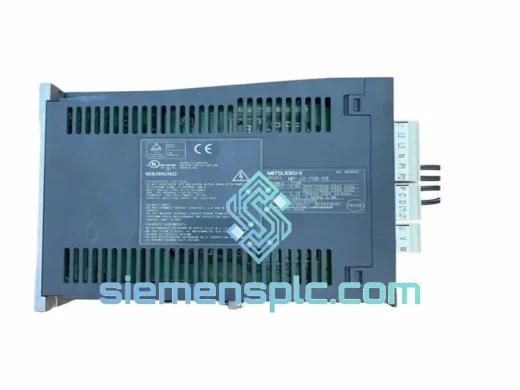
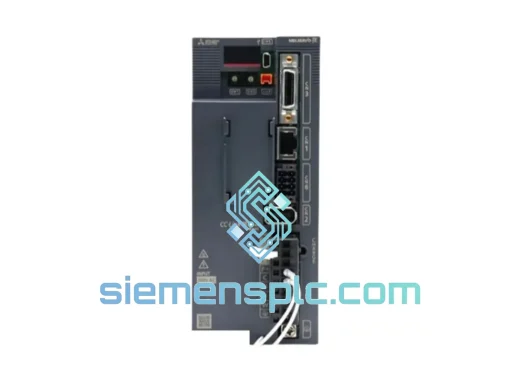
Mitsubishi MR-JE-70C AC Servo Amplifier
MELSERVO-JE CC-Link IE
Origin JP
AC Servo Amplifier
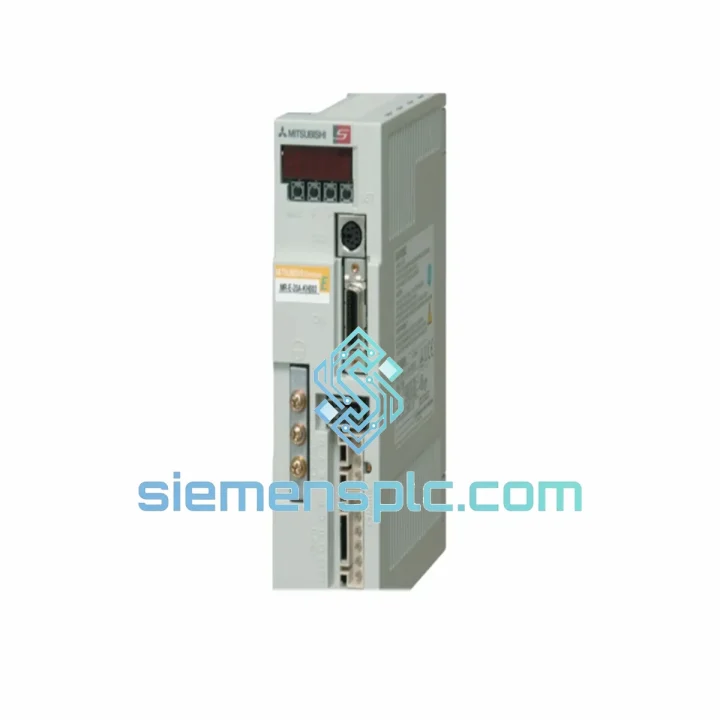
Request verified availability, condition, replacement risk review, packing options and courier lead time for MR-E-200A-KH003.
Click Request Quote and the part number is inserted into the inquiry form automatically.
Core fields for model confirmation and RFQ routing. Detailed product narrative remains below.
The MR-E-200A-KH003 is a 2.0 kW single-axis AC servo amplifier manufactured by Mitsubishi Electric under the MELSERVO-E platform. Within a motion control loop, this amplifier occupies the position between the command-issuing controller and the mechanical load: it receives a pulse-train or analog reference from the host PLC or motion controller, closes the position, speed, and torque loops in real time using encoder feedback from the paired servo motor, and delivers the conditioned three-phase PWM output to the motor windings. The result is deterministic axis behavior with sub-millisecond loop closure latency — a requirement in packaging, CNC auxiliary axes, and high-throughput material handling.
The -KH003 suffix designates the connector kit variant. The amplifier ships with the full set of mating connectors pre-included, eliminating a separate accessory procurement step and reducing commissioning lead time on the machine floor. Compatible drive motors are the Mitsubishi HF-KE204 and HF-SE204 (2 kW, 200 V frame), both of which use a 2500 pulse/revolution incremental encoder whose feedback cable plugs directly into the CN2 encoder port on this amplifier.
Input power is accepted from a 200–230 V AC single-phase or three-phase supply at 50/60 Hz. The internal IGBT inverter stage converts this to a variable-frequency, variable-voltage three-phase output sized to the 2 kW motor frame. A built-in regenerative braking resistor handles moderate deceleration energy; for high-duty-cycle applications with frequent stop-reverse cycles, an external MR-RB series resistor can be wired to the dedicated terminals without any firmware change. The dynamic brake circuit engages automatically on servo-off or alarm conditions, bringing the motor to a controlled stop without relying on the host controller.
Command interface flexibility is a practical strength of this amplifier. The CN1 connector accepts pulse-train position commands in three formats — sign + pulse, CW/CCW pulse, or A/B quadrature — from either open-collector outputs (up to 200 kpps) or line-driver outputs (up to 500 kpps). This covers the full range of Mitsubishi MELSEC positioning modules (QD75, LD75, FX3U-20SSC-H) as well as third-party motion controllers. For speed and torque control modes, the amplifier accepts a ±10 V DC analog reference on the VC terminal, making it compatible with analog output modules across all major PLC families.
The auto-tuning function measures load inertia at startup and sets proportional gain, integral time, and derivative gain automatically. An adaptive notch filter, configurable across four frequency bands, attenuates mechanical resonance in low-rigidity systems such as belt-driven axes or long ballscrew assemblies. These two features together reduce the time from first power-on to stable, in-spec motion to under 30 minutes on most machine types — a measurable reduction in commissioning cost per axis.
Diagnostics are accessible via the front-panel LED display, which shows alarm codes, motor speed, and load ratio in real time, and via the RS-422 serial port (CN3), which connects to Mitsubishi’s MR Configurator software. MR Configurator provides a software oscilloscope for capturing position error, speed, and torque waveforms simultaneously, a parameter comparison tool for documenting machine-specific tuning, and an alarm history log with timestamps. This level of diagnostic transparency is directly relevant to reducing mean time to repair (MTTR) in production environments where downtime carries a measurable cost per minute.
The enclosure is rated IP20 (open chassis), designed for panel-mount installation in a control cabinet. At 55 mm wide × 170 mm tall × 168 mm deep and approximately 1.5 kg, the unit fits into standard 200 mm deep enclosures alongside MELSEC PLC racks without requiring a dedicated servo cabinet. Ambient operating temperature range is 0 °C to +55 °C; storage is rated to −20 °C to +65 °C. Vibration resistance is 5.9 m/s² (0.6 G) across 10–55 Hz, consistent with IEC 60068-2-6 test conditions applicable to machine-mounted panels.
Regulatory compliance covers CE marking under the EMC Directive (2014/30/EU) and Low Voltage Directive (2014/35/EU), plus UL and cUL listing — satisfying the certification requirements for machinery destined for European, North American, and most Asia-Pacific markets without additional component-level testing.
Real-time Stock & RFQ: [email protected] | WhatsApp: +86 18359268345
| Parameter | Specification |
|---|---|
| Model Number | MR-E-200A-KH003 |
| Series | MELSERVO-E (MR-E) |
| Manufacturer | Mitsubishi Electric Corporation |
| Rated Output Power | 2.0 kW |
| Input Voltage | 200–230 V AC, 1-phase or 3-phase |
| Input Frequency | 50 / 60 Hz |
| Continuous Output Current | 11.0 A rms |
| Peak Output Current | 33.0 A (300% for 3 s) |
| Control Modes | Position / Speed / Torque (software-selectable) |
| Encoder Interface | Incremental, 2500 p/rev (CN2) |
| Pulse Command Input | Sign+Pulse / CW+CCW / A/B Quadrature |
| Max Pulse Frequency (Line Driver) | 500 kpps |
| Max Pulse Frequency (Open Collector) | 200 kpps |
| Analog Speed/Torque Reference | ±10 V DC (VC terminal) |
| Regenerative Braking | Built-in resistor; external MR-RB option |
| Dynamic Brake | Built-in, auto-engage on servo-off/alarm |
| Protective Functions | Overcurrent, Overvoltage, Undervoltage, Overheat, Encoder fault, Regeneration overload |
| Ambient Operating Temperature | 0 °C to +55 °C |
| Storage Temperature | −20 °C to +65 °C |
| Humidity | ≤ 90% RH, non-condensing |
| Vibration Resistance | 5.9 m/s² (0.6 G), 10–55 Hz |
| Enclosure Rating | IP20 (panel-mount) |
| Dimensions (W × H × D) | 55 × 170 × 168 mm |
| Mass | Approx. 1.5 kg |
| Compatible Motors | Mitsubishi HF-KE204, HF-SE204 (2 kW, 200 V) |
| Diagnostic Interface | RS-422, CN3 (MR Configurator compatible) |
| Connector Kit | Included (−KH003 designation) |
| Regulatory Compliance | CE (EMC + LVD), UL, cUL |
| Country of Origin | Japan |
| Warranty | 12 months from dispatch date |
The MR-E-200A-KH003 implements a three-tier closed-loop architecture. The outermost position loop runs at a 1 ms cycle, comparing the accumulated encoder pulse count against the command pulse count and generating a speed reference for the inner loop. The speed loop, executing at 250 µs, applies a PI controller to the speed error derived from encoder differentiation, producing a torque (current) reference. The innermost current loop, running at 62.5 µs, regulates the d-axis and q-axis stator currents via field-oriented control (FOC), driving the IGBT gate signals through a space-vector PWM modulator at a carrier frequency of 10 kHz. This nested structure ensures that mechanical disturbances — load torque steps, friction transitions, backlash impacts — are rejected at the current loop before they propagate to the position loop, maintaining position error within ±1 encoder pulse under normal load transients.
EMC design on the MR-E series addresses both conducted and radiated emissions. The input stage incorporates a common-mode choke and X/Y capacitor network that attenuates switching noise from the IGBT stage from coupling back onto the AC supply lines. The motor output cables are routed through a ferrite core clamp at the CN2 exit point, reducing high-frequency common-mode current on the motor cable shield. The chassis ground terminal (PE) is bonded directly to the heatsink and the control board ground plane through a low-impedance copper strap, keeping the ground potential difference between the power stage and the signal processing board below 50 mV under full-load switching — a figure that prevents false triggering of the encoder line receiver circuits.
The auto-tuning algorithm uses a frequency-sweep method: at startup, the amplifier injects a low-amplitude torque disturbance across 1–200 Hz and measures the resulting speed response. The ratio of speed response amplitude to torque input amplitude gives the mechanical frequency response function, from which the load inertia ratio (J_load / J_motor) is estimated. Gain parameters are then set from a lookup table indexed by inertia ratio and the user-selected response level (1–15). This approach is more robust than step-response tuning because it characterizes the system across the full bandwidth rather than at a single operating point.
Every MR-E-200A-KH003 unit supplied through siemensplc.com is sourced as genuine Mitsubishi Electric original hardware. Units are verified against Mitsubishi Electric’s published date code and label format standards before acceptance into stock. Incoming inspection includes a power-on functional test covering DC bus charge sequence, alarm-free initialization, encoder communication handshake on CN2, and parameter read-back via MR Configurator to confirm factory default state. Units that do not pass all inspection steps are quarantined and not offered for sale.
Packaging follows anti-static and mechanical protection standards appropriate for precision servo electronics: each unit is placed in an anti-static PE bag, surrounded by 30 mm minimum closed-cell foam on all six faces, and sealed in a double-wall corrugated carton. A desiccant sachet is included to control humidity during transit. The gross weight of the packaged unit is approximately 2.5 kg.
Dispatch is from our warehouse in Xiamen, China. Standard export shipping options include DHL Express (3–5 business days to most destinations), FedEx International Priority (3–5 business days), and UPS Worldwide Expedited (4–6 business days). For volume orders, sea freight consolidation via Xiamen Port is available with transit times of 18–35 days depending on destination port. All shipments include a commercial invoice, packing list, and certificate of origin. Export classification falls under HS Code 8537.10 (boards, panels, consoles for electric control). Customers requiring specific customs documentation — such as Form A (GSP), EUR.1, or a manufacturer’s declaration — should specify this at the time of order placement.
A 12-month warranty is provided from the dispatch date. Warranty coverage applies to manufacturing defects and component failures under normal operating conditions as defined in the Mitsubishi MR-E Series Instruction Manual. Warranty claims are processed by submitting the unit serial number, fault description, and alarm code log to [email protected]. Return shipping for warranty replacements is covered by siemensplc.com for confirmed defective units.
Email: [email protected]
WhatsApp: +86 18359268345
Web: siemensplc.com
Location: Xiamen, China
© 2026 siemensplc.com. All rights reserved.
We check the full part number, brand, series and visible nameplate information before quotation.
Sales confirms stock path, condition option, quantity and realistic lead time for export dispatch.
DHL, FedEx, UPS or buyer courier arrangements can be reviewed with packing requirements.
Similar brand or category products for fast comparison and multi-item RFQ lists.