ProSoft Technology
RFQ Ready
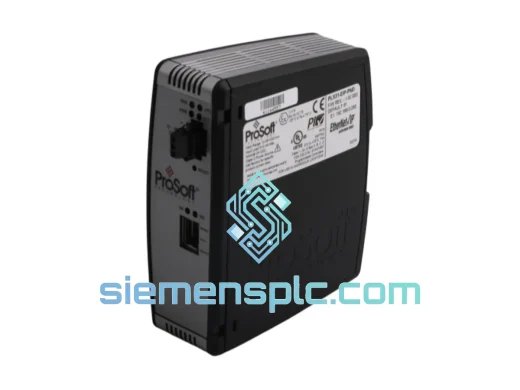
ProSoft PLX31-EIP-PND Protocol Gateway – PLX31 Series
Origin US
Protocol Gateway
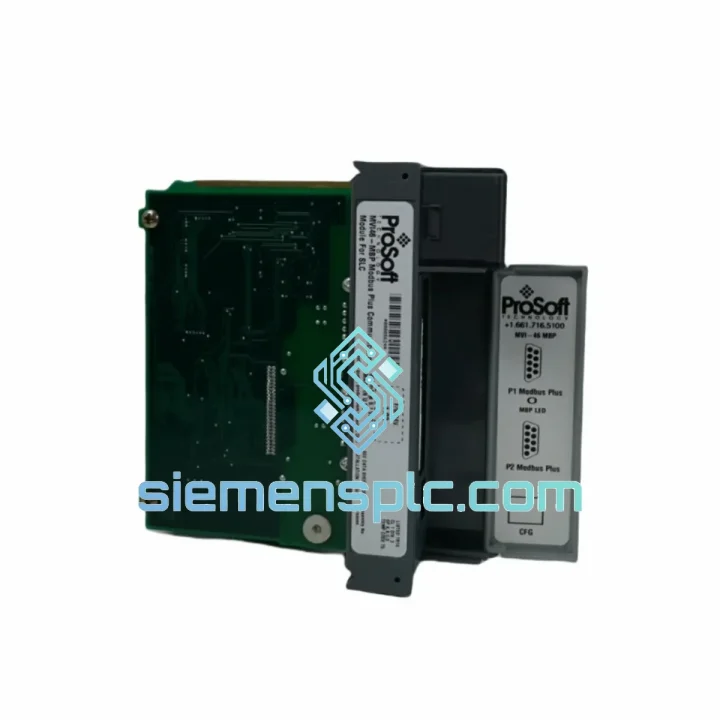
Request verified availability, condition, replacement risk review, packing options and courier lead time for MVI46-MBP.
Click Request Quote and the part number is inserted into the inquiry form automatically.
Core fields for model confirmation and RFQ routing. Detailed product narrative remains below.
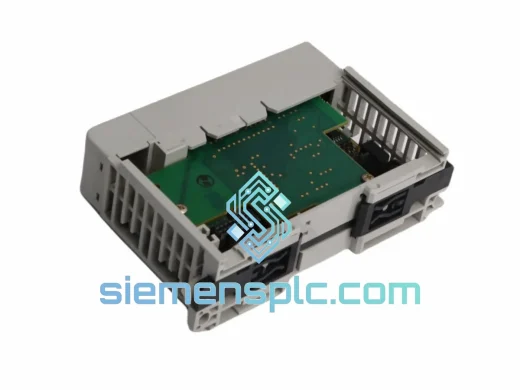
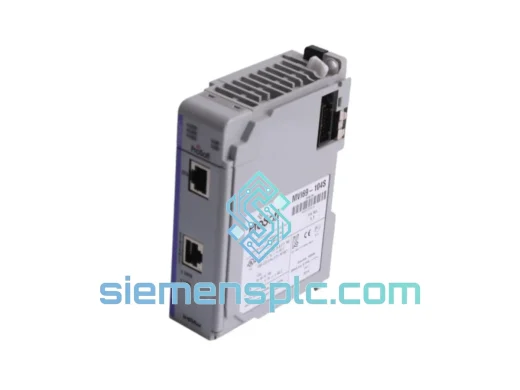
The ProSoft Technology MVI46-MBP is a single-slot communication module engineered for direct integration into Allen-Bradley SLC 500 chassis. Its primary function is to terminate a Modbus Plus (MB+) token-passing network segment at the SLC 500 backplane, enabling bidirectional register exchange between the SLC processor data files and any addressable node on the MB+ trunk — without external gateways, protocol converters, or additional panel hardware.
Modbus Plus is a deterministic, peer-to-peer LAN protocol developed by Modicon (now Schneider Electric) operating at 1 Mbit/s over shielded twisted-pair cable (Belden 9841 or equivalent). Its token-rotation mechanism guarantees bounded latency across all network nodes — a property that makes it suitable for closed-loop process control where scan-cycle predictability is non-negotiable. The MVI46-MBP implements the full MB+ node stack in firmware, handling token acquisition, global data broadcast, and peer-to-peer messaging autonomously, so the SLC 500 processor is relieved of all network management overhead.
In control architectures where Allen-Bradley SLC 500 controllers must coexist with Modicon Quantum, Premium, or Momentum PLCs on a shared MB+ segment — common in petrochemical, power generation, and water treatment facilities — the MVI46-MBP provides the lowest-complexity integration path. The module maps up to 4,000 internal registers directly to SLC 500 data files (N, F, or B file types), and the SLC processor reads and writes those files using standard MSG instructions or implicit I/O block transfers. No proprietary ladder function blocks are required beyond what the SLC 500 instruction set already provides.
Configuration is performed offline using ProSoft Configuration Builder (PCB), a no-cost Windows utility that generates a binary configuration file downloaded to the module via its RS-232 configuration port. Parameters include MB+ node address (1–64), data table size, peer-to-peer read/write command lists, global data slot assignments, and watchdog timeout values. Once commissioned, the module operates independently; PCB is not required at runtime.
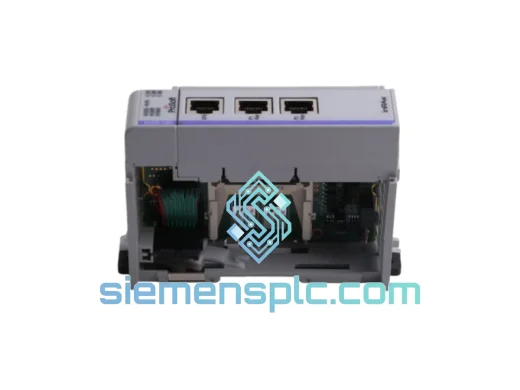
The dual-port MB+ physical interface — two RJ-45 connectors wired in parallel to the internal MB+ transceiver — allows the module to sit mid-segment on the trunk cable rather than at a termination point, supporting daisy-chain topologies without external T-taps. Each port carries the same electrical signal; the second port is used to continue the trunk to the next node, not as a redundant path in the traditional sense. For high-availability architectures requiring true redundant MB+ trunks, ProSoft’s application notes describe a dual-module configuration where two MVI46-MBP units occupy adjacent slots and a supervisory ladder routine arbitrates between their data tables based on communication health flags.
The module draws all operating power from the SLC 500 backplane 5 VDC rail, consuming approximately 800 mA. No external 24 VDC supply is required. This simplifies panel design and eliminates a potential failure point in the power distribution chain. The operating temperature range of 0°C to 60°C covers the majority of industrial enclosure environments without forced cooling, and the 5%–95% non-condensing humidity rating is consistent with IEC 60068-2-78 damp heat test conditions.
Firmware is field-upgradeable via the RS-232 configuration port using PCB’s firmware download utility. This allows ProSoft to issue protocol stack corrections or feature additions without requiring module replacement — a practical consideration for installations with long planned service intervals.
Real-time Stock & RFQ: [email protected] | WhatsApp: +86 18359268345
| Parameter | Value |
|---|---|
| Part Number / SKU | MVI46-MBP |
| Manufacturer | ProSoft Technology |
| Platform | Allen-Bradley SLC 500 (any chassis slot) |
| Network Protocol | Modbus Plus (MB+), token-passing, peer-to-peer |
| Network Speed | 1 Mbit/s |
| MB+ Node Address Range | 1–64 (software-configurable) |
| Internal Register Table | Up to 4,000 registers (read/write) |
| Physical Ports | 2 × RJ-45 (dual-port MB+ trunk pass-through) |
| Backplane Interface | SLC 500 standard I/O bus (5 VDC powered) |
| Backplane Current Draw | ~800 mA @ 5 VDC |
| Configuration Port | RS-232 (DB-9), 9600–115200 baud |
| Configuration Tool | ProSoft Configuration Builder (PCB) — no license fee |
| Firmware Upgrade | Field-upgradeable via RS-232 configuration port |
| Form Factor | Single-slot SLC 500 I/O module |
| Operating Temperature | 0°C to +60°C |
| Storage Temperature | −40°C to +85°C |
| Relative Humidity | 5%–95% non-condensing |
| Weight | 230 g |
| Certifications | CE, UL Listed, cUL |
| Country of Origin | United States |
| Warranty | 12 months from date of shipment |
The MVI46-MBP is built around a dedicated embedded processor that runs the MB+ node firmware stack independently of the SLC 500 CPU. This architectural separation is deliberate: the SLC 500 processor is a scan-based controller with a fixed program scan cycle; embedding network protocol management inside the SLC scan would introduce variable scan-time jitter proportional to network traffic volume. By offloading MB+ token management to the module’s own processor, the SLC scan cycle remains deterministic regardless of MB+ network load.
Dual-Port Physical Layer: The two RJ-45 ports connect to a single MB+ transceiver IC via an internal passive junction. This allows the module to be inserted mid-segment on the MB+ trunk cable without breaking the bus — a significant wiring advantage over single-port devices that require external T-connectors. The transceiver implements the RS-485-derived MB+ physical layer with differential signaling, providing inherent common-mode noise rejection suitable for industrial environments with high electromagnetic interference (EMI) from variable-frequency drives (VFDs), contactors, and power distribution equipment.
EMC Design Considerations: The module’s PCB layout isolates the MB+ transceiver ground plane from the SLC 500 backplane logic ground, with opto-isolation on the backplane data lines. This galvanic separation prevents ground loop currents — a common source of communication errors in mixed-voltage industrial panels — from coupling noise into the MB+ signal path. The RS-232 configuration port similarly uses a separate ground reference, preventing laptop ground potentials from disturbing backplane logic during commissioning.
Watchdog and Fault Logic: The module firmware implements a configurable watchdog timer that monitors MB+ token rotation health. If the token is not received within the configured timeout window (indicating a broken trunk cable, failed node, or network overload), the module sets a fault status bit in its backplane data block. The SLC 500 ladder program can monitor this bit and execute a defined fault response — such as holding last-known-good values, driving outputs to a safe state, or triggering an alarm — without waiting for the SLC processor’s own I/O fault detection to activate. This provides a faster, application-specific fault response than relying solely on the SLC 500’s generic I/O module fault handling.
Global Data Support: MB+ global data allows a node to broadcast up to 32 words to all other nodes on the segment simultaneously, once per token rotation. The MVI46-MBP supports both transmitting and receiving global data slots, enabling low-latency broadcast of high-priority process variables (e.g., emergency stop status, master setpoints) across the entire MB+ segment without consuming peer-to-peer transaction bandwidth.
Every MVI46-MBP unit supplied by siemensplc.com is sourced through verified industrial automation distribution channels with full traceability to ProSoft Technology’s authorized supply chain. Incoming inspection includes visual examination of module labeling, firmware version verification, and a functional power-on test confirming backplane communication and MB+ transceiver operation prior to dispatch. Units that fail any inspection criterion are quarantined and not offered for sale.
Original ProSoft Technology packaging, including the module, configuration cable, and documentation CD or download card, is preserved intact. Serial numbers are recorded against each order for post-sale traceability. A 12-month warranty from the date of shipment covers manufacturing defects and confirmed functional failures under normal operating conditions.
Logistics operations are based in Xiamen, China — a major southeastern China port city with direct access to international air freight hubs (Xiamen Gaoqi International Airport) and sea freight terminals. Standard export documentation (commercial invoice, packing list, certificate of origin) is prepared for all international shipments. DHL Express, FedEx International Priority, and UPS Worldwide Express are the primary carriers, with typical transit times of 3–5 business days to North America and Europe. EMS and sea freight options are available for cost-sensitive or bulk orders. All shipments are fully insured and tracked from dispatch to delivery confirmation.
For customers in regions with import duty sensitivities, HS code documentation and formal customs declarations are prepared accurately to facilitate smooth clearance. Pre-shipment photos and packing videos are available on request for high-value orders.
Email: [email protected]
WhatsApp: +86 18359268345
Web: siemensplc.com
Location: Xiamen, China
© 2026 siemensplc.com. All rights reserved.
We check the full part number, brand, series and visible nameplate information before quotation.
Sales confirms stock path, condition option, quantity and realistic lead time for export dispatch.
DHL, FedEx, UPS or buyer courier arrangements can be reviewed with packing requirements.
Similar brand or category products for fast comparison and multi-item RFQ lists.