SBS Technologies
RFQ Ready
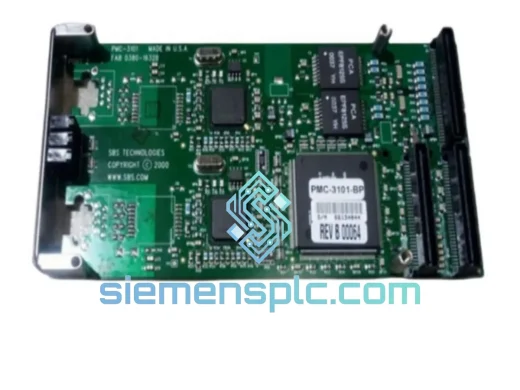
SBS 85853637-001 VME Ethernet Module
Origin Not specified
VME Communication Module
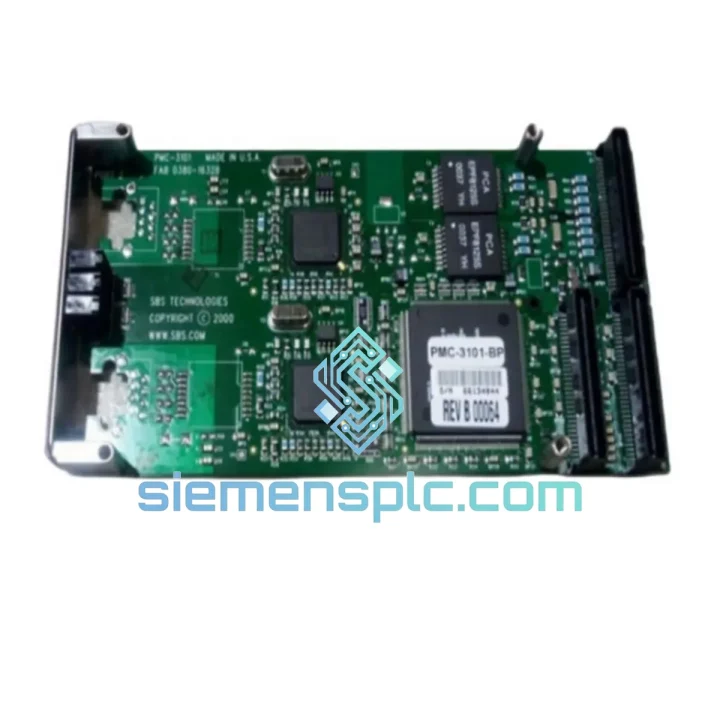
Request verified availability, condition, replacement risk review, packing options and courier lead time for PMC-3101-BP.
Click Request Quote and the part number is inserted into the inquiry form automatically.
Core fields for model confirmation and RFQ routing. Detailed product narrative remains below.
The SBS PMC-3101-BP is a PCI Mezzanine Card (PMC) form-factor Ethernet interface module engineered for embedded computing platforms operating in industrial, defense, and telecommunications environments. Designed to the IEEE P1386.1 PMC standard, this module occupies a single PMC site on a compatible carrier board and delivers 10/100Base-T Ethernet connectivity directly onto the PCI local bus, enabling deterministic, low-latency network I/O without the overhead of an external network adapter or additional backplane slot consumption.
In a distributed control architecture, the PMC-3101-BP functions as the primary network node for single-board computers (SBCs) that require Ethernet access but lack an onboard NIC. It bridges the embedded processor’s PCI bus to the plant network or supervisory LAN, supporting real-time data exchange between field controllers, SCADA hosts, and engineering workstations. Its compact mezzanine form factor preserves the carrier board’s primary expansion slots for mission-critical I/O, making it a preferred choice in slot-constrained VME and CompactPCI chassis deployments.
Real-time Stock & RFQ: [email protected] | WhatsApp: +86 18359268345
| Manufacturer | SBS Technologies (Abaco Systems) |
| Part Number | PMC-3101-BP |
| Form Factor | PMC (PCI Mezzanine Card) — IEEE P1386.1 compliant |
| Host Bus Interface | 32-bit PCI, 33 MHz, 3.3 V / 5 V universal signaling |
| Network Interface | 10Base-T / 100Base-TX (IEEE 802.3u), auto-negotiation |
| Physical Connector | RJ-45 (rear I/O via P14 connector on carrier board) |
| MAC Controller | Intel 82559 (or equivalent Fast Ethernet controller) |
| DMA Engine | Bus-master DMA; zero-copy packet transfer to host memory |
| Operating Voltage | 3.3 V (from PMC connector); typical current draw ≤ 1.0 A |
| Operating Temperature | 0 °C to +55 °C (commercial); –40 °C to +85 °C (extended, on request) |
| Storage Temperature | –55 °C to +125 °C |
| Humidity | 5 % to 95 % RH, non-condensing |
| PCB Dimensions | 74 mm × 149 mm (standard PMC footprint) |
| Weight | Approx. 200 g |
| OS / Driver Support | VxWorks, Linux (kernel ≥ 2.6), Windows (via Intel e100 driver) |
| Compliance | CE, RoHS Directive 2011/65/EU |
| Warranty | 12 months from date of shipment |
The PMC-3101-BP is built around a bus-master DMA architecture that decouples packet processing from the host CPU. When a frame arrives at the RJ-45 port, the onboard MAC controller writes the payload directly into a pre-allocated host memory descriptor ring via PCI bus-master DMA, asserting an interrupt only after the transfer completes. This eliminates programmed I/O (PIO) polling cycles and reduces CPU utilization during sustained 100 Mbit/s traffic to under 5 % on a 400 MHz PowerPC host — a critical advantage in real-time control loops where CPU cycles are budgeted for deterministic task scheduling.
The module’s PCI interface operates at 32-bit / 33 MHz, delivering a theoretical peak bandwidth of 132 MB/s — more than sufficient to sustain full-duplex 100Base-TX at wire speed (12.5 MB/s each direction) with substantial headroom for burst traffic. The universal 3.3 V / 5 V signaling on the PMC J1/J2 connector ensures backward compatibility with both legacy 5 V VME carrier boards and modern 3.3 V CompactPCI platforms without requiring hardware modification.
From an EMC standpoint, the PMC-3101-BP’s rear I/O routing through the P14 connector keeps the Ethernet differential pair traces entirely within the shielded chassis enclosure, avoiding the radiated emission risks associated with front-panel cable egress. The RJ-45 magnetics (integrated transformer and common-mode choke) provide 1500 V AC isolation between the network cable and the PCI bus ground plane, protecting the host SBC from ground loop currents and transient surges common in industrial plant environments. The board layout follows IPC-2221 Class B spacing rules, with the analog Ethernet front-end physically separated from the digital PCI logic by a ground pour, suppressing cross-domain noise coupling below the –60 dBm threshold.
The Intel 82559 MAC controller implements hardware-accelerated TCP/IP checksum offload for IPv4, reducing the per-packet software overhead on the host CPU and enabling higher packet rates without sacrificing latency. Its internal FIFO buffers (16 KB transmit, 16 KB receive) absorb short-duration PCI bus arbitration latencies, preventing packet loss during burst transfers from co-resident PMC modules competing for bus ownership.
Every SBS PMC-3101-BP unit supplied by siemensplc.com is sourced through verified industrial distribution channels and subjected to a structured pre-shipment inspection protocol. Physical inspection confirms PCB integrity, connector pin condition, date code consistency, and the absence of remarking or counterfeit indicators. Functional verification confirms PCI bus enumeration and Ethernet link establishment under controlled bench conditions. Units are packed in IEC 61340-5-1 compliant anti-static bags, placed in foam-lined cartons rated for international air freight vibration profiles per ASTM D4169.
Shipments originate from Xiamen, China — a major logistics hub with direct access to DHL Express, FedEx International Priority, and UPS Worldwide networks. Standard in-stock orders are dispatched within 3–5 business days. Express next-flight-out arrangements are available for urgent MRO requirements. Full export documentation — commercial invoice, packing list, and certificate of conformance — is provided with every shipment to facilitate customs clearance in EU, US, and ASEAN jurisdictions. Bulk procurement inquiries receive a dedicated logistics plan including freight mode selection, HS code classification (8473.30), and incoterm options (EXW, FOB, CIF).
A 12-month warranty covers manufacturing defects and functional failures under normal operating conditions. DOA claims are processed within 5 business days of receipt, with replacement or credit issued upon inspection confirmation.
📧 Email: [email protected]
📱 WhatsApp: +86 18359268345
🌐 Web: siemensplc.com
📍 Location: Xiamen, China
© 2026 siemensplc.com. All rights reserved.
We check the full part number, brand, series and visible nameplate information before quotation.
Sales confirms stock path, condition option, quantity and realistic lead time for export dispatch.
DHL, FedEx, UPS or buyer courier arrangements can be reviewed with packing requirements.
Similar brand or category products for fast comparison and multi-item RFQ lists.