Siemens
RFQ Ready
Siemens T8191 Safety Controller Module – Trusted TMR Series
Trusted Series
Origin DE
Safety Controller Module
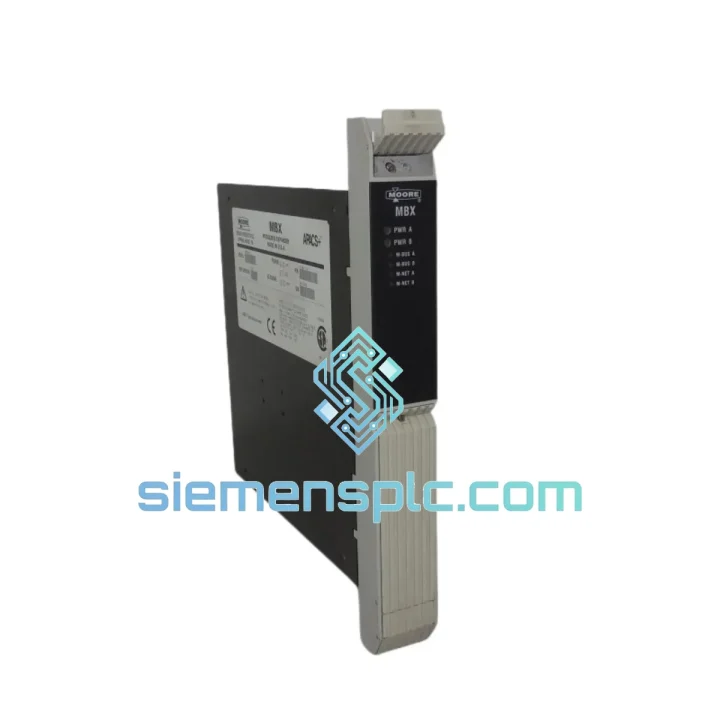
Request verified availability, condition, replacement risk review, packing options and courier lead time for 16180-1/14.
Click Request Quote and the part number is inserted into the inquiry form automatically.
Core fields for model confirmation and RFQ routing. Detailed product narrative remains below.
The Siemens 39MBXNAN (order reference 16180-1/14) is a backplane expansion module engineered for Siemens Modulbus-based distributed control systems. Its primary function within a control loop is to extend the physical and logical reach of the Modulbus segment, allowing additional I/O, communication, or specialty modules to be inserted into an existing rack assembly without restructuring the host controller’s addressing scheme. In process-critical environments — refinery distributed control, power plant auxiliary systems, chemical batch reactors — the ability to expand I/O capacity without controller downtime or re-parameterization is a measurable operational advantage. The 39MBXNAN fulfills this role by acting as a transparent bus bridge: it propagates Modulbus arbitration signals, slot-addressing tokens, and diagnostic frames across the expanded segment while maintaining the deterministic cycle time expected by the host CPU.
Unlike generic backplane extenders, the 39MBXNAN is designed to the Siemens Modulbus electrical specification, which defines strict impedance matching, termination resistance, and signal propagation delay budgets. Deviating from these parameters — as third-party alternatives often do — introduces reflections on the differential bus lines that manifest as intermittent communication faults under high I/O load or elevated ambient temperature. The 39MBXNAN eliminates this risk by design.
📩 Real-time Stock & RFQ: [email protected] | WhatsApp: +86 18359268345
| Parameter | Value / Specification |
|---|---|
| Manufacturer | Siemens AG |
| Part Number | 39MBXNAN |
| Order / Reference No. | 16180-1/14 |
| Module Classification | MBX Modulbus Expander |
| Bus Protocol | Siemens Modulbus (proprietary differential backplane bus) |
| Bus Topology | Daisy-chain segment extension |
| Signal Interface | Differential pair, impedance-matched per Modulbus spec |
| Mounting Form Factor | Rack-mount, compatible with Siemens Modulbus backplane chassis |
| Operating Temperature | 0 °C to +60 °C (standard industrial cabinet range) |
| Storage Temperature | -25 °C to +70 °C |
| Relative Humidity | 5 % to 95 %, non-condensing |
| EMC Compliance | Designed to EN 61000 series; shielded backplane connector |
| Weight | Approx. 1,800 g |
| Country of Origin | Germany |
| Warranty | 12 months from date of shipment |
The 39MBXNAN’s internal architecture centers on a bus repeater and arbitration relay circuit. The Modulbus protocol operates on a token-passing arbitration model: the host CPU issues a slot-address token that propagates sequentially across all modules on the segment. When the segment is extended via the 39MBXNAN, the expander must re-drive the token signal with sufficient voltage swing and edge rate to meet the setup/hold timing requirements of downstream modules — typically within a 50 ns propagation budget per segment hop.
EMC and Signal Integrity Design: The module employs a shielded backplane connector with ground-plane stitching at the PCB level, reducing common-mode noise injection from adjacent power supply switching transients. The differential bus lines are routed with controlled impedance (typically 120 Ω differential) and terminated with precision resistor networks at both ends of the extended segment. This termination strategy suppresses reflections that would otherwise corrupt the address token at bus speeds above 1 Mbit/s.
Optical Isolation Boundary: At the electrical boundary between the host segment and the expanded segment, the 39MBXNAN incorporates optocoupler-based isolation on diagnostic and interrupt lines. This prevents ground loop currents — common in large cabinet installations where multiple rack sections share separate PE conductors — from corrupting the diagnostic frame data that the host CPU uses for module health monitoring. The isolation barrier is rated to withstand transient voltages consistent with IEC 61000-4-5 surge immunity requirements.
Redundancy Arbitration Logic: In systems configured with redundant CPUs, the 39MBXNAN participates in the bus arbitration handshake that determines which CPU holds the active token. The expander’s relay logic is designed to switch the active bus path within the arbitration window defined by the Modulbus specification, ensuring that a CPU switchover does not cause a missed scan cycle on the expanded I/O segment. This is particularly relevant in hot-standby configurations where scan cycle determinism is a contractual requirement.
Thermal Management: The module’s power dissipation is managed through a combination of low-dropout linear regulators for internal logic supply and copper-poured thermal relief areas on the PCB. Under maximum bus load conditions, junction temperatures of internal ICs remain within datasheet limits at ambient temperatures up to 60 °C, consistent with the operating range of the host rack’s forced-air cooling system.
Every 39MBXNAN unit dispatched from our Xiamen, China facility undergoes a structured pre-shipment verification process. Visual inspection confirms connector pin integrity, PCB surface condition, and label authenticity against Siemens OEM markings. Functional verification — where test equipment permits — includes bus signal continuity checks and isolation resistance measurement on the optocoupler boundary. Units are packed in anti-static ESD bags, placed in foam-lined cartons, and sealed with tamper-evident tape. For high-value or multi-unit orders, a packing list with individual serial numbers is included to support receiving inspection at the customer’s facility.
Logistics from Xiamen covers all major international freight lanes. Standard export channels include DHL Express (3–5 business days to Europe and North America), FedEx International Priority, and UPS Worldwide Expedited. For bulk orders or freight-sensitive shipments, sea freight consolidation via Xiamen Port is available with full export customs documentation. All shipments are accompanied by a commercial invoice, packing list, and — upon request — a certificate of conformance. Import duty classification is supported with HS code guidance for the destination country.
The 12-month warranty covers defects in materials and workmanship under normal operating conditions. Warranty claims are processed with a replacement-first policy: a replacement unit is dispatched upon receipt and inspection of the returned item, minimizing plant downtime. Expedited warranty replacement is available for critical infrastructure customers with documented uptime requirements.
📧 Email: [email protected]
💬 WhatsApp: +86 18359268345
🌐 Web: siemensplc.com
📍 Location: Xiamen, China
© 2026 siemensplc.com. All rights reserved.
We check the full part number, brand, series and visible nameplate information before quotation.
Sales confirms stock path, condition option, quantity and realistic lead time for export dispatch.
DHL, FedEx, UPS or buyer courier arrangements can be reviewed with packing requirements.
Similar brand or category products for fast comparison and multi-item RFQ lists.