Siemens
RFQ Ready
Siemens T8191 Safety Controller Module – Trusted TMR Series
Trusted Series
Origin DE
Safety Controller Module
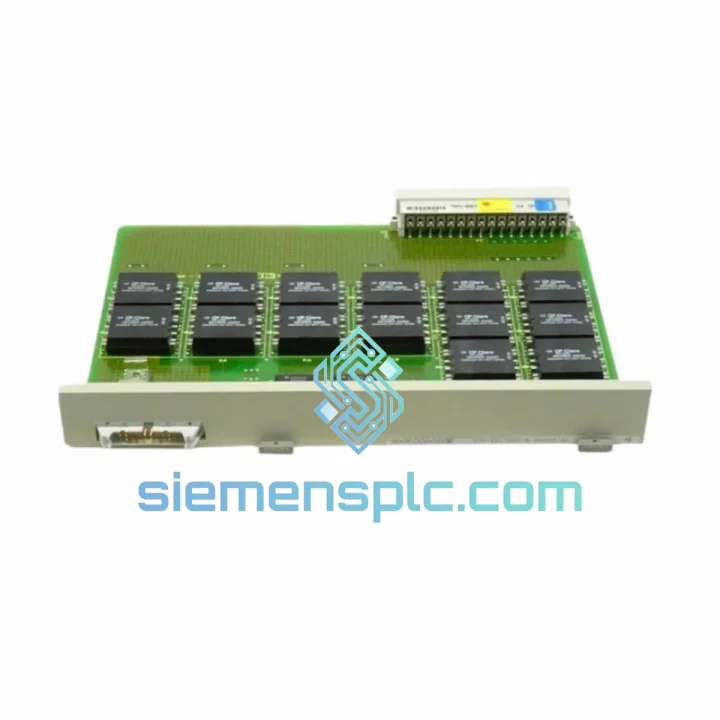
Request verified availability, condition, replacement risk review, packing options and courier lead time for 6DS1703-8AB.
Click Request Quote and the part number is inserted into the inquiry form automatically.
Core fields for model confirmation and RFQ routing. Detailed product narrative remains below.
The Siemens 6DS1703-8AB is a dedicated MS (Measuring and Switching) Point Extension module engineered for the TELEPERM M Distributed Control System platform — a process automation architecture that Siemens developed for continuous and batch process industries including petrochemical, power generation, and pharmaceutical manufacturing. Within a TELEPERM M installation, the 6DS1703-8AB occupies a defined slot in the MS rack and extends the measurable and switchable point capacity of the connected Automation Station (AS 230 or AS 235), enabling engineers to scale I/O density without modifying the existing backplane wiring infrastructure or reconfiguring the station’s communication topology.
The module interfaces with the TELEPERM M internal bus via a passive backplane connector, drawing both power and data signaling from the rack. Its point extension function operates by mapping additional physical I/O channels into the logical address space of the parent AS, which the station’s cyclic task scheduler then polls at a deterministic scan rate. This architecture preserves the real-time determinism of the control loop even as the I/O count grows, because the extension module does not introduce an independent communication master — it remains a subordinate node on the rack bus, subject to the AS’s arbitration logic.
Real-time Stock & RFQ: [email protected] | WhatsApp: +86 18359268345
| Parameter | Value |
|---|---|
| Manufacturer | Siemens AG |
| Part Number | 6DS1703-8AB |
| Module Function | MS Point Extension |
| Platform | TELEPERM M DCS |
| Compatible Stations | AS 230, AS 235 |
| Rack Interface | TELEPERM M passive backplane bus |
| Form Factor | Standard TELEPERM M rack-mount card |
| Supply Voltage | 24 V DC (via backplane) |
| Operating Temperature | 0 °C to +60 °C |
| Storage Temperature | -25 °C to +70 °C |
| Relative Humidity | 5 % to 95 %, non-condensing |
| EMC Compliance | EN 61000-4 series (OEM design) |
| Country of Origin | Germany |
| Weight (approx.) | 300 g |
| Warranty | 12 months from dispatch date |
The 6DS1703-8AB’s internal architecture reflects the design philosophy of TELEPERM M: determinism and signal integrity take precedence over raw channel density. Several hardware-level decisions are worth examining for engineers evaluating this module in a sustaining-engineering context.
Backplane Bus Arbitration: The module does not act as a bus master. It responds to polling frames issued by the parent AS at fixed intervals, which means the extension point count does not degrade the bus cycle time in a non-linear fashion. Each additional 6DS1703-8AB adds a fixed, predictable increment to the AS scan cycle — a property that simplifies worst-case execution time (WCET) analysis during safety reviews.
Signal Conditioning and Isolation: Analog input channels on TELEPERM M MS modules employ galvanic isolation between the field-side terminal block and the backplane logic. The isolation barrier — typically implemented via transformer coupling or optocoupler arrays depending on the channel type — attenuates common-mode noise injected from field cabling. In industrial environments where variable-frequency drives, large motor contactors, and high-current bus bars share cable trays with instrumentation wiring, this isolation margin is not a convenience feature; it is a functional requirement for measurement accuracy at the millivolt level.
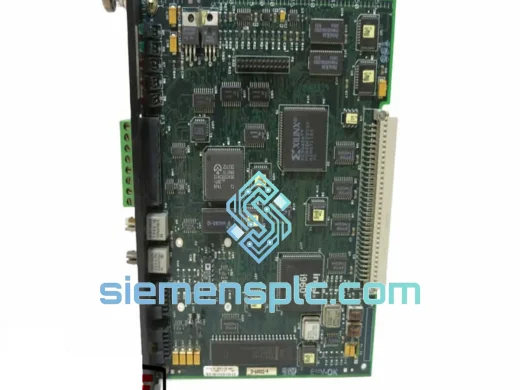
EMC Design: The PCB layout follows Siemens’ internal EMC guidelines for rack-mount industrial modules: ground planes are continuous beneath high-frequency signal traces, decoupling capacitors are placed at each IC power pin, and the front-panel connector shield is bonded to the rack chassis ground at the point of insertion. This approach suppresses both conducted and radiated emissions within the rack enclosure and reduces susceptibility to externally coupled transients on the backplane.
Thermal Management: The module relies on convective airflow through the rack enclosure rather than active cooling. Component placement is optimized to avoid thermal stacking of high-dissipation devices, and the PCB substrate is rated for continuous operation at the upper end of the specified temperature range without derating the channel count.
Firmware Revision Compatibility: TELEPERM M AS firmware versions maintain backward compatibility with the 6DS17xx module family through a structured module descriptor table stored in the AS’s non-volatile memory. When a 6DS1703-8AB is inserted, the AS reads the module’s hardware identification register and maps it to the correct I/O driver routine. Engineers replacing a failed unit do not need to modify the AS configuration database provided the replacement carries the same hardware revision suffix.
Every Siemens 6DS1703-8AB unit dispatched from our Xiamen facility is a genuine OEM component sourced through verified industrial supply channels. Each module undergoes a structured pre-shipment inspection: physical examination of PCB, connectors, and Siemens part markings against OEM reference documentation; verification of hardware revision suffix against the stated part number; and ESD-safe handling throughout the receiving, storage, and packing workflow. Units are packed in anti-static bags within foam-lined cartons rated for international air freight handling.
A 12-month warranty covers functional failure under normal operating conditions from the date of dispatch. Failed units within the warranty period are replaced or credited without requiring the buyer to return the module to the original manufacturer.
Logistics from Xiamen, China to global destinations are handled via DHL Express, FedEx International Priority, and UPS Worldwide for time-critical shipments. Sea freight consolidation is available for project quantities. In-stock units are typically dispatched within 1–3 business days of order confirmation. All export documentation — commercial invoice, packing list, and HS code declaration — is prepared to facilitate smooth customs clearance in the destination country. Buyers in regions with specific import licensing requirements are advised to verify local regulations prior to ordering.
Email: [email protected]
WhatsApp: +86 18359268345
Web: siemensplc.com
Location: Xiamen, China
© 2026 siemensplc.com. All rights reserved.
We check the full part number, brand, series and visible nameplate information before quotation.
Sales confirms stock path, condition option, quantity and realistic lead time for export dispatch.
DHL, FedEx, UPS or buyer courier arrangements can be reviewed with packing requirements.
Similar brand or category products for fast comparison and multi-item RFQ lists.