Siemens
RFQ Ready
Siemens T8191 Safety Controller Module – Trusted TMR Series
Trusted Series
Origin DE
Safety Controller Module
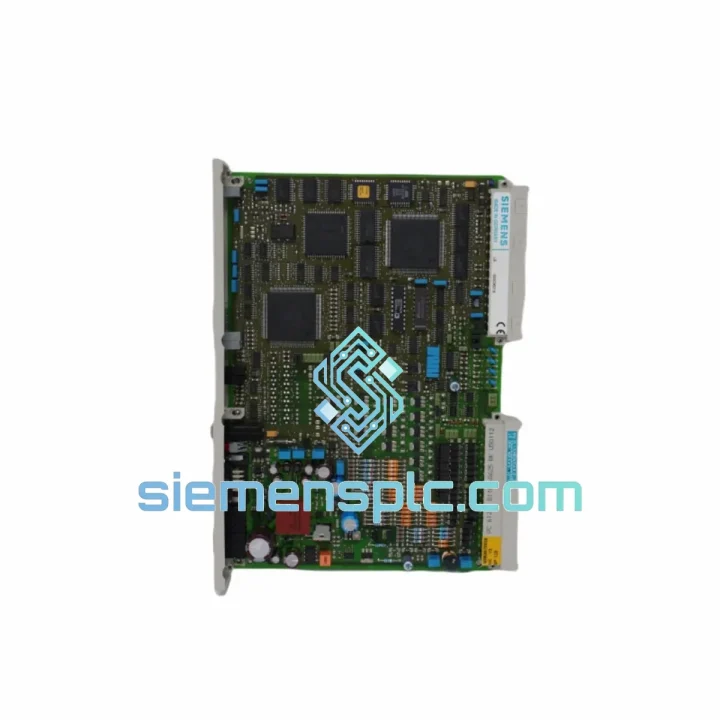
Request verified availability, condition, replacement risk review, packing options and courier lead time for 6DS1727-8AA.
Click Request Quote and the part number is inserted into the inquiry form automatically.
Core fields for model confirmation and RFQ routing. Detailed product narrative remains below.
The Siemens 6DS1727-8AA is a controller module within the TELEPERM M Distributed Control System platform, a rack-based DCS architecture that Siemens AG developed for continuous and batch process industries. Within the TELEPERM M control hierarchy, this module occupies the closed-loop execution layer: it receives setpoint commands from the operator station or supervisory level, executes PID or sequence-based control algorithms against live process values, and issues corrective output signals to field actuators — all within a deterministic scan cycle that does not vary under normal operating conditions.
Unlike general-purpose PLCs that execute ladder logic in a single-threaded scan, the TELEPERM M architecture separates function block processing from I/O acquisition. The 6DS1727-8AA handles the algorithmic computation tier, communicating with dedicated I/O modules via the TELEPERM M backplane bus. This structural separation reduces jitter in loop execution timing, which is critical in processes where a 50 ms deviation in a temperature or pressure control output can trigger downstream safety interlocks or product quality excursions.
Real-time Stock & RFQ: [email protected] | WhatsApp: +86 18359268345
| Part Number | 6DS1727-8AA |
| Manufacturer | Siemens AG |
| Platform / Series | TELEPERM M DCS |
| Module Function | Closed-loop DCS Controller / Function Block Processor |
| Form Factor | Eurocard plug-in module, rack-mount |
| Backplane Interface | TELEPERM M internal bus (parallel backplane architecture) |
| Operating Temperature | 0 °C to +60 °C (ambient, forced-air cabinet) |
| Storage Temperature | −40 °C to +70 °C |
| Relative Humidity | 5 % to 95 % RH, non-condensing |
| Supply Voltage | 24 VDC via rack backplane (regulated) |
| Vibration Resistance | Per IEC 60068-2-6 (sinusoidal, 10–150 Hz) |
| EMC Compliance | CE, EN 61000 series (per TELEPERM M system certification) |
| Weight | Approx. 360 g |
| Country of Origin | Germany |
| Warranty | 12 months from date of shipment (siemensplc.com quality guarantee) |
The 6DS1727-8AA operates within TELEPERM M’s modular rack architecture, where each functional module is electrically isolated from adjacent cards through the backplane’s slot-specific power and signal routing. This physical partitioning limits fault propagation: a hardware failure on one module does not corrupt the address space or power rail of neighboring cards, a design discipline that predates modern IEC 61131-3 safety partitioning concepts by over a decade.
Backplane Bus Arbitration: The TELEPERM M backplane uses a time-division multiplexed (TDM) bus protocol. The 6DS1727-8AA participates as a bus master during its allocated time slot, reading I/O data from the acquisition modules and writing computed output values in a single atomic transaction. This eliminates the race conditions that can occur in asynchronous bus architectures where read and write operations are not synchronized to a common clock domain.
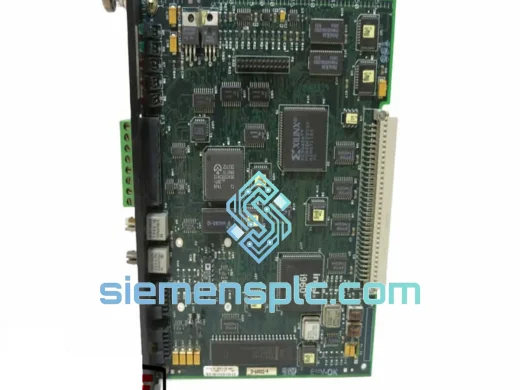
EMC Design Discipline: The PCB layout of TELEPERM M controller modules follows Siemens’ internal EMC design rules, which include ground plane continuity across the full card area, decoupling capacitors placed within 5 mm of each IC power pin, and signal trace impedance control on high-frequency clock lines. The front panel connector uses a shielded backshell that bonds to the rack chassis ground, providing a low-impedance return path for induced RF currents. In plant environments where variable-frequency drives (VFDs) and high-current switching equipment generate conducted and radiated interference in the 150 kHz–30 MHz range, this shielding architecture maintains signal integrity on the backplane data lines.
Function Block Execution Model: The 6DS1727-8AA executes TELEPERM M function blocks — pre-compiled control algorithms stored in firmware — rather than interpreted user code. This approach eliminates the variable execution overhead associated with software interpreters, producing a fixed worst-case execution time (WCET) for each scan cycle. For PID loops controlling exothermic reactors or high-pressure steam systems, a bounded WCET is a non-negotiable design requirement.
Thermal Management: The module’s component layout places high-dissipation ICs near the card edge, where convective airflow from the rack’s forced-air cooling system is most effective. Thermal interface materials between heat-generating components and the PCB substrate maintain junction temperatures within rated limits at the maximum ambient of 60 °C, extending component service life in continuously operating plant environments.
Every Siemens 6DS1727-8AA unit dispatched from siemensplc.com undergoes a structured pre-shipment verification sequence:
Shipments originate from our warehouse in Xiamen, China. Standard international express freight via DHL, FedEx, or UPS delivers to most destinations within 3–7 business days. Expedited next-flight-out options are available for critical plant shutdowns. Full export documentation — including certificate of origin, packing declaration, and MSDS where applicable — is prepared for each shipment to facilitate customs clearance in the destination country.
Email: [email protected]
WhatsApp: +86 18359268345
Web: siemensplc.com
Location: Xiamen, China
© 2026 siemensplc.com. All rights reserved.
We check the full part number, brand, series and visible nameplate information before quotation.
Sales confirms stock path, condition option, quantity and realistic lead time for export dispatch.
DHL, FedEx, UPS or buyer courier arrangements can be reviewed with packing requirements.
Similar brand or category products for fast comparison and multi-item RFQ lists.