Siemens
RFQ Ready
Siemens 6ES7321-1BL00-0AA0 Digital Input Module
SIMATIC
Origin DE
PLC Digital Input Module
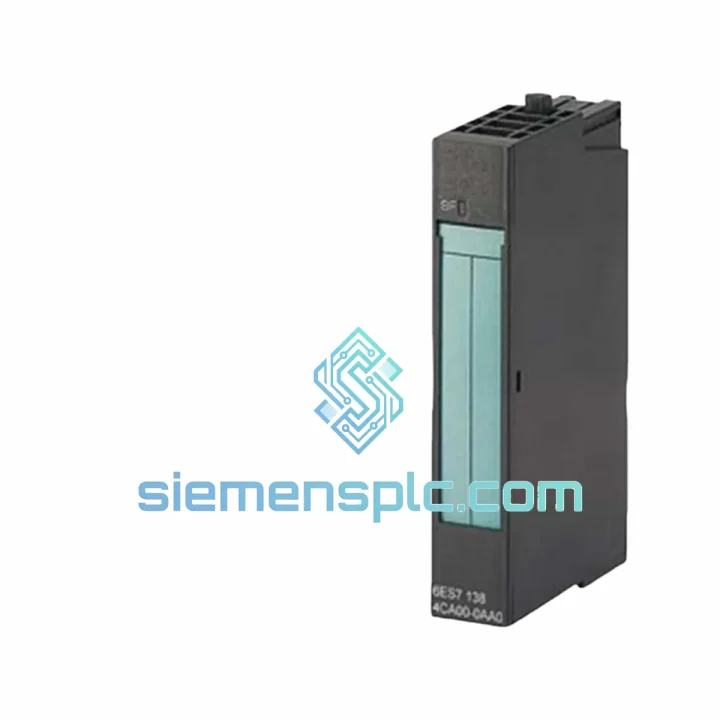
Request verified availability, condition, replacement risk review, packing options and courier lead time for 6ES7134-4MB00-0AB0.
Click Request Quote and the part number is inserted into the inquiry form automatically.
Core fields for model confirmation and RFQ routing. Detailed product narrative remains below.
The 6ES7134-4MB00-0AB0 is a 2-channel, 4-wire current analog input module engineered for the SIMATIC ET 200S modular distributed I/O platform. Accepting standard industrial current signals across the 0–20 mA and 4–20 mA ranges, the module performs sigma-delta analog-to-digital conversion at 13-bit + sign resolution, producing a 14-bit effective digital word that is transferred to the host controller via the ET 200S internal backplane bus. The station communicates upstream via PROFIBUS DP or PROFINET, depending on the interface module installed — the 6ES7134-4MB00-0AB0 itself is bus-agnostic and operates identically in either configuration.
Within a distributed control architecture, this module occupies the signal conditioning boundary between field-mounted transmitters and the controller’s process image. It handles excitation current sourcing, voltage-to-current measurement, power-line interference rejection, and channel-level fault detection — all within a 15 mm wide housing that mounts on the ET 200S terminal module rail. The Standard (ST) accuracy class delivers ±0.5% full-scale measurement error across 0 °C to +60 °C, covering the majority of industrial process monitoring applications including flow, pressure, level, and temperature via 4–20 mA transmitters.
The 4-wire connection topology separates the transmitter excitation path from the measurement sense path. The module sources loop current through the transmitter and measures the resulting voltage across an internal sense resistor of approximately 50 Ω. Because the sense circuit draws negligible current, cable resistance — even across runs exceeding 100 meters — does not contribute to measurement error. This is a fundamental distinction from 2-wire configurations, where lead resistance directly degrades accuracy. For a 100-meter run of 1.5 mm² conductor (approximately 2.4 Ω/km total loop resistance), the 4-wire topology eliminates roughly 0.24 Ω from the measurement path, preserving the ±0.5% specification at the module terminals under all practical field wiring conditions.
Real-time Stock & RFQ: [email protected] | WhatsApp: +86 18359268345
| Parameter | Specification |
|---|---|
| Order Number (SKU) | 6ES7134-4MB00-0AB0 |
| Product Series | SIMATIC ET 200S |
| Module Function | 2-Channel Analog Input (2AI), 4-Wire Current |
| Measuring Ranges | 0–20 mA / 4–20 mA (selectable per channel) |
| ADC Architecture | Sigma-Delta (ΣΔ) |
| Resolution | 13 bits + sign (14-bit effective word) |
| Accuracy Class | Standard (ST) — ±0.5% of full scale |
| Conversion Time per Channel | ~6 ms (50 Hz suppression mode) |
| Interference Suppression | 50 Hz / 60 Hz selectable |
| Input Resistance | ~50 Ω (current input sense resistor) |
| Permissible Continuous Input Voltage | Max. 30 V DC (overvoltage protection active) |
| Supply Voltage | 24 V DC via ET 200S power module |
| Backplane Current Consumption | Max. 60 mA at 5 V DC |
| Channel Isolation | Galvanic isolation — channels to backplane bus and between channels |
| Wire-Break Detection | Yes — threshold ~1 mA (4–20 mA range) |
| Required Terminal Module | 6ES7193-4CA40-0AA0 (TM-E15S24-01) |
| Dimensions (W × H × D) | 15 mm × 81 mm × 52 mm |
| Weight | ~50 g |
| Operating Temperature | 0 °C to +60 °C (horizontal mounting) |
| Storage Temperature | −40 °C to +70 °C |
| Relative Humidity | 10%–95%, non-condensing (IEC 60068-2-30) |
| Degree of Protection | IP20 (IEC 60529) |
| EMC Compliance | EN 61000-6-2 (immunity), EN 61000-6-4 (emission) |
| Certifications | CE, UL, cULus, ATEX Zone 2 (with compatible IM) |
| Warranty | 12 months from date of shipment |
The sigma-delta ADC architecture employed in the 6ES7134-4MB00-0AB0 integrates the input signal over a full interference suppression period — 20 ms at 50 Hz, 16.7 ms at 60 Hz — before computing the digital output word. This integration window acts as a notch filter precisely centered on the selected power-line frequency. The result is that sinusoidal interference at 50 Hz or 60 Hz, which is the dominant noise source in industrial cabinet environments, is attenuated to near-zero without any external passive filtering on the field wiring. This is not a software filter applied post-conversion; it is a structural property of the ΣΔ topology itself, meaning the rejection is unconditional and does not degrade with signal amplitude or temperature drift.
Galvanic isolation between each analog channel and the ET 200S backplane bus is implemented via optocoupler barriers. The isolation boundary interrupts the DC path between field-side ground references and the controller-side logic ground. In process plants where field transmitters are grounded at remote junction boxes — a common practice in hazardous area installations — the potential difference between field ground and cabinet ground can reach several volts. Without isolation, this potential difference appears as a common-mode offset on the measurement, directly corrupting the current reading. The optocoupler barrier presents a high impedance to this common-mode voltage, confining it to the field side and preventing it from reaching the ADC input. The module’s isolation voltage rating satisfies IEC 61131-2 requirements for distributed I/O in Class I industrial environments.
The PCB layout within the module follows Siemens’ standard ET 200S analog design rules: analog signal traces are routed on layers physically separated from digital switching traces, with ground plane segmentation between the analog and digital domains. The module housing, when seated in the terminal module, forms a continuous shielded enclosure. The terminal module provides a dedicated shield connection terminal that routes field cable shields directly to the station PE rail via a low-impedance path, preventing high-frequency interference currents from circulating through the measurement circuit. This shielding architecture is consistent with IEC 61000-5-2 installation guidelines for analog signal cables in industrial environments.
Wire-break detection operates by monitoring the channel current continuously. In 4–20 mA mode, a loop current below approximately 1 mA — which cannot occur under normal transmitter operation — is interpreted as an open-circuit condition. The detection threshold is set below the NAMUR NE43 lower fault level (3.6 mA), ensuring that a broken wire is distinguished from a transmitter reporting a low-range process value. Detection latency is within one conversion cycle (~6 ms), providing near-immediate fault signaling to the CPU without requiring polling logic in the user program.
Each 6ES7134-4MB00-0AB0 unit supplied through siemensplc.com is sourced as genuine Siemens-manufactured product. Authentication is performed against Siemens’ official product identification criteria: factory label format and print quality, date code structure, holographic security markings, and PCB revision markings consistent with the declared production period. Units that do not satisfy all authentication criteria are rejected before entering inventory — no exceptions.
Pre-shipment handling includes inspection of connector integrity, housing condition, and label legibility. Modules are individually packaged in anti-static shielding bags with silica gel desiccant, placed in foam-lined inner cartons, and shipped in double-wall corrugated outer packaging rated for international air freight drop and compression loads per ISTA 2A test protocols.
All shipments originate from Xiamen, China (Xiamen Gaoqi International Airport, IATA: XMN). Xiamen’s established position as a southeastern China logistics hub provides direct access to DHL, FedEx, UPS, and TNT express networks, as well as sea freight consolidators serving Europe, North America, the Middle East, and Southeast Asia. Standard express delivery to major European and North American destinations is typically completed within 3–7 business days from shipment date. Sea freight consolidation is available for volume orders where extended lead time is acceptable.
Export documentation — commercial invoice, packing list, certificate of origin, and airway bill — is prepared in compliance with destination country import requirements. HS code classification and customs value declaration are managed by our in-house logistics team. Certificates of conformity or third-party pre-shipment inspection reports can be arranged upon request prior to order confirmation. All units carry a 12-month warranty from the date of shipment, covering manufacturing defects. Warranty service is handled by direct replacement or credit note, subject to inspection of the returned unit.
Email: [email protected]
WhatsApp: +86 18359268345
Web: siemensplc.com
Location: Xiamen, China
© 2026 siemensplc.com. All rights reserved.
We check the full part number, brand, series and visible nameplate information before quotation.
Sales confirms stock path, condition option, quantity and realistic lead time for export dispatch.
DHL, FedEx, UPS or buyer courier arrangements can be reviewed with packing requirements.
Similar brand or category products for fast comparison and multi-item RFQ lists.