Siemens
RFQ Ready
Siemens 6ES7321-1BL00-0AA0 Digital Input Module
SIMATIC
Origin DE
PLC Digital Input Module
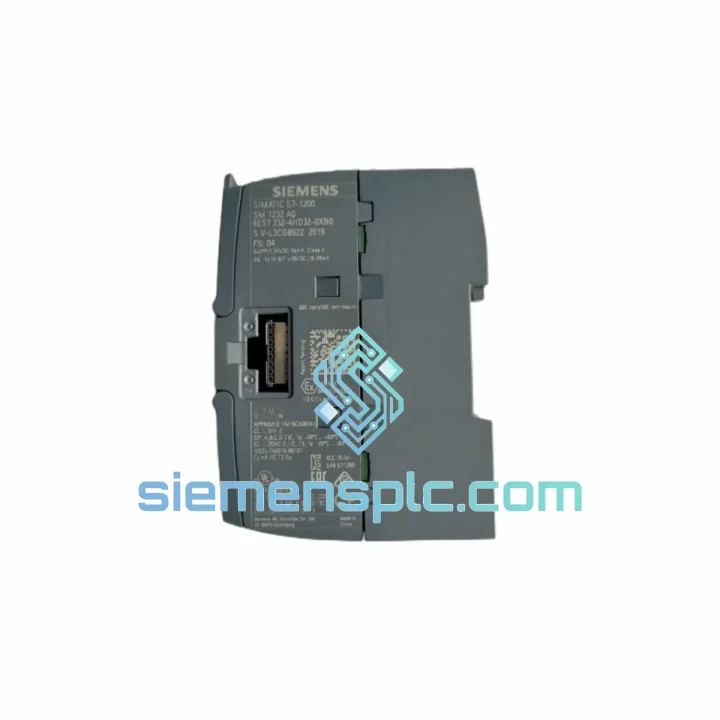
Request verified availability, condition, replacement risk review, packing options and courier lead time for 6ES7232-4HD32-0XB0.
Click Request Quote and the part number is inserted into the inquiry form automatically.
Core fields for model confirmation and RFQ routing. Detailed product narrative remains below.
The 6ES7232-4HD32-0XB0 is a four-channel analog output signal module (SM 1232) designed for the SIMATIC S7-1200 compact PLC platform. It occupies a single slot on the S7-1200 expansion rail and delivers independently configurable voltage or current output on each channel, making it a direct interface between the CPU’s control logic and field actuators such as control valve positioners, variable-frequency drives (VFDs), electro-pneumatic converters, and proportional solenoid valves. The module communicates with the CPU over the S7-1200 backplane bus at the internal I/O cycle rate, ensuring that analog setpoints are refreshed synchronously with the PLC scan cycle without additional latency introduced by external fieldbus arbitration.
In closed-loop process control architectures, the SM 1232 serves as the final command-signal conduit. A PID_Compact or PID_3Step instruction block running in the CPU writes a normalized output value (0.0–1.0 or –1.0 to 1.0) to the module’s process image output (PIO) area. The module’s internal DAC converts this digital word into a calibrated analog signal within one conversion cycle, driving the actuator to the commanded position. The 14-bit voltage resolution (1.25 mV per LSB across ±10 V) and 13-bit current resolution (0.58 µA per LSB across 0–20 mA) are sufficient for Class 0.5 control loops in most process industries without external signal conditioning.
Real-time Stock & RFQ: [email protected] | WhatsApp: +86 18359268345
| Part Number | 6ES7232-4HD32-0XB0 |
| Module Series | SM 1232 — SIMATIC S7-1200 Signal Module |
| Analog Output Channels | 4 (independently configurable per channel) |
| Voltage Output Range | ±10 V DC |
| Current Output Range | 0–20 mA / 4–20 mA (selectable per channel) |
| Resolution — Voltage | 14-bit (1.25 mV/LSB) |
| Resolution — Current | 13-bit (0.58 µA/LSB over 0–20 mA) |
| Settling Time — Voltage | ≤ 300 µs (to within 0.1% of full scale) |
| Settling Time — Current | ≤ 600 µs (resistive load) |
| Load Impedance — Voltage | ≥ 1 kΩ |
| Load Impedance — Current | ≤ 600 Ω |
| Accuracy (25 °C) | ±0.3% of full-scale output |
| Temperature Drift | ±0.01% FS/°C (typical) |
| Backplane Supply Voltage | 24 V DC (via S7-1200 internal bus) |
| Backplane Current Draw | ≤ 80 mA at 5 V DC (logic); ≤ 60 mA at 24 V DC |
| Power Dissipation | ≤ 1.5 W (module) + ≤ 4 W (load-side) |
| Isolation | Optical isolation between backplane logic and analog output circuits |
| Short-Circuit Protection | Voltage outputs: electronic short-circuit protection with diagnostic interrupt |
| Wire-Break Detection | Current outputs: open-circuit detection with CPU diagnostic event |
| Operating Temperature | 0 °C to +55 °C (horizontal DIN rail) / 0 °C to +45 °C (vertical) |
| Storage Temperature | −40 °C to +70 °C |
| Relative Humidity | 5%–95% RH, non-condensing (IEC 60068-2-78) |
| Vibration Resistance | 5–150 Hz, 1 g (IEC 60068-2-6) |
| Shock Resistance | 15 g, 11 ms half-sine (IEC 60068-2-27) |
| Protection Class | IP20 (IEC 60529) |
| Dimensions (W × H × D) | 45 mm × 100 mm × 75 mm |
| Weight | 180 g |
| Mounting | 35 mm DIN rail via S7-1200 side-bus connector |
| Wiring | Front connector, 2-wire per channel (screw or push-in terminal variants) |
| Configuration Software | TIA Portal V13 SP1 and above (V17+ recommended) |
| Firmware Update | Via TIA Portal online function |
| Certifications | CE, UL 508, cULus, RoHS, IEC 61131-2 |
| Warranty | 12 months against manufacturing defects from dispatch date |
| Country of Origin | Germany |
The SM 1232’s internal architecture is built around a multi-channel sigma-delta DAC array with per-channel output amplifiers. Each channel’s digital word is latched from the S7-1200 backplane bus during the CPU’s output phase and held in a dedicated channel register until the next scan cycle update. This register-hold architecture ensures that the analog output remains stable between PLC scan cycles — a critical requirement in applications where actuator dither caused by output glitching would degrade process stability.
Optical Isolation Architecture: The boundary between the S7-1200’s 5 V DC logic domain and the 24 V DC analog output domain is enforced by a dual-stage optocoupler barrier. Digital control signals cross this boundary via high-speed optocouplers rated for ≥ 2.5 kV AC isolation voltage. This prevents ground loops — a common failure mode in analog instrumentation — from propagating noise from field wiring back into the CPU’s logic circuits. In installations where VFDs generate significant common-mode noise on the 24 V supply rail, this isolation stage provides measurable attenuation of conducted interference.
EMC Design: The module’s PCB layout follows IEC 61000-6-2 Class A immunity requirements. Analog signal traces are routed on inner PCB layers with ground-plane shielding on both outer layers, reducing susceptibility to radiated electric fields. Ferrite bead filters on the backplane power supply pins suppress high-frequency switching noise from the CPU’s internal DC-DC converter before it reaches the DAC reference voltage rail. The front connector’s cable shield clamp provides a low-impedance path to the module’s chassis ground, enabling proper shielded-cable termination without additional grounding hardware.
Output Stage Protection: Voltage output channels incorporate a series current-limiting resistor and a crowbar clamp circuit. If the output is inadvertently short-circuited to 0 V or 24 V, the protection circuit limits fault current to a safe level and asserts a diagnostic bit in the module’s status word, which the CPU reads as a hardware interrupt. The PLC program can then execute a fault-handling routine — for example, commanding the output to a safe state and triggering an HMI alarm — without requiring operator intervention at the panel. Current output channels include an open-circuit detection comparator that monitors the voltage across the output terminals; if the loop impedance exceeds the maximum rated value (indicating a broken wire or disconnected actuator), a wire-break diagnostic event is generated within one conversion cycle.
Backplane Bus Timing: The SM 1232 participates in the S7-1200’s synchronous I/O update cycle. During the CPU’s output phase, all four channel registers are updated in a single burst transfer over the internal parallel bus, with a maximum transfer latency of one bus clock cycle (typically < 1 µs). This deterministic update behavior means that the analog output settling time (≤ 300 µs for voltage, ≤ 600 µs for current) is the dominant latency in the control loop — not bus arbitration or module scheduling overhead.
Every 6ES7232-4HD32-0XB0 unit supplied by siemensplc.com is sourced through verified supply channels and subjected to a structured pre-dispatch inspection protocol before leaving our Xiamen, China warehouse.
Authenticity Verification: Each unit’s part number label, date code, firmware version string, and housing markings are cross-referenced against Siemens’ published product identification data. Counterfeit modules are identified and quarantined at this stage; only units passing all identification checks proceed to functional inspection.
Physical Inspection: Housing integrity, front connector pin condition, backplane connector contact alignment, and label adhesion are inspected against OEM reference samples. Modules showing evidence of prior installation (contact wear, terminal screw marks, or housing scratches inconsistent with new stock) are classified and disclosed accordingly.
Functional Bench Test: Selected units undergo power-up testing on an S7-1200 test rack with TIA Portal online diagnostics active. Backplane communication, channel output continuity, and diagnostic interrupt generation are verified before packaging.
Packaging & ESD Protection: Units are shipped in original Siemens packaging where available, or in equivalent ESD-safe anti-static bags with foam cushioning. International shipments are double-boxed with shock-absorbing fill material rated for air freight handling.
Global Shipping from Xiamen: Our Xiamen logistics hub provides direct access to DHL Express, FedEx International Priority, and UPS Worldwide Express services. Typical transit times: 3–5 business days to Europe and North America; 2–4 business days to Southeast Asia and the Middle East. Export documentation including commercial invoice, packing list, and certificate of origin is prepared for all international shipments. HS Code 8537.10 applies to this product category for customs classification purposes.
Warranty: 12-month warranty from dispatch date against manufacturing defects. DOA (dead-on-arrival) units are replaced within 7 business days of confirmed fault report. Warranty claims require photographic evidence of the defect and the unit’s serial number label.
Email: [email protected]
WhatsApp: +86 18359268345
Web: siemensplc.com
Location: Xiamen, China
© 2026 siemensplc.com. All rights reserved.
We check the full part number, brand, series and visible nameplate information before quotation.
Sales confirms stock path, condition option, quantity and realistic lead time for export dispatch.
DHL, FedEx, UPS or buyer courier arrangements can be reviewed with packing requirements.
Similar brand or category products for fast comparison and multi-item RFQ lists.