Siemens
RFQ Ready
Siemens 6ES7321-1BL00-0AA0 Digital Input Module
SIMATIC
Origin DE
PLC Digital Input Module
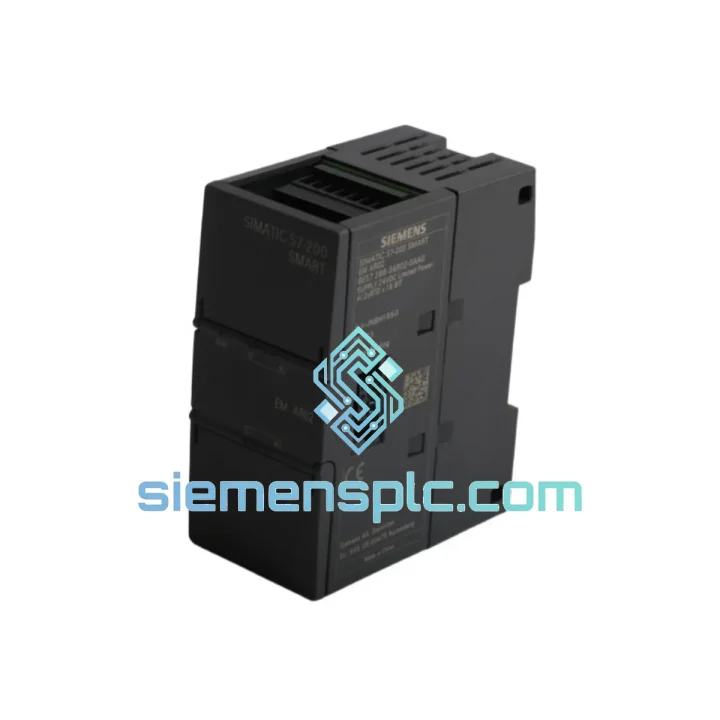
Request verified availability, condition, replacement risk review, packing options and courier lead time for 6ES7288-3AR02-0AA0.
Click Request Quote and the part number is inserted into the inquiry form automatically.
Core fields for model confirmation and RFQ routing. Detailed product narrative remains below.
The Siemens 6ES7288-3AR02-0AA0 is a two-channel RTD analog input expansion module purpose-built for the S7-200 SMART compact PLC platform. Its functional position within a control architecture is unambiguous: it sits at the boundary between the physical process and the CPU’s data processing layer, converting the resistance output of temperature sensors into calibrated 15-bit digital integers that the CPU maps directly into the process image input (PII) table. This dedicated signal path — from resistive element to register — avoids the multiplexed signal conditioning overhead present in general-purpose mixed-signal modules, resulting in a tighter, more deterministic measurement chain.
Two independent input channels each accept PT100, PT1000, Ni100, Ni1000, Cu50, and Cu100 sensor types. The measurement span extends from −200 °C to +850 °C for PT100 sensors, with a native resolution of 0.1 °C per digit. This granularity is operationally significant in processes where thermal deviation of ±0.5 °C triggers a batch rejection or a safety interlock — pharmaceutical lyophilization, food sterilization validation, precision heat treatment, and HVAC zone balancing all fall within this tolerance class. The module draws 24 V DC from the S7-200 SMART system bus at a maximum of 40 mA, contributing less than 1 W to the expansion bus power budget and leaving headroom for additional modules in multi-slot configurations.
Mounting follows the standard S7-200 SMART expansion rail geometry. No additional DIN rail adapters, terminal block converters, or inter-module wiring harnesses are required. The module connects directly to the CPU or preceding expansion module via the integrated side-bus connector, and the STEP 7-Micro/WIN SMART software wizard handles all channel configuration — sensor type selection, wire mode, and diagnostic enable — without hardware jumpers.
Real-time Stock & RFQ: [email protected] | WhatsApp: +86 18359268345
| Parameter | Specification |
|---|---|
| Part Number | 6ES7288-3AR02-0AA0 |
| Product Series | S7-200 SMART Expansion Modules |
| Module Function | RTD Analog Input |
| Input Channels | 2 (galvanically isolated per channel) |
| Supported RTD Types | PT100, PT1000, Ni100, Ni1000, Cu50, Cu100 |
| Temperature Range (PT100) | −200 °C to +850 °C |
| Resolution | 0.1 °C / digit (15-bit effective) |
| ADC Architecture | Sigma-delta with digital decimation filter |
| Conversion Cycle (both channels) | ≤ 405 ms |
| Excitation Current | Constant-current source, ~1 mA (PT100) |
| Wiring Modes | 2-wire, 3-wire, 4-wire RTD |
| Isolation Voltage (field-to-logic) | 500 V AC rated working voltage |
| Supply Voltage | 24 V DC via S7-200 SMART system bus |
| Current Consumption | Max. 40 mA at 24 V DC |
| Diagnostic Functions | Wire-break detection, overflow/underflow flags, out-of-range alarm |
| Operating Temperature | 0 °C to +55 °C |
| Storage Temperature | −40 °C to +70 °C |
| Relative Humidity | 5% to 95%, non-condensing |
| Protection Rating | IP20 |
| EMC Compliance | IEC 61000-4-4 (2 kV EFT/Burst), IEC 61000-4-5 (1 kV Surge) |
| Dimensions (W × H × D) | 45 mm × 100 mm × 81 mm |
| Weight | Approx. 150 g |
| Certifications | CE, UL, cULus, RoHS |
| Warranty | 12 months from shipment date |
The signal acquisition chain in the 6ES7288-3AR02-0AA0 begins with a precision constant-current excitation source applied across the RTD element. The excitation current magnitude — held stable across the module’s full 0 °C to 55 °C ambient operating range — is critical because any drift in excitation current directly translates into a proportional error in the measured resistance value. For a PT100 sensor at 0 °C (100 Ω nominal), a 1% excitation current error produces a 1 Ω resistance error, which maps to approximately 2.6 °C of temperature error. The module’s internal current reference circuit suppresses this drift to well below the 0.05%/10 K gain temperature coefficient specified in the datasheet.
The resistance measurement is performed using a sigma-delta ADC topology. The converter oversamples the differential voltage across the RTD at a rate far exceeding the Nyquist criterion for the target bandwidth, then applies a multi-stage digital decimation filter to extract the final output word. This architecture provides two structural advantages over successive-approximation (SAR) ADCs in this application: first, the oversampling process averages out broadband thermal noise from the front-end amplifier, achieving effective resolution of 15 bits without requiring an ultra-low-noise analog front end; second, the digital filter’s frequency response can be shaped to provide high attenuation at 50 Hz and 60 Hz simultaneously, suppressing power-line interference that would otherwise appear as a 0.1 °C to 0.5 °C ripple on the temperature reading in industrial environments with heavy motor loads.
Galvanic isolation between each field input channel and the module’s internal logic bus is implemented via optical coupling. The isolation barrier is rated at 500 V AC working voltage, which addresses the ground potential difference problem common in large industrial installations: when a PT100 sensor is mounted on a motor frame or a process vessel that is grounded at a different point than the control cabinet, the potential difference between the two ground references can reach 20 V to 50 V. Without isolation, this common-mode voltage would saturate the differential amplifier input and produce a reading error or permanent damage. The optical isolation stage rejects this common-mode voltage entirely, allowing the module to measure the small differential resistance signal accurately regardless of the field-side ground reference.
Wire-break detection operates by monitoring the terminal voltage during the excitation phase against a defined upper threshold. When the RTD circuit is open, the excitation current drives the terminal voltage to the supply rail, which the monitoring circuit detects as an overflow condition. The corresponding channel’s status bit is set in the module’s diagnostic register within the same conversion cycle, and if the CPU’s hardware interrupt configuration has the diagnostic interrupt enabled, the OB82 organization block is called within one CPU scan cycle — typically 1 ms to 10 ms depending on program size. This response latency is orders of magnitude faster than polling-based fault detection schemes.
The PCB layout routes analog signal traces on inner copper layers, sandwiched between ground planes on the outer layers. This stripline geometry reduces the effective loop area of the analog signal path, which directly reduces susceptibility to magnetically coupled interference from adjacent switching power supplies and relay coils. The module passes IEC 61000-4-4 at 2 kV (electrical fast transient/burst) and IEC 61000-4-5 at 1 kV line-to-earth (surge), confirming that the EMC design is validated for installation in cabinets containing variable-frequency drives, soft starters, and high-current contactors without supplementary surge suppression on the sensor wiring.
All 6ES7288-3AR02-0AA0 units dispatched from siemensplc.com are genuine Siemens factory-manufactured product. Each unit retains its original Siemens production label bearing a traceable date code and manufacturing batch number. These identifiers can be verified against Siemens’ product authenticity resources. No units in our inventory are remanufactured, relabeled, or assembled from non-OEM components.
Before dispatch from our Xiamen warehouse, each module passes a four-stage pre-shipment inspection: (1) housing and connector integrity check — all terminal blocks, side-bus connectors, and LED windows are inspected for mechanical damage; (2) label and date-code authentication — the production label is cross-checked against the purchase documentation; (3) functional power-on verification — the module is energized and LED status indicators are confirmed to respond correctly to the initialization sequence; (4) packaging audit — ESD-protective inner wrap continuity and outer carton structural integrity are verified before sealing.
Xiamen’s logistics infrastructure supports same-day dispatch for orders confirmed before 14:00 CST. Xiamen Gaoqi International Airport provides direct access to DHL Express, FedEx International Priority, and UPS Worldwide Expedited networks. Indicative transit times: Southeast Asia 3–5 business days; Europe and Middle East 5–7 business days; North America 5–8 business days. Each shipment includes a commercial invoice, packing list, and certificate of origin. Tracking numbers are issued within 24 hours of dispatch. The 12-month warranty covers manufacturing defects under conditions consistent with Siemens’ published electrical and environmental specifications, with a 2-business-day target response time for warranty claim processing.
Email: [email protected]
WhatsApp: +86 18359268345
Web: siemensplc.com
Location: Xiamen, China
© 2026 siemensplc.com. All rights reserved.
We check the full part number, brand, series and visible nameplate information before quotation.
Sales confirms stock path, condition option, quantity and realistic lead time for export dispatch.
DHL, FedEx, UPS or buyer courier arrangements can be reviewed with packing requirements.
Similar brand or category products for fast comparison and multi-item RFQ lists.