Siemens
RFQ Ready
Siemens A5E03378158 Communication Processor – SIMATIC S7-300 CP 343-1
SIMATIC S7-300
Origin DE
Communication Processor
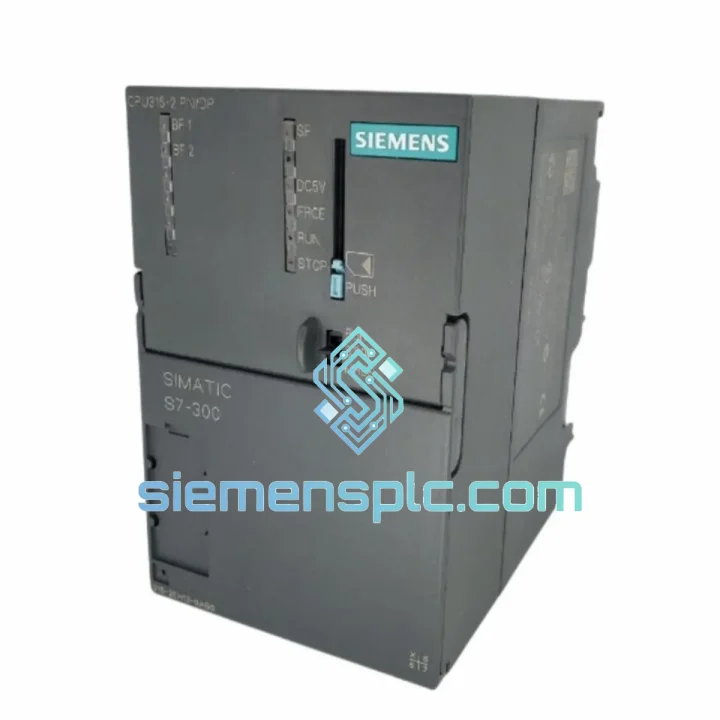
Request verified availability, condition, replacement risk review, packing options and courier lead time for 6ES7315-2EH13-0AB0.
Click Request Quote and the part number is inserted into the inquiry form automatically.
Core fields for model confirmation and RFQ routing. Detailed product narrative remains below.
Your S7-300 rack is dark. The CPU 315-2 DP is dead, the line is stopped, and the clock is running. You don’t need a sales pitch — you need the part on a plane today. We stock the Siemens 6ES7315-2EH13-0AB0 in Xiamen and ship DHL/FedEx same day on confirmed orders. This page exists for one reason: get your system back online before the next shift.
URGENT REQUIREMENT? Contact: [email protected] | WhatsApp: +86 18359268345
| Parameter | Value | Status |
|---|---|---|
| Order Number | 6ES7315-2EH13-0AB0 | ✅ Ready to Ship |
| Series | SIMATIC S7-300 | |
| CPU Designation | CPU 315-2 DP | |
| Work Memory | 256 KB | |
| Processing Speed | 0.05 µs / binary instruction | |
| PROFIBUS DP Interfaces | 2× (1× MPI/DP + 1× DP master/slave) | |
| Digital I/O Address Space | 16,384 bits IN / 16,384 bits OUT | |
| Analog I/O Channels | 1,024 IN / 1,024 OUT | |
| Timers / Counters | 256 / 256 | |
| Supply Voltage | 24 V DC (backplane bus) | |
| Operating Temperature | 0 °C to +60 °C | |
| Firmware Version | V3.3 | |
| Dimensions (W×H×D) | 80 × 125 × 130 mm | |
| Weight | 514 g | |
| Protection Rating | IP20 | |
| Origin | Germany | |
| Stock Location | Xiamen, China | ✅ Ready to Ship |
Ten years of field calls on S7-300 systems. Here’s what actually matters when you’re swapping a 315-2EH13 under pressure:
1. Back up the project before you touch anything. If the old CPU still powers on — even with a fault — upload the program via STEP 7 or TIA Portal immediately. The MMC (Micro Memory Card) retains the program, but don’t assume it’s current. Confirm the upload matches your last known-good version.
2. MMC is not optional — it’s the CPU’s brain. The 6ES7315-2EH13-0AB0 requires a Micro Memory Card (e.g., 6ES7953-8LG31-0AA0) to retain the program after power loss. If you’re installing a bare replacement CPU without transferring the MMC from the failed unit, the CPU will boot to STOP mode with no program. Slot the MMC from the old CPU into the new one before powering up.
3. MPI address and PROFIBUS DP node address. The CPU’s MPI address defaults to 2 on a fresh unit. If your network uses a non-default address, set it via STEP 7 → PLC → Set MPI Address before going online. The DP master address is configured in hardware config — it does not survive a CPU swap unless the MMC carries the full hardware configuration.
4. Firmware version matching. The 315-2EH13 runs firmware V3.3. If your project was compiled against an older firmware revision, you may see a hardware mismatch warning in STEP 7. In most cases this is non-blocking — accept the warning and download. If the project uses features specific to an older firmware, test in STOP mode before switching to RUN.
5. Common fault codes on this CPU:
6. Rack slot position. The CPU always occupies slot 2 in an S7-300 rack. The power supply is slot 1. This is fixed — there is no configuration option. If you’re rebuilding a rack from scratch, confirm the IM (interface module) is in slot 3 if you’re using expansion racks.
7. Cold restart vs. warm restart. After replacing the CPU, perform a cold restart (MRES → RUN sequence) to ensure the CPU initializes all data blocks from their initial values. A warm restart retains retentive data — useful in some applications, but after a hardware swap, a clean cold start is safer.
The 315-2EH13 was engineered for environments that would kill consumer-grade electronics. Siemens designed the S7-300 CPU series to operate continuously in conditions that are routine in heavy industry: ambient temperatures up to 60 °C without forced cooling, humidity up to 95% non-condensing, and mechanical vibration per IEC 60068-2-6 (10–58 Hz, 0.075 mm amplitude; 58–500 Hz, 1g). The conformal coating on the PCB provides a barrier against airborne contaminants — oil mist, metallic dust, and chemical vapors that are standard in machining, chemical processing, and foundry environments.
Every unit we ship has been stored in climate-controlled conditions and inspected for corrosion on the backplane connector pins — the single most common failure point on modules that have been warehoused improperly. We do not ship units with oxidized or bent pins. If a unit doesn’t pass visual and functional inspection, it doesn’t leave our facility.
The CPU’s internal watchdog and self-diagnostic routines run continuously during operation. If the unit detects an internal fault — memory parity error, clock failure, or power rail deviation — it transitions to STOP and logs the event in the diagnostic buffer with a timestamp. This deterministic fault behavior is what makes the S7-300 platform trusted in safety-adjacent applications: it fails loudly and traceably, not silently.
Stock is held in Xiamen, Fujian Province — one of China’s primary export hubs with direct access to DHL, FedEx, and UPS international gateways. Here’s the actual flow from your order to your dock:
We’ve shipped to Germany, the Netherlands, the United States, Mexico, India, Thailand, Saudi Arabia, and South Africa in the past 90 days. If your country isn’t on that list, it doesn’t mean we can’t ship there — it means we haven’t been asked yet.
Email: [email protected]
WhatsApp: +86 18359268345
Web: siemensplc.com
© 2026 siemensplc.com. All rights reserved.
We check the full part number, brand, series and visible nameplate information before quotation.
Sales confirms stock path, condition option, quantity and realistic lead time for export dispatch.
DHL, FedEx, UPS or buyer courier arrangements can be reviewed with packing requirements.
Similar brand or category products for fast comparison and multi-item RFQ lists.