Siemens
RFQ Ready
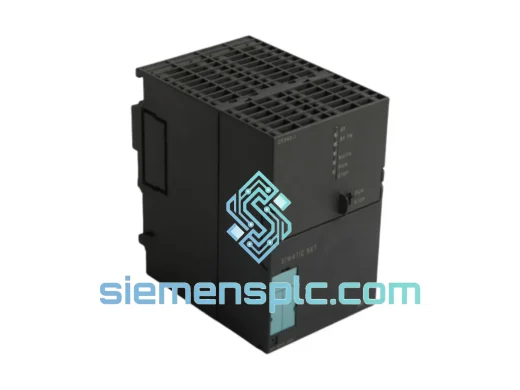
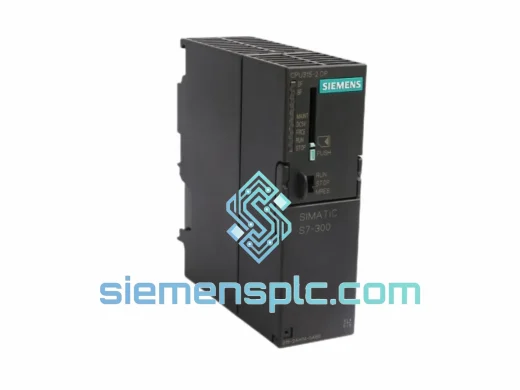
Siemens 6ES7 315-2EH14-0AB0 CPU 315-2 PN/DP PLC Module
SIMATIC S7-300
Origin DE
PLC CPU Module
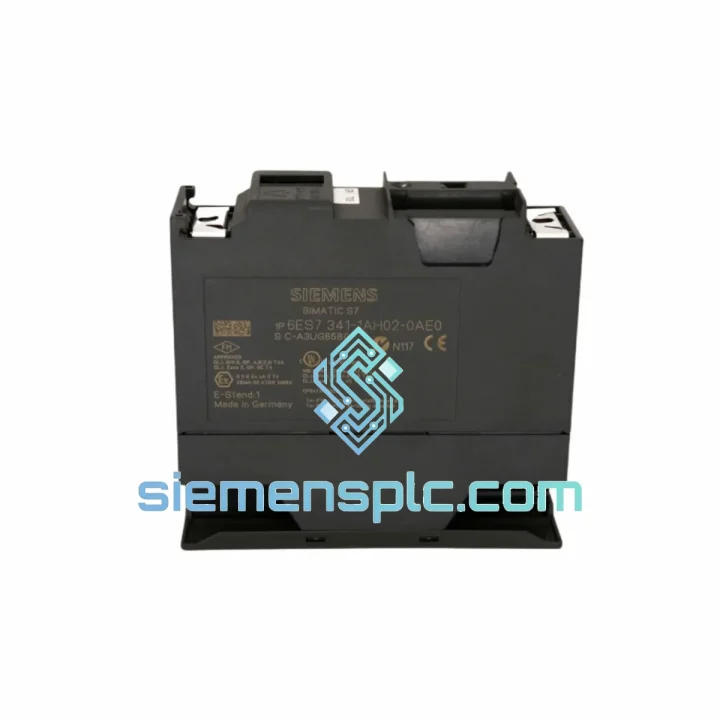
Request verified availability, condition, replacement risk review, packing options and courier lead time for 6ES7341-1AH02-0AE0.
Click Request Quote and the part number is inserted into the inquiry form automatically.
Core fields for model confirmation and RFQ routing. Detailed product narrative remains below.
The 6ES7341-1AH02-0AE0 is a CP 341 Communications Processor designed for the Siemens SIMATIC S7-300 modular PLC platform. Its primary function is to offload serial point-to-point communication tasks from the CPU, establishing a dedicated data path between the S7-300 backplane and external field devices operating on RS-232C, RS-422, or RS-485 physical layers. By handling protocol framing, baud rate negotiation, and character-level timing independently, the CP 341 eliminates the CPU scan-cycle jitter that would otherwise compromise deterministic serial data exchange in time-sensitive process loops.
In a typical S7-300 control cabinet, the CP 341 occupies one slot on the standard DIN-rail mounting rail and draws its operating power entirely from the 5 VDC backplane bus — no auxiliary 24 VDC feed is required. Communication with the CPU occurs via the internal S7-300 backplane bus using the SFC/SFB function block interface (FC 5 / FC 6 / FC 15 / FC 16), which allows the application program to initiate send and receive jobs asynchronously without blocking the OB1 cycle. This architecture is particularly significant in installations where the CPU must simultaneously manage fast analog PID loops, high-speed counter inputs, and serial device polling — tasks that would conflict if handled sequentially in a single-threaded scan.
The module’s loadable driver concept is a defining hardware-software co-design feature. The physical ASIC on the CP 341 provides the UART engine and line driver circuitry, while the protocol logic — ASCII framing, 3964(R) block transfer, RK 512 master/slave, USS drive parameter access, and Modbus RTU/ASCII — is loaded into the module’s onboard RAM via STEP 7 or TIA Portal during commissioning. This means a single hardware SKU can serve as a Modbus RTU master polling a VFD network one day and be reconfigured as a USS master communicating with a Sinamics drive the next, without any physical modification to the panel.
Real-time Stock & RFQ: [email protected] | WhatsApp: +86 18359268345
| Parameter | Value |
|---|---|
| Order Number | 6ES7341-1AH02-0AE0 |
| Product Family | SIMATIC S7-300 |
| Module Class | CP 341 Communications Processor |
| Physical Interfaces | RS-232C (X1), RS-422 / RS-485 (X1) — selectable via front connector |
| Supported Protocols | ASCII, 3964(R), RK 512, USS, Modbus RTU, Modbus ASCII |
| Max. Transmission Rate | 76.8 kbps |
| Data Bits | 7 or 8 |
| Parity | None / Even / Odd |
| Stop Bits | 1 or 2 |
| Supply Voltage | 5 VDC via S7-300 backplane bus |
| Current Consumption (5 VDC) | ≤ 160 mA |
| Power Dissipation | ≤ 0.8 W |
| Operating Temperature | 0 °C to +60 °C (horizontal installation) |
| Storage Temperature | −40 °C to +70 °C |
| Relative Humidity | 10 % to 95 %, non-condensing |
| Degree of Protection | IP 20 |
| Dimensions (W × H × D) | 40 × 125 × 120 mm |
| Weight | Approx. 300 g |
| Mounting | S7-300 DIN rail (35 mm), any slot position |
| Configuration Software | STEP 7 V5.5 SP4+, TIA Portal V13+ |
| Certifications | CE, UL, RoHS, cULus |
| Warranty | 12 months from date of shipment |
The CP 341’s internal architecture separates the communication task into three discrete hardware layers, each with a defined responsibility boundary.
UART Engine and Line Driver Stage: The onboard UART ASIC handles all character-level timing — start bit detection, data bit sampling at 16× oversampling, parity generation and checking, and stop bit insertion. At 76.8 kbps on RS-485, the bit period is approximately 13 µs; the 16× oversampling clock runs at ~1.23 MHz, providing a sampling resolution of ±3.9 % of the bit period. This tolerance is well within the ±5 % margin specified by the RS-485 standard (TIA-485-A), ensuring reliable framing even on cable runs with moderate impedance mismatch. The RS-485 driver stage includes integrated bus termination resistor switching and fail-safe biasing resistors, which hold the bus in a defined idle state (logic 1) when no driver is active — a critical requirement in multi-drop networks where the master may release the bus between polling cycles.
EMC Design and Galvanic Isolation: The CP 341 implements optical isolation between the backplane logic domain (5 VDC, referenced to S7-300 chassis ground) and the serial port signal domain. This galvanic barrier, rated to withstand transient voltages per IEC 61000-4-5 (surge immunity, 1 kV line-to-line), prevents ground loop currents from coupling noise into the backplane bus. In industrial environments where field devices such as VFDs generate common-mode noise in the range of 50–500 V at switching frequencies of 2–16 kHz, this isolation barrier is the primary defense against data corruption and hardware damage. The module also incorporates transient voltage suppression (TVS) diodes on the serial port lines, clamping ESD events to safe levels per IEC 61000-4-2 (contact discharge, 4 kV).
Onboard RAM and Loadable Driver Architecture: Protocol logic resides in a dedicated RAM segment on the CP 341’s local processor, separate from the UART engine. The Siemens loadable driver mechanism transfers a compiled protocol object from the STEP 7 project into this RAM during the download sequence. The local processor executes the protocol state machine — managing frame assembly, timeout supervision, retry logic, and error flagging — entirely autonomously. The S7-300 CPU interacts with the CP 341 only at the job level: issuing a SEND or RECEIVE request via SFB 60/61 and reading the completion status. This decoupled execution model means that a Modbus RTU polling cycle with a 500 ms inter-poll gap does not consume any CPU scan time during the wait period.
Backplane Bus Interface: The CP 341 connects to the S7-300 backplane via the K-bus (communication bus), which operates at a fixed 12 Mbps transfer rate. Data exchange between the CPU and CP 341 uses a shared memory model: the CPU writes job parameters to a defined address range in the CP’s dual-port RAM, sets a handshake flag, and the CP’s local processor reads the job, executes it, and sets a completion flag. This mechanism adds a worst-case latency of one CPU scan cycle (typically 1–10 ms depending on program size) between job issuance and CP execution start — a deterministic and predictable delay that can be accounted for in application timing analysis.
Every 6ES7341-1AH02-0AE0 unit supplied by siemensplc.com is sourced as genuine Siemens factory production. Each module carries the original Siemens AG product label with order number, firmware version identifier, and factory serial number traceable through Siemens Industry Online Support (SIOS). Units are stored in ESD-safe packaging in our Xiamen, China warehouse under controlled temperature and humidity conditions consistent with Siemens storage specifications (−40 °C to +70 °C, 10–95 % RH non-condensing).
Prior to dispatch, each unit undergoes a physical inspection covering label integrity, connector condition, housing for mechanical damage, and firmware sticker verification against the known production revision matrix for the 6ES7341-1AH02-0AE0 order number. A 12-month warranty against manufacturing defects and dead-on-arrival (DOA) conditions is provided from the date of shipment.
Logistics from Xiamen are handled via DHL Express, FedEx International Priority, and UPS Worldwide for time-critical shipments, with EMS and consolidated sea freight available for bulk project orders. In-stock units are dispatched within 1–3 business days of payment confirmation. Export documentation — commercial invoice, packing list, and certificate of origin — is prepared for all international shipments. HS Code 8537.10 applies to this product category for customs classification purposes. We serve customers across Asia-Pacific, Europe, the Middle East, North America, South America, and Africa, with established export compliance procedures for each region.
Email: [email protected]
WhatsApp: +86 18359268345
Web: siemensplc.com
Location: Xiamen, China
© 2026 siemensplc.com. All rights reserved.
We check the full part number, brand, series and visible nameplate information before quotation.
Sales confirms stock path, condition option, quantity and realistic lead time for export dispatch.
DHL, FedEx, UPS or buyer courier arrangements can be reviewed with packing requirements.
Similar brand or category products for fast comparison and multi-item RFQ lists.