Siemens
RFQ Ready
Siemens 6ES7321-1BL00-0AA0 Digital Input Module
SIMATIC
Origin DE
PLC Digital Input Module
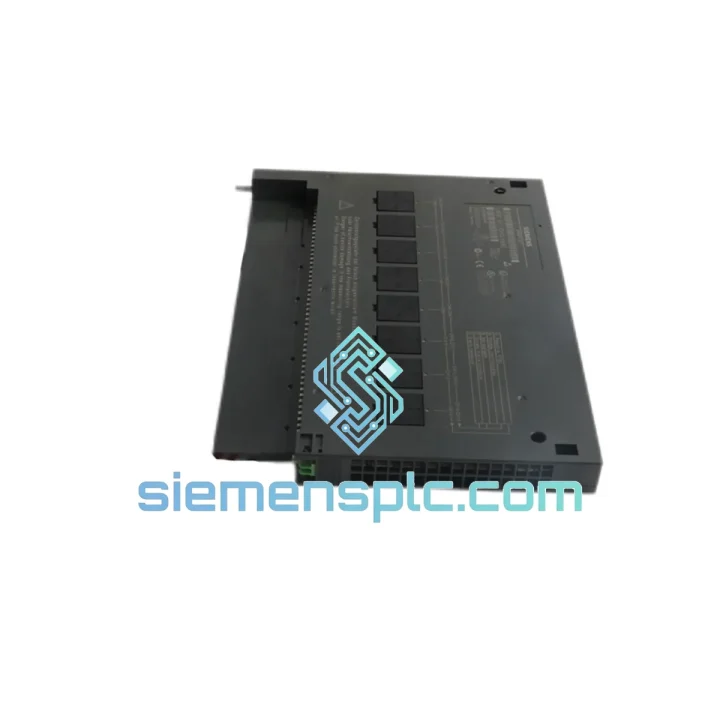
Request verified availability, condition, replacement risk review, packing options and courier lead time for 6ES7431-7QH00-0AB0.
Click Request Quote and the part number is inserted into the inquiry form automatically.
Core fields for model confirmation and RFQ routing. Detailed product narrative remains below.
The 6ES7431-7QH00-0AB0 is a 16-channel analog input module belonging to the SM 431 family within the Siemens SIMATIC S7-400 platform. Its primary function in a control loop is signal acquisition: it converts continuous physical process variables — temperature transmitter outputs, pressure transducers, flow meters, and position sensors — from analog electrical signals into 14-bit digital words that the S7-400 CPU processes each scan cycle for closed-loop PID control, alarm threshold evaluation, and process historian logging. The module occupies a single slot in any standard S7-400 rack (UR1, UR2, UR2-H, CR2, CR3), making it the highest-density analog input option in the SM 431 series without requiring an expansion rack.
In distributed control architectures, the 6ES7431-7QH00-0AB0 is positioned at the field signal boundary — the point where instrumentation wiring terminates and deterministic digital processing begins. Its 16-ms full-scan cycle (all 16 channels at 50 Hz interference suppression) is consistent with the update rate requirements of most process control loops, including temperature PID and flow ratio control. For applications requiring sub-millisecond per-channel throughput, the SM 431 high-speed variants should be evaluated instead.
📩 Real-time Stock & RFQ: [email protected] | WhatsApp: +86 18359268345
| Parameter | Value |
|---|---|
| Part Number | 6ES7431-7QH00-0AB0 |
| Module Family | SM 431 Analog Input |
| Platform | SIMATIC S7-400 |
| Number of Analog Inputs | 16 channels |
| Input Ranges — Voltage | ±10 V, ±5 V, ±2.5 V, 1–5 V, 0–10 V |
| Input Ranges — Current | ±20 mA, 0–20 mA, 4–20 mA |
| Resolution | 13 bits + sign (14-bit data word) |
| Conversion Time per Channel | 1 ms (50 Hz suppression mode) |
| Full Cycle Time (16 ch) | 16 ms |
| Input Impedance — Voltage | ≥ 100 kΩ |
| Input Impedance — Current | 50 Ω |
| Max Continuous Input Voltage | ±15 V |
| Max Continuous Input Current | ±40 mA |
| Backplane Supply | 5 VDC via S7-400 P-bus |
| Load Voltage (L+) | 24 VDC (20.4–28.8 V) |
| Current Draw from L+ | Typ. 100 mA |
| Power Dissipation | Typ. 3.5 W |
| Form Factor | S7-400 single-width, 1 slot |
| Dimensions (W × H × D) | 25 mm × 290 mm × 210 mm |
| Weight | Approx. 500 g |
| Front Connector | 48-pin (6ES7492-1AL00-0AA0, ordered separately) |
| Compatible Racks | UR1, UR2, UR2-H, CR2, CR3 |
| Operating Temperature | 0 °C to +60 °C |
| Storage Temperature | −40 °C to +70 °C |
| Relative Humidity | 10%–95%, non-condensing |
| Degree of Protection | IP20 |
| EMC Immunity Standard | EN 61000-6-2 (industrial) |
| Certifications | CE, UL 508, cULus, RCM |
| Warranty | 12 months from date of dispatch |
The 6ES7431-7QH00-0AB0 implements a shared-multiplexer, single-ADC architecture. All 16 input channels feed into a common analog multiplexer, which sequentially routes each channel’s signal to a single successive-approximation ADC. This design concentrates conversion accuracy in one calibrated ADC rather than distributing it across 16 independent converters, which would introduce inter-channel gain and offset variation. The trade-off is sequential rather than simultaneous sampling — a characteristic that must be accounted for in applications where phase relationships between channels are analytically significant (e.g., power factor measurement). For standard process control — temperature, pressure, flow — the 1 ms per-channel sequencing introduces no meaningful phase error.
EMC Design: The module’s input stage incorporates RC low-pass filtering on each channel input, attenuating high-frequency conducted interference before the multiplexer. The selectable 50 Hz / 60 Hz digital notch filter at the ADC stage suppresses power-line frequency interference, which is the dominant noise source in industrial panel environments where signal cables run parallel to power conductors. This dual-stage filtering (analog RC + digital notch) provides effective common-mode rejection without requiring shielded cable for most 4–20 mA loop installations.
Backplane Interface: Converted digital values are written to the module’s local dual-port RAM and transferred to the S7-400 CPU’s process image input area (PAE) via the P-bus (peripheral bus) during each scan cycle’s input update phase. The P-bus operates at a fixed transfer rate independent of the number of modules installed, ensuring deterministic data availability to the CPU regardless of rack population. The module does not participate in the S7-400 K-bus (coordination bus) — it is a standard signal module, not a communication processor.
Diagnostic Architecture: Each channel independently monitors its input signal for wire-break conditions (applicable to current inputs with 4 mA live-zero), overflow (signal exceeds upper range limit), and underflow (signal falls below lower range limit). Fault conditions are written to the module’s diagnostic data record and, if diagnostic interrupts are enabled in STEP 7 hardware configuration, generate an OB82 interrupt to the CPU. This allows the application program to respond to individual channel faults without polling all 16 channels each scan — reducing CPU load in fault-handling routines.
Isolation Topology: The 6ES7431-7QH00-0AB0 provides group isolation between the field-side signal inputs and the backplane electronics, not per-channel galvanic isolation. All 16 channels share a common reference potential on the field side. This is adequate for installations where all transmitters share a common ground reference (e.g., a single control panel with a unified instrument earth). For installations where transmitters are located at different ground potentials — common in large plants with distributed earthing — external signal isolators or the per-channel isolated SM 431 variant (6ES7431-7KF00-0AB0) should be specified to prevent ground loop currents from corrupting measurement accuracy.
Every 6ES7431-7QH00-0AB0 unit offered through siemensplc.com is sourced from verified supply channels and subjected to a structured incoming inspection before dispatch. Siemens original packaging, label authenticity (part number, firmware revision, date code, hologram), and physical condition are verified on receipt. Each unit undergoes a functional power-on test in an S7-400 test rack: module identification, firmware version readback, and absence of hardware fault codes are confirmed via STEP 7 before the unit is cleared for sale. Representative channel inputs are stimulated with a calibrated 4–20 mA source and digital output values verified within ±0.5% of the expected conversion result.
All units are dispatched from Xiamen, China — a major international logistics hub with direct air freight connections to Europe, North America, Southeast Asia, and the Middle East. Standard international shipment transit times are 3–7 business days via DHL Express or FedEx International Priority. Export documentation — commercial invoice, packing list, and certificate of origin — is prepared for all international orders. Units are packed in anti-static ESD bags with foam cushioning inside double-wall cartons rated for air freight handling. A 12-month warranty covers manufacturing defects and functional failures under normal operating conditions from the date of dispatch.
📧 Email: [email protected]
📱 WhatsApp: +86 18359268345
🌐 Web: siemensplc.com
📍 Location: Xiamen, China
© 2026 siemensplc.com. All rights reserved.
We check the full part number, brand, series and visible nameplate information before quotation.
Sales confirms stock path, condition option, quantity and realistic lead time for export dispatch.
DHL, FedEx, UPS or buyer courier arrangements can be reviewed with packing requirements.
Similar brand or category products for fast comparison and multi-item RFQ lists.