Siemens
RFQ Ready
Siemens A5E03378158 Communication Processor – SIMATIC S7-300 CP 343-1
SIMATIC S7-300
Origin DE
Communication Processor
Request verified availability, condition, replacement risk review, packing options and courier lead time for 6ES7951-0KG00-0AA0.
Click Request Quote and the part number is inserted into the inquiry form automatically.
Core fields for model confirmation and RFQ routing. Detailed product narrative remains below.
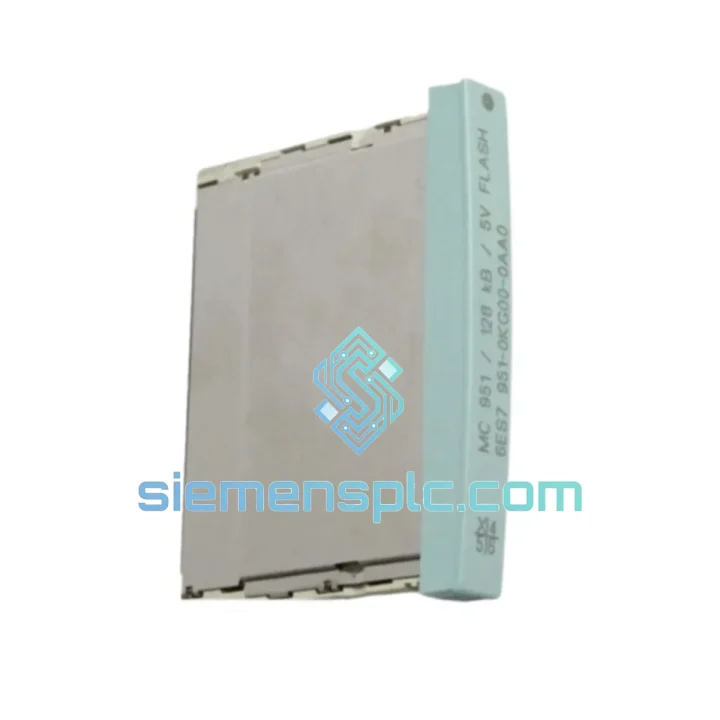
The 6ES7951-0KG00-0AA0 is a 64 KB Micro Memory Card (MMC) manufactured by Siemens AG for exclusive use within the SIMATIC S7-300 programmable logic controller platform. Its primary function within a control loop is deterministic, battery-free program persistence: the CPU copies its user program, data blocks, and system parameters from the MMC into internal work RAM at every cold restart, ensuring that the controller resumes its last-known operational state without manual intervention or external backup media. In process-critical environments — continuous chemical dosing, conveyor sequencing, or multi-axis coordinated motion — this behavior eliminates the single-point failure mode introduced by battery-backed SRAM, which degrades over a 3–5 year service cycle and requires scheduled replacement.
At the architectural level, the MMC interfaces with the S7-300 CPU through a proprietary low-voltage serial bus embedded in the CPU’s front-panel card slot. The bus operates at 3.3 V logic levels and uses a synchronous read/write protocol managed by the CPU’s internal memory controller. Write cycles are initiated only during program download or firmware update operations; during normal PLC scan execution, the MMC is read-only, which eliminates write-wear as a reliability concern in steady-state production. The 64 KB capacity of the 6ES7951-0KG00-0AA0 accommodates user programs up to approximately 48 KB of compiled STL/LAD/FBD code, with the remaining address space reserved for data block storage and system diagnostics headers.
Real-time Stock & RFQ: [email protected] | WhatsApp: +86 18359268345
| Parameter | Value |
|---|---|
| Order Number (MLFB) | 6ES7951-0KG00-0AA0 |
| Product Family | SIMATIC S7-300 Micro Memory Card (MMC) |
| Memory Capacity | 64 KB |
| Card Form Factor | Siemens proprietary MMC (non-standard SD) |
| Interface Voltage | 3.3 V (CPU-managed serial bus) |
| Data Retention | Non-volatile Flash; no battery required |
| Write Endurance | ≥ 100,000 program download cycles (typical) |
| Storage Content | User program, OBs/FBs/FCs/DBs, firmware images |
| Operating Temperature | 0 °C to +60 °C |
| Storage Temperature | −20 °C to +70 °C |
| Humidity (operating) | 10 % to 95 % RH, non-condensing |
| Dimensions (L × W × H) | Approx. 32 mm × 20 mm × 1.4 mm |
| Weight | Approx. 10 g |
| Compliance Standards | IEC/EN 61131-2, CE, UL, cULus |
| Compatible CPU Series | SIMATIC S7-300 (MMC-slot CPUs) |
| Programming Software | STEP 7 V5.x (SIMATIC Manager), TIA Portal V13+ |
| Manufacturer | Siemens AG, Germany |
| Warranty | 12 months from date of shipment |
The 6ES7951-0KG00-0AA0 employs NOR Flash memory architecture rather than the NAND Flash used in consumer SD cards. NOR Flash provides byte-addressable random reads with access latencies in the sub-microsecond range, which is essential for the CPU’s memory controller to execute a full program load into work RAM within the cold-restart timing window defined by the S7-300 watchdog. NAND Flash, by contrast, requires page-level reads and introduces variable latency that would be incompatible with the deterministic startup sequencing of the S7-300 platform.
From an EMC standpoint, the MMC card slot on S7-300 CPUs is shielded by the CPU’s metal front-panel housing, and the card’s internal traces are kept short enough that radiated emissions from the serial bus remain well below the EN 55011 Class A industrial limits. The card itself carries no active components beyond the Flash array and a minimal interface logic cell, which means it contributes negligible conducted noise to the CPU’s internal power rail. This passive architecture also means the card draws no standby current when the CPU is powered down, unlike battery-backed SRAM modules that maintain a continuous trickle drain.
The proprietary card format — physically distinct from standard MMC or SD specifications — is an intentional design constraint by Siemens. It prevents accidental insertion of consumer-grade Flash media, which would lack the industrial temperature rating and write-endurance specification required for 24/7 PLC operation. The card’s gold-plated contact pads are rated for a minimum of 1,000 insertion/extraction cycles, supporting routine program updates and field maintenance without contact degradation.
Firmware update capability is a secondary but operationally significant function. When a CPU firmware image is placed on the MMC and the CPU is cold-started with the card inserted, the bootloader detects the firmware file by its header signature and initiates a self-update sequence before loading the user program. This mechanism allows field engineers to update CPU firmware without a laptop or STEP 7 connection, reducing on-site service time in remote installations.
Every unit of the 6ES7951-0KG00-0AA0 supplied through siemensplc.com is sourced from verified Siemens-authorized distribution channels or authenticated surplus stock with full traceability documentation. Each card undergoes a functional verification procedure prior to shipment: the card is inserted into a compatible S7-300 CPU, a test program is downloaded via STEP 7, and a cold-restart cycle confirms successful program retention and reload. Cards that fail any step of this procedure are quarantined and not shipped.
Packaging is inspected for Siemens holographic authenticity markings and tamper-evident seals before dispatch. Batch records — including lot number, date code, and test results — are retained for a minimum of three years and are available on request for MRO procurement teams and OEM quality audits.
Logistics operations are based in Xiamen, China, a major export hub with direct access to international freight carriers including DHL Express, FedEx International Priority, and UPS Worldwide Expedited. Standard in-stock orders are dispatched within 1–2 business days. Express delivery to most destinations in Southeast Asia, Europe, and North America is achievable within 3–7 business days. All shipments include a commercial invoice, packing list, and certificate of origin. Export compliance is verified against ECCN classifications and applicable dual-use regulations prior to each shipment. Customs documentation is prepared to minimize clearance delays at destination ports.
A 12-month warranty covers all units against manufacturing defects and functional failure under normal operating conditions. Warranty claims are processed with a target response time of 48 hours, and replacement units are dispatched from Xiamen stock upon claim approval.
Email: [email protected]
WhatsApp: +86 18359268345
Web: siemensplc.com
Location: Xiamen, China
© 2026 siemensplc.com. All rights reserved.
We check the full part number, brand, series and visible nameplate information before quotation.
Sales confirms stock path, condition option, quantity and realistic lead time for export dispatch.
DHL, FedEx, UPS or buyer courier arrangements can be reviewed with packing requirements.
Similar brand or category products for fast comparison and multi-item RFQ lists.