Siemens
RFQ Ready
Siemens A5E03378158 Communication Processor – SIMATIC S7-300 CP 343-1
SIMATIC S7-300
Origin DE
Communication Processor
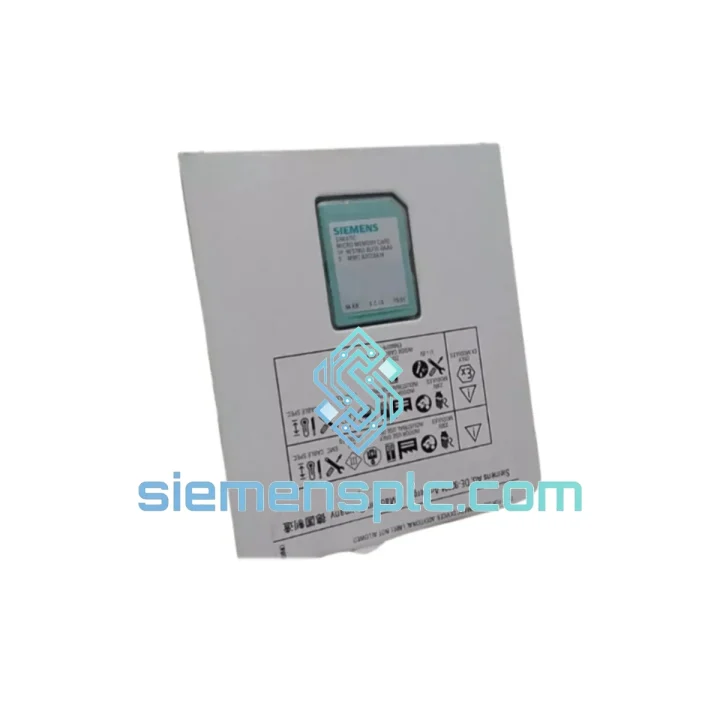
Request verified availability, condition, replacement risk review, packing options and courier lead time for 6ES7953-8LF31-0AA0.
Click Request Quote and the part number is inserted into the inquiry form automatically.
Core fields for model confirmation and RFQ routing. Detailed product narrative remains below.
The Siemens 6ES7953-8LF31-0AA0 is an 8MB Micro Memory Card (MMC) designed as the mandatory load memory medium for the entire SIMATIC S7-300 CPU family and ET 200 distributed I/O CPUs. Unlike volatile RAM-based storage schemes, this card employs a Flash EEPROM cell array that retains all stored data — user program blocks, hardware configuration, and system data — indefinitely without any battery backup. In S7-300 architecture, the MMC is not optional peripheral storage; it is the sole load memory. No MMC means no program persistence across power cycles.
The 8LF31 suffix encodes the 8MB capacity tier — the highest standard capacity in the S7-300 MMC product line, positioned above the 2MB (8LG31) and 4MB (8LJ31) variants. This headroom is critical for installations running large OB/FB/FC hierarchies, extensive DB structures, or source code stored alongside object code in STEP 7 Classic or TIA Portal V13+ projects. Automation engineers specifying new S7-300 panels or executing MRO replacements consistently select the 8MB variant to eliminate future capacity constraints.
Real-time Stock & RFQ: [email protected] | WhatsApp: +86 18359268345
| Part Number (MLFB) | 6ES7953-8LF31-0AA0 |
| Product Series | SIMATIC S7-300 Micro Memory Card |
| Memory Technology | Flash EEPROM (NOR-type, non-volatile) |
| Storage Capacity | 8 MB |
| Form Factor | Proprietary SIMATIC MMC — not SD/CF compatible |
| Compatible Platforms | All SIMATIC S7-300 CPUs (CPU 312 through CPU 319-3 PN/DP); ET 200S / ET 200pro CPUs |
| Battery Backup Required | None — Flash EEPROM retains data at power-off |
| Endurance (Write Cycles) | ≥ 100,000 program download cycles per Siemens specification |
| Data Retention | 10 years at 55 °C ambient |
| Operating Temperature | 0 °C to +60 °C |
| Storage Temperature | −20 °C to +85 °C |
| Relative Humidity | 5 % to 95 % RH, non-condensing |
| Protection Rating | IP20 (card inserted in CPU front slot) |
| Card Dimensions | Approx. 24 × 32 × 2.1 mm |
| Weight | Approx. 2 g |
| RoHS Compliance | Yes — EU Directive 2011/65/EU |
| HS Code | 8523.52 |
| Country of Origin | Germany |
| Warranty | 12 months against manufacturing defects; DOA replacement within 7 days of confirmed receipt |
The 6ES7953-8LF31-0AA0 operates within a well-defined two-tier memory hierarchy inside every S7-300 CPU. At cold start or warm restart, the CPU’s internal boot loader reads the executable object code from the MMC’s Flash array and copies it into the CPU’s internal work memory (SRAM). The SRAM executes the cyclic scan; the MMC is not accessed during normal program execution, which means MMC read latency has zero impact on scan cycle time. This architectural separation is deliberate: it decouples storage endurance from real-time determinism.
The Flash EEPROM array in the 8LF31 uses a NOR-type cell topology. NOR Flash provides byte-addressable random reads — essential for the CPU boot loader to locate and transfer specific block addresses without sequential scanning. Write operations (program downloads from STEP 7 / TIA Portal) are sector-erase-then-write sequences managed by the CPU’s memory management unit, transparent to the programmer. The ≥100,000 write cycle endurance rating applies per sector; given that typical S7-300 installations perform program downloads infrequently (commissioning, maintenance windows), the practical service life of the card far exceeds the rated cycle count.
From an EMC standpoint, the MMC slot on S7-300 CPUs is shielded by the CPU housing’s grounded metal backplane frame. The card itself carries no active circuitry beyond the Flash array and a minimal interface logic layer, which means it generates no switching noise and presents no EMC emission risk. The proprietary card format — physically incompatible with standard SD or CF interfaces — also prevents accidental insertion of non-qualified media that could corrupt the load memory partition.
Retentive data handling is managed at the CPU level, not the MMC level. When retentive M-bits or DB variables are declared in the hardware configuration, the CPU writes these values back to a designated MMC sector on controlled power-down (using the CPU’s internal capacitor-backed power-fail routine). This mechanism ensures that process state variables survive unplanned power interruptions without requiring an external UPS for the memory card itself.
Every 6ES7953-8LF31-0AA0 unit dispatched from siemensplc.com is sourced as genuine Siemens OEM product. Pre-shipment verification covers label authenticity and hologram integrity, functional read/write test against a SIMATIC S7-300 CPU, capacity confirmation at 8MB per MLFB specification, and anti-static packaging with humidity indicator card.
Shipments originate from our warehouse in Xiamen, China. Standard export documentation — commercial invoice, packing list, and certificate of origin — is included with every international order. DHL Express, FedEx International Priority, and UPS Worldwide Expedited are available as carrier options, with typical transit times of 3–7 business days to Europe, North America, Southeast Asia, and the Middle East. For time-critical MRO requirements, same-day dispatch is available for orders confirmed before 14:00 CST. Bulk orders of 10+ units qualify for consolidated freight options with reduced per-unit logistics cost.
A 12-month warranty covers manufacturing defects from the date of confirmed receipt. Dead-on-arrival units are replaced within 7 business days upon return authorization. Certificates of conformity and incoming inspection reports are available on request for MRO procurement teams operating under ISO 9001 or IEC 62443 quality frameworks.
Email: [email protected]
WhatsApp: +86 18359268345
Web: siemensplc.com
Location: Xiamen, China
© 2026 siemensplc.com. All rights reserved.
We check the full part number, brand, series and visible nameplate information before quotation.
Sales confirms stock path, condition option, quantity and realistic lead time for export dispatch.
DHL, FedEx, UPS or buyer courier arrangements can be reviewed with packing requirements.
Similar brand or category products for fast comparison and multi-item RFQ lists.