Siemens
RFQ Ready
Siemens A5E03378158 Communication Processor – SIMATIC S7-300 CP 343-1
SIMATIC S7-300
Origin DE
Communication Processor
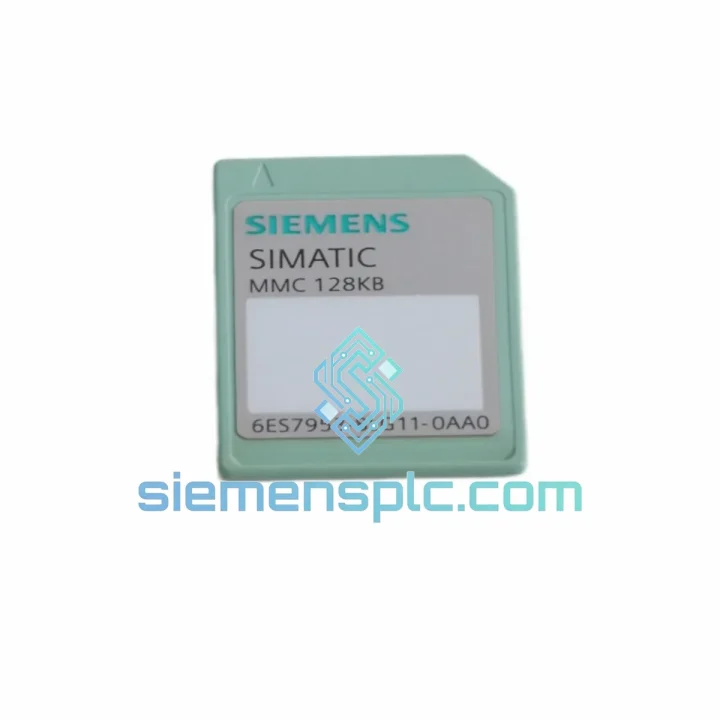
Request verified availability, condition, replacement risk review, packing options and courier lead time for 6ES7953-8LG11-0AA0.
Click Request Quote and the part number is inserted into the inquiry form automatically.
Core fields for model confirmation and RFQ routing. Detailed product narrative remains below.
The Siemens 6ES7953-8LG11-0AA0 is a 128 KB Micro Memory Card (MMC) designed exclusively for the SIMATIC S7-300 programmable logic controller platform. It functions as the sole non-volatile storage medium for S7-300 CPU modules, holding the user program, data blocks, and CPU operating system image in a single compact Flash EEPROM package. Unlike battery-backed SRAM architectures used in earlier Siemens PLC generations, this card retains all stored data indefinitely without any auxiliary power source, eliminating the maintenance overhead and failure risk associated with backup batteries.
Within the S7-300 MMC capacity hierarchy — which spans 64 KB, 128 KB, 512 KB, 2 MB, and 4 MB variants — the 6ES7953-8LG11-0AA0 occupies the 128 KB tier. This capacity accommodates medium-complexity control programs: multi-axis motion sequencing logic, PID loop management with multiple control objects, PROFIBUS DP communication handler blocks, and structured diagnostic routines. The card interfaces directly with the CPU’s internal MMC slot via a dedicated card-edge connector, and program transfer is managed entirely through STEP 7 V5.x or TIA Portal without requiring an external card reader for standard download operations.
The 6ES7953-8LG11-0AA0 is a mandatory component for any S7-300 CPU that does not carry an integrated load memory variant. Without a valid MMC inserted, the CPU will not transition from STOP to RUN state, and no user program can be retained across a power cycle. This architectural dependency makes the MMC a critical spare part for plant maintenance inventories, OEM machine builders, and system integrators managing large S7-300 installed bases.
Real-time Stock & RFQ: [email protected] | WhatsApp: +86 18359268345
| Parameter | Value |
|---|---|
| Order Number | 6ES7953-8LG11-0AA0 |
| Brand / Manufacturer | Siemens AG (SIMATIC) |
| Product Series | S7-300 Micro Memory Card (MMC) |
| Storage Capacity | 128 KB |
| Memory Technology | Flash EEPROM (non-volatile, battery-free) |
| Form Factor | Micro Memory Card — proprietary S7-300 slot interface |
| Data Retention | Permanent without backup power; rated >10 years at 25 °C |
| Write Endurance | Industrial-grade Flash; suitable for repeated commissioning cycles |
| Operating Temperature | Governed by host CPU specifications (typically 0 °C to +60 °C) |
| Storage Temperature | -40 °C to +85 °C |
| Compatible CPU Families | S7-300: CPU 312, 313C, 314, 314C-2 DP/PN, 315-2 DP/PN, 317-2 DP/PN, 319-3 PN/DP |
| Programming Software | STEP 7 V5.x / TIA Portal V13 and above |
| Stored Content Types | User program (OB/FB/FC/DB blocks), CPU OS image, hardware configuration |
| Weight | Approx. 20 g |
| Origin | Germany |
| Warranty | 12 months from date of shipment |
The 6ES7953-8LG11-0AA0 operates within the S7-300 CPU’s load memory architecture. When the CPU powers up, its internal firmware reads the MMC via the card-edge interface and copies the user program into the CPU’s internal work memory (RAM). Execution occurs entirely from work memory; the MMC is not accessed during normal RUN-mode operation, which means card read latency has zero impact on scan cycle time. This separation of load memory (MMC) and work memory (internal RAM) is a deliberate architectural decision by Siemens to maintain deterministic cycle execution regardless of card access speed.
The Flash EEPROM cells used in this card are organized in a block-erase structure. When STEP 7 initiates a program download, the CPU firmware erases the relevant Flash sectors before writing new program blocks. This erase-before-write characteristic means that partial writes during a power interruption mid-download can leave the card in an inconsistent state — a condition the CPU detects at next startup via a checksum validation routine, triggering a STOP state and a diagnostic buffer entry rather than executing corrupted code. This fail-safe behavior is a hardware-enforced protection mechanism, not a software workaround.
From an EMC perspective, the MMC slot on S7-300 CPUs is located within the CPU housing, shielded by the module’s metal backplane rail mounting and the CPU’s own enclosure. The card itself carries no active circuitry beyond the Flash array and interface logic, making it inherently immune to conducted or radiated interference that might affect active electronic modules. The card’s passive architecture also means it generates no electromagnetic emissions, which is relevant in installations subject to EN 61000-6-4 industrial emission standards.
The hardware revision suffix -8LG11 (versus the later -8LG20 revision) indicates a specific OS image compatibility range. The LG11 revision supports CPU operating system versions up to a defined firmware boundary. Plant engineers managing mixed-revision CPU populations should cross-reference the Siemens SIMATIC S7-300 compatibility matrix (available via the Siemens Industry Online Support portal) to confirm OS image compatibility before deploying this card in CPUs running the latest firmware releases.
Every 6ES7953-8LG11-0AA0 unit supplied by siemensplc.com is sourced through verified industrial distribution channels with full traceability to authorized Siemens supply networks. Incoming units undergo physical inspection covering label authenticity, connector condition, and packaging integrity. Anti-counterfeit screening follows Siemens-recommended authentication protocols to identify and reject non-genuine components before they enter our warehouse.
Units are stored in ESD-safe, climate-controlled conditions and dispatched in anti-static packaging with moisture barrier protection. From our logistics hub in Xiamen, China, we ship globally via DHL Express, FedEx International Priority, and UPI, with typical transit times of 3–7 business days to Europe, North America, Southeast Asia, and the Middle East. Full shipment tracking is provided for every order. For time-critical plant shutdowns or emergency maintenance situations, same-day dispatch is available for in-stock units upon order confirmation before 14:00 CST.
All units are covered by a 12-month warranty from the date of shipment. Warranty claims are handled directly by our technical team, with replacement dispatch prioritized to minimize customer downtime. Documentation packages — including certificates of conformity, sourcing declarations, and inspection records — are available upon request for regulated industries and quality-audited procurement processes.
Email: [email protected]
WhatsApp: +86 18359268345
Web: siemensplc.com
Location: Xiamen, China
© 2026 siemensplc.com. All rights reserved.
We check the full part number, brand, series and visible nameplate information before quotation.
Sales confirms stock path, condition option, quantity and realistic lead time for export dispatch.
DHL, FedEx, UPS or buyer courier arrangements can be reviewed with packing requirements.
Similar brand or category products for fast comparison and multi-item RFQ lists.