Siemens
RFQ Ready
Siemens A5E03378158 Communication Processor – SIMATIC S7-300 CP 343-1
SIMATIC S7-300
Origin DE
Communication Processor
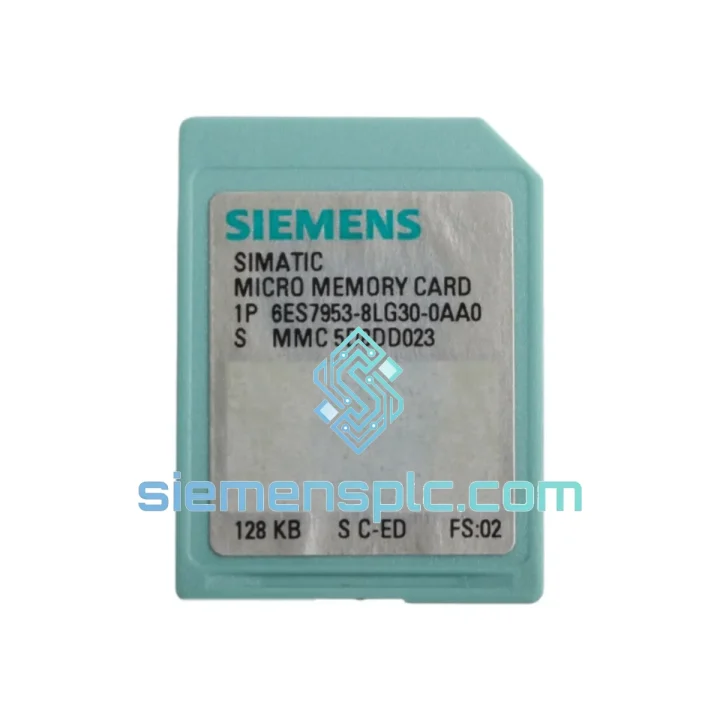
Request verified availability, condition, replacement risk review, packing options and courier lead time for 6ES7953-8LG30-0AA0.
Click Request Quote and the part number is inserted into the inquiry form automatically.
Core fields for model confirmation and RFQ routing. Detailed product narrative remains below.
The 6ES7953-8LG30-0AA0 is the designated non-volatile load memory medium for the SIMATIC S7-300 programmable logic controller family. Unlike battery-backed RAM modules used in earlier S5 generations, this Micro Memory Card (MMC) employs NAND flash technology to achieve persistent program storage without any auxiliary power source. Its role within the S7-300 control loop is structurally mandatory: the CPU cannot retain user programs, data blocks, or firmware images across a power cycle without a valid MMC inserted in the front-panel card slot.
From an architectural standpoint, the MMC occupies the load memory address space of the S7-300 CPU. When the CPU powers up, the operating system copies the executable code from the MMC into internal work memory (RAM) for runtime execution. This separation between load memory (MMC) and work memory (internal RAM) is a deliberate design decision by Siemens: it allows the MMC to serve simultaneously as a program repository, a firmware carrier, and a CPU-independent backup medium — three functions consolidated into a single 11 × 15 × 1 mm form factor.
The 8 MB capacity of the 8LG30 variant positions it at the upper tier of the standard S7-300 MMC range, accommodating large structured programs written in STL, LAD, FBD, or SCL, along with extensive data block arrays and multiple firmware revisions. In practice, 8 MB is sufficient for the most complex single-CPU S7-300 configurations, including those with dense PROFIBUS DP slave tables, extensive symbol tables, and multi-language comment blocks retained for maintenance purposes.
In distributed control architectures, the MMC also enables a critical field-service workflow: CPU hot-swap without a programming device. A pre-programmed MMC inserted into a replacement CPU will trigger an automatic program load sequence on first power-up, restoring the controller to its last saved state without requiring a STEP 7 laptop, MPI adapter, or network connection. This capability directly reduces mean time to repair (MTTR) in remote or unmanned installations.
Real-time Stock & RFQ: [email protected] | WhatsApp: +86 18359268345
| Parameter | Value |
|---|---|
| MLFB / Order Number | 6ES7953-8LG30-0AA0 |
| Product Family | SIMATIC S7-300 |
| Module Category | Micro Memory Card (MMC) — Load Memory |
| Storage Technology | NAND Flash (Non-Volatile) |
| Usable Capacity | 8 MB |
| Data Retention (unpowered) | ≥ 10 years at 25 °C |
| Endurance (write cycles) | ≥ 100,000 program write cycles |
| Compatible CPU Families | S7-300 CPUs with MMC slot: CPU 312, 313C, 314, 314C, 315-2 DP, 315-2 PN/DP, 317-2 DP, 317-2 PN/DP, 319-3 PN/DP |
| Physical Dimensions (W × H × D) | 11 mm × 15 mm × 1 mm |
| Weight | ≈ 1 g |
| Operating Temperature | 0 °C to +60 °C |
| Storage Temperature | −20 °C to +85 °C |
| Relative Humidity (operating) | 5 % to 95 %, non-condensing |
| Interface | Proprietary Siemens MMC slot (front panel) |
| Firmware Update Support | Yes — CPU firmware upgradeable via MMC |
| Program Cloning / CPU Swap | Yes — autonomous load on first power-up |
| Battery Dependency | None — flash retention is power-independent |
| CE / UL / RoHS | CE marked; UL 508 recognized; RoHS 2011/65/EU compliant |
| Warranty | 12 months from date of shipment |
The 6ES7953-8LG30-0AA0 integrates into the S7-300 CPU’s memory subsystem through a dedicated MMC controller embedded in the CPU ASIC. At power-on, the CPU firmware executes a memory initialization sequence that reads the MMC’s file allocation table, validates the stored program checksum, and transfers executable blocks into internal SRAM work memory. This two-stage memory architecture — persistent load memory on flash, volatile work memory in SRAM — ensures that runtime execution speed is governed by SRAM access latency (typically sub-100 ns), while program persistence is handled entirely by the flash medium.
EMC Design: The MMC card body is enclosed in a grounded metal shell that provides shielding against radiated electromagnetic interference. The CPU’s MMC slot incorporates ESD protection diodes rated to IEC 61000-4-2 Level 4 (±8 kV contact discharge), preventing electrostatic damage during card insertion in industrial environments where operators may carry significant static charge. The flash memory cells themselves are isolated from the backplane power rail by an internal LDO regulator on the CPU board, decoupling the MMC supply from backplane voltage transients that can reach ±500 mV in high-inrush switching scenarios.
Write Integrity and Wear Leveling: The MMC controller implements a static wear-leveling algorithm that distributes write operations across the full flash array, preventing premature cell exhaustion in frequently rewritten sectors (e.g., retentive data blocks updated at every scan cycle). A power-fail detection circuit within the CPU halts any in-progress MMC write operation and completes a partial-write recovery sequence on the next power-up, preventing file system corruption from mid-write power interruptions — a critical safeguard in installations subject to unstable grid power.
Checksum Verification: Each program block stored on the MMC carries a CRC-32 checksum computed by STEP 7 at download time. The CPU verifies this checksum during the load sequence and generates a diagnostic event (OB 87 or stop-mode fault) if corruption is detected, preventing execution of a partially corrupted program. This mechanism provides a hardware-level integrity guarantee that software-only backup solutions cannot replicate.
Every 6ES7953-8LG30-0AA0 unit supplied by siemensplc.com is sourced as a genuine Siemens original component. Each card is inspected upon receipt for label authenticity, holographic security features, and physical integrity of the metal shell and contact pads. Functional verification is performed using Siemens-compatible MMC read/write equipment to confirm full capacity availability and write-cycle integrity prior to dispatch.
Units are packed individually in anti-static bags with desiccant and humidity indicator cards, then placed in rigid ESD-safe boxes to prevent mechanical damage and electrostatic discharge during international transit. Lot numbers and date codes are recorded for full traceability. Certificate of Conformity (CoC) documentation is available upon request for OEM and system integrator procurement teams.
Shipments originate from our warehouse in Xiamen, China. Standard export channels include DHL Express, FedEx International Priority, and UPS Worldwide Express, with typical transit times of 3–5 business days to Europe, North America, Southeast Asia, and the Middle East. Expedited same-day dispatch is available for orders confirmed before 14:00 CST. All shipments include commercial invoice, packing list, and HS code documentation (HS 8473.30) to facilitate customs clearance.
Email: [email protected]
WhatsApp: +86 18359268345
Web: siemensplc.com
Location: Xiamen, China
© 2026 siemensplc.com. All rights reserved.
We check the full part number, brand, series and visible nameplate information before quotation.
Sales confirms stock path, condition option, quantity and realistic lead time for export dispatch.
DHL, FedEx, UPS or buyer courier arrangements can be reviewed with packing requirements.
Similar brand or category products for fast comparison and multi-item RFQ lists.