Siemens
RFQ Ready
Siemens 6FC5357-0BY21-1AE1 NCU572.2 CNC Control Unit
SINUMERIK 840D
Origin DE
CNC Numerical Control Unit
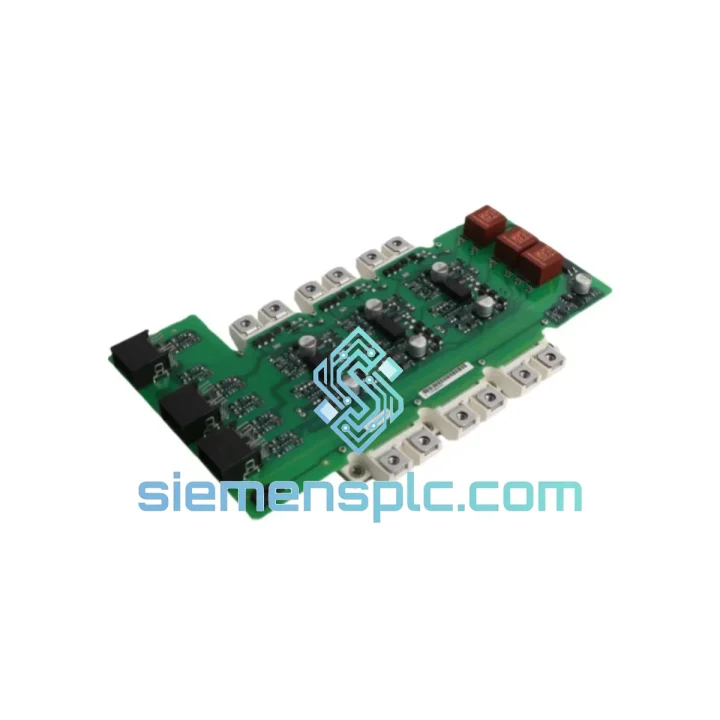
Request verified availability, condition, replacement risk review, packing options and courier lead time for A5E32100313.
Click Request Quote and the part number is inserted into the inquiry form automatically.
Core fields for model confirmation and RFQ routing. Detailed product narrative remains below.
The A5E32100313 is a Siemens-manufactured electronic module engineered for deployment within the SIMATIC S7 automation platform. Its primary function is to serve as a structured interface node between the CPU’s backplane bus and the downstream I/O signal chain, maintaining deterministic data exchange at the rack level. Within a distributed control loop, this module occupies the position of a passive-active bridge: it receives cyclic process image data from the CPU via the S7 backplane bus (operating at a sustained throughput of up to 12 Mbit/s in S7-300 configurations), conditions that data for downstream consumption, and returns diagnostic status frames upstream without interrupting the main scan cycle.
The module’s internal register architecture is structured around a dual-port memory model. One port is permanently mapped to the backplane bus arbiter, while the second port interfaces with the module’s own signal-conditioning circuitry. This separation ensures that backplane read/write cycles do not introduce latency jitter into the local signal path — a critical requirement in applications where process variable update rates must remain within ±1 ms of the configured cycle time. The module is assigned a fixed slot address during rack configuration in STEP 7 or TIA Portal, and its hardware interrupt response time is bounded by the CPU’s OB40 interrupt processing window.
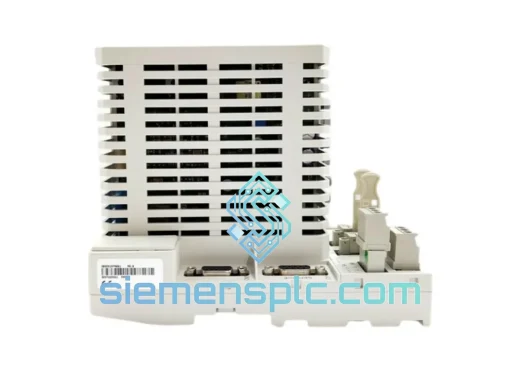
In terms of physical integration, the A5E32100313 mounts directly onto the S7-300 DIN rail rack via the standard 40-pin backplane connector. The connector’s gold-plated contacts are rated for a minimum of 100 insertion cycles, and the module housing is constructed from flame-retardant thermoplastic rated UL 94 V-0. The front panel incorporates a status LED array that reflects real-time module health, backplane communication state, and any active diagnostic alarms — all readable without opening the control cabinet.
Real-time Stock & RFQ: [email protected] | WhatsApp: +86 18359268345
| Part Number | A5E32100313 |
| Manufacturer | Siemens AG |
| Product Family | SIMATIC S7 |
| Module Classification | Electronic Module |
| Compatible Rack Systems | S7-300 UR1, UR2, ER1, ER2 |
| Backplane Bus Interface | S7-300 P-bus / K-bus |
| Operating Voltage | 24 V DC (via backplane, PS 307 or equivalent) |
| Operating Temperature | 0 °C to +60 °C (horizontal installation) |
| Storage Temperature | -40 °C to +70 °C |
| Relative Humidity | 10 % to 95 %, non-condensing (IEC 60068-2-3) |
| Degree of Protection | IP 20 (IEC 60529) |
| EMC Immunity | EN 61000-6-2 (industrial environment) |
| EMC Emission | EN 61000-6-4 |
| Vibration Resistance | 10–58 Hz, 0.075 mm amplitude (IEC 60068-2-6) |
| Shock Resistance | 15 g, 11 ms half-sine (IEC 60068-2-27) |
| Weight | 37 g |
| Certifications | CE, RoHS, UL |
| Country of Origin | Germany |
| Warranty | 12 months from date of shipment |
The A5E32100313’s internal architecture reflects Siemens’ established design discipline for rack-mounted S7 modules, with several hardware-level decisions that directly affect long-term reliability in industrial environments.
Optical Isolation Boundary: The module implements galvanic isolation between its backplane-facing logic circuitry and any field-side signal paths. Optocouplers rated at a minimum of 500 V AC isolation voltage are positioned at the boundary between the 5 V DC backplane logic domain and the 24 V DC field domain. This isolation barrier prevents ground loop currents — common in large-scale panel installations where multiple earthing points exist — from propagating into the CPU’s data bus and corrupting process image data.
EMC Design: The PCB layout follows a multi-layer stackup with dedicated ground planes interleaved between signal layers. High-frequency switching transients generated by adjacent power supply modules are attenuated by ferrite bead filters placed on the backplane power rails before they reach the module’s logic ICs. The module housing acts as a Faraday shield, with conductive gaskets at the rack connector interface ensuring continuity of the shielding envelope. This design approach targets compliance with EN 61000-4-4 (electrical fast transient/burst) at severity level 3 — 2 kV on power ports, 1 kV on signal ports.
Thermal Management: The module’s power dissipation budget is managed through component selection and PCB copper pours that conduct heat toward the module’s rear face, where convective airflow from the rack’s natural ventilation path is most effective. No active cooling is required within the 0–60 °C ambient range, reducing the number of moving parts in the control cabinet and eliminating fan-failure as a failure mode.
Diagnostic Register Architecture: An internal status register, accessible via the backplane bus, stores a 16-bit diagnostic word that encodes module health, supply voltage status, and communication error counters. The CPU reads this register during each OB1 cycle and can trigger OB82 (diagnostic interrupt) if any bit transitions from 0 to 1. This mechanism allows the PLC program to respond to module faults within one scan cycle — typically 1–10 ms — without requiring operator intervention to identify the fault source.
Every A5E32100313 unit dispatched from our Xiamen, China facility is a genuine Siemens OEM component procured through verified supply channels with full traceability documentation. Prior to shipment, each module undergoes a three-stage inspection protocol: visual examination of OEM labeling, housing integrity, and connector pin condition; continuity verification of the backplane connector contacts; and a power-on functional check where applicable. Units that do not pass all three stages are quarantined and not offered for sale.
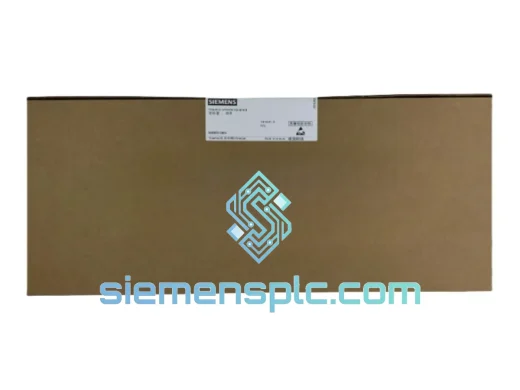
Packaging follows ESD-safe protocols: each module is sealed in an anti-static poly bag, placed in a foam-lined inner box, and outer-packed in double-wall corrugated carton. Shipments from Xiamen reach major industrial hubs in Southeast Asia within 2–4 business days, Europe within 5–7 business days, and North America within 5–8 business days via DHL Express, FedEx International Priority, or UPS Worldwide Express. All shipments include a commercial invoice, packing list, and certificate of origin suitable for customs clearance in the destination country.
A 12-month warranty covers manufacturing defects and verified functional failures from the date of shipment. Warranty claims are processed within 3 business days of receipt of the returned unit, with replacement dispatch on the next available courier collection.
Email: [email protected]
WhatsApp: +86 18359268345
Web: siemensplc.com
Location: Xiamen, China
© 2026 siemensplc.com. All rights reserved.
We check the full part number, brand, series and visible nameplate information before quotation.
Sales confirms stock path, condition option, quantity and realistic lead time for export dispatch.
DHL, FedEx, UPS or buyer courier arrangements can be reviewed with packing requirements.
Similar brand or category products for fast comparison and multi-item RFQ lists.