SST
RFQ Ready
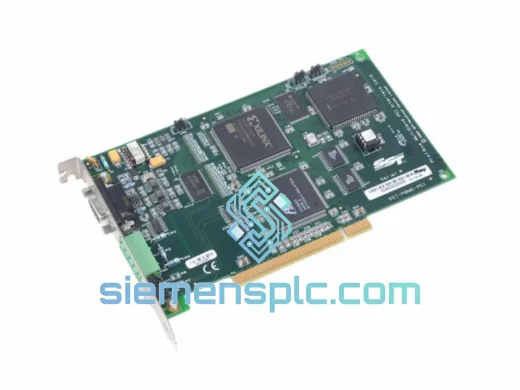
SST SST-PFB-PLC5 PROFIBUS-DP Interface Module – PLC-5 Series
Origin CA
PROFIBUS Interface Module
Request verified availability, condition, replacement risk review, packing options and courier lead time for ST-PFB-PLC5.
Click Request Quote and the part number is inserted into the inquiry form automatically.
Core fields for model confirmation and RFQ routing. Detailed product narrative remains below.
The SST ST-PFB–PLC5 is a single-slot PROFIBUS-DP communication interface card engineered specifically for the Allen-Bradley PLC5 I/O chassis. It occupies one slot in the 1771-series backplane and presents itself to the PLC5 processor as a standard block-transfer I/O module, eliminating the need for any external gateway, media converter, or protocol bridge. The module implements the full PROFIBUS-DP EN 50170 specification, supporting both Class 1 DP-Master (DPM1) and DP-Slave operating modes within a single firmware image, selectable at configuration time.
In a typical control loop, the PLC5 processor exchanges data with the ST-PFB–PLC5 via the 1771 parallel backplane at the rack’s native scan rate. The module’s onboard microprocessor — operating independently of the host CPU — manages the PROFIBUS-DP token-ring arbitration, cyclic data exchange (CDX), and acyclic messaging (MSAC1/MSAC2) without burdening the PLC5 scan cycle. This architectural separation means that PROFIBUS-DP network latency does not propagate into the deterministic ladder-logic execution time of the host controller.
The module supports baud rates from 9.6 kbps up to 12 Mbps, auto-detected per the PROFIBUS-DP standard. At 12 Mbps, the maximum cable segment length is 100 m; at 1.5 Mbps, this extends to 200 m per segment, with up to 32 stations per segment and 126 addressable nodes across the full network using repeaters. The onboard DB9 female connector follows the standard PROFIBUS-DP pinout (pin 3: RxD/TxD-P, pin 8: RxD/TxD-N, pin 5: DGND), compatible with all standard PROFIBUS-DP connectors and cables.
Real-time Stock & RFQ: [email protected] | WhatsApp: +86 18359268345
| Parameter | Specification |
|---|---|
| Part Number | ST-PFB–PLC5 |
| Brand | SST (Woodhead SST / Molex SST) |
| Series | PLC5 Fieldbus Communication Interface |
| Host Platform | Allen-Bradley PLC5 (1771 I/O chassis) |
| Form Factor | Single-slot 1771 backplane module |
| Protocol | PROFIBUS-DP (EN 50170 / IEC 61158 Type 3) |
| Operating Mode | DPM1 Master and/or DP-Slave (firmware-selectable) |
| Supported Baud Rates | 9.6 kbps, 19.2 kbps, 45.45 kbps, 93.75 kbps, 187.5 kbps, 500 kbps, 1.5 Mbps, 3 Mbps, 6 Mbps, 12 Mbps (auto-detect) |
| Max. Network Nodes | 126 (with repeaters); 32 per segment |
| Physical Interface | DB9 female, RS-485 differential, shielded twisted pair |
| Max. Segment Length @ 12 Mbps | 100 m |
| Max. Segment Length @ 1.5 Mbps | 200 m |
| Host Data Exchange | Block Transfer Read/Write via 1771 backplane |
| Configuration Interface | SST PROFIBUS Configuration Software (Windows) |
| Operating Temperature | 0 °C to +60 °C |
| Storage Temperature | -40 °C to +85 °C |
| Relative Humidity | 5% to 95% non-condensing |
| EMC Compliance | CE marked; designed to EN 61000-4 series immunity levels |
| Weight | Approx. 500 g |
| Warranty | 12 months from date of shipment |
The ST-PFB–PLC5 implements a dual-processor architecture. The host-side processor handles the 1771 backplane protocol state machine — managing block-transfer initiation, data buffering, and handshake sequencing with the PLC5 rack adapter. The network-side processor runs the PROFIBUS-DP stack independently, maintaining the token-passing bus arbitration and executing the cyclic data exchange scheduler. A shared dual-port RAM (DPRAM) region with hardware semaphore arbitration serves as the inter-processor communication boundary, ensuring atomic data consistency between the two clock domains without requiring software polling loops.
The RS-485 physical layer driver incorporates automatic transmit/receive direction switching controlled by the PROFIBUS-DP stack, with a propagation delay of less than 1 µs — well within the PROFIBUS-DP Tset timing margin at 12 Mbps. The differential line driver is rated for ±15 kV ESD protection on the bus pins, and the signal path includes common-mode choke filtering to suppress conducted EMI from the cable shield. The module’s PCB layout routes the RS-485 differential pair as a controlled-impedance 120 Ω trace pair, matched to the characteristic impedance of standard PROFIBUS-DP cable (Type A: 135–165 Ω at 3–20 MHz).
Optical isolation is implemented between the RS-485 bus interface and the module’s internal logic ground. The isolation barrier provides a minimum 500 V DC working isolation, protecting the PLC5 backplane from ground potential differences and transient surges that are common in industrial environments with long cable runs between control cabinets and field junction boxes. This galvanic isolation is particularly significant in applications where the PROFIBUS-DP cable traverses areas with heavy motor drives or welding equipment, where common-mode noise can reach tens of volts.
The module’s onboard watchdog timer monitors both the host-side and network-side processors independently. If either processor fails to service its watchdog within the configured timeout period, the module asserts a hardware fault output and forces the PROFIBUS-DP network into a safe state — either freezing outputs at last-known-good values or driving them to a configured fail-safe state, depending on the GSD file parameterization of each slave device. This fail-safe behavior is deterministic and does not depend on the PLC5 application program detecting the fault condition first.
Every SST ST-PFB–PLC5 unit supplied by siemensplc.com is sourced through verified industrial automation supply channels and subjected to a structured incoming inspection process before dispatch. Physical inspection covers PCB condition, connector integrity, component markings, and date code consistency. Functional verification confirms that the module’s onboard firmware responds correctly to configuration commands and that the RS-485 interface meets the PROFIBUS-DP electrical specification for differential output voltage (minimum 1.5 V differential at the transmitter) and input sensitivity (minimum 200 mV differential at the receiver).
All units are shipped from our warehouse in Xiamen, China — a major international logistics hub with direct access to DHL Express, FedEx International Priority, and UPS Worldwide Express services. Transit times to major industrial centers in Europe, North America, Southeast Asia, and the Middle East are typically 3–7 business days via express courier. Each shipment is packed in anti-static foam-lined cartons with moisture barrier bags, meeting JEDEC J-STD-033 handling requirements for moisture-sensitive electronic assemblies. Export documentation, including commercial invoice, packing list, and certificate of origin, is prepared in compliance with the destination country’s import requirements.
A 12-month warranty is provided on all units from the date of shipment. Warranty coverage addresses manufacturing defects and functional failures under normal operating conditions as defined by the SST product specification. Our technical team is available to support fault diagnosis and, where applicable, coordinate warranty replacement logistics.
Email: [email protected]
WhatsApp: +86 18359268345
Web: siemensplc.com
Location: Xiamen, China
© 2026 siemensplc.com. All rights reserved.
We check the full part number, brand, series and visible nameplate information before quotation.
Sales confirms stock path, condition option, quantity and realistic lead time for export dispatch.
DHL, FedEx, UPS or buyer courier arrangements can be reviewed with packing requirements.
Similar brand or category products for fast comparison and multi-item RFQ lists.