
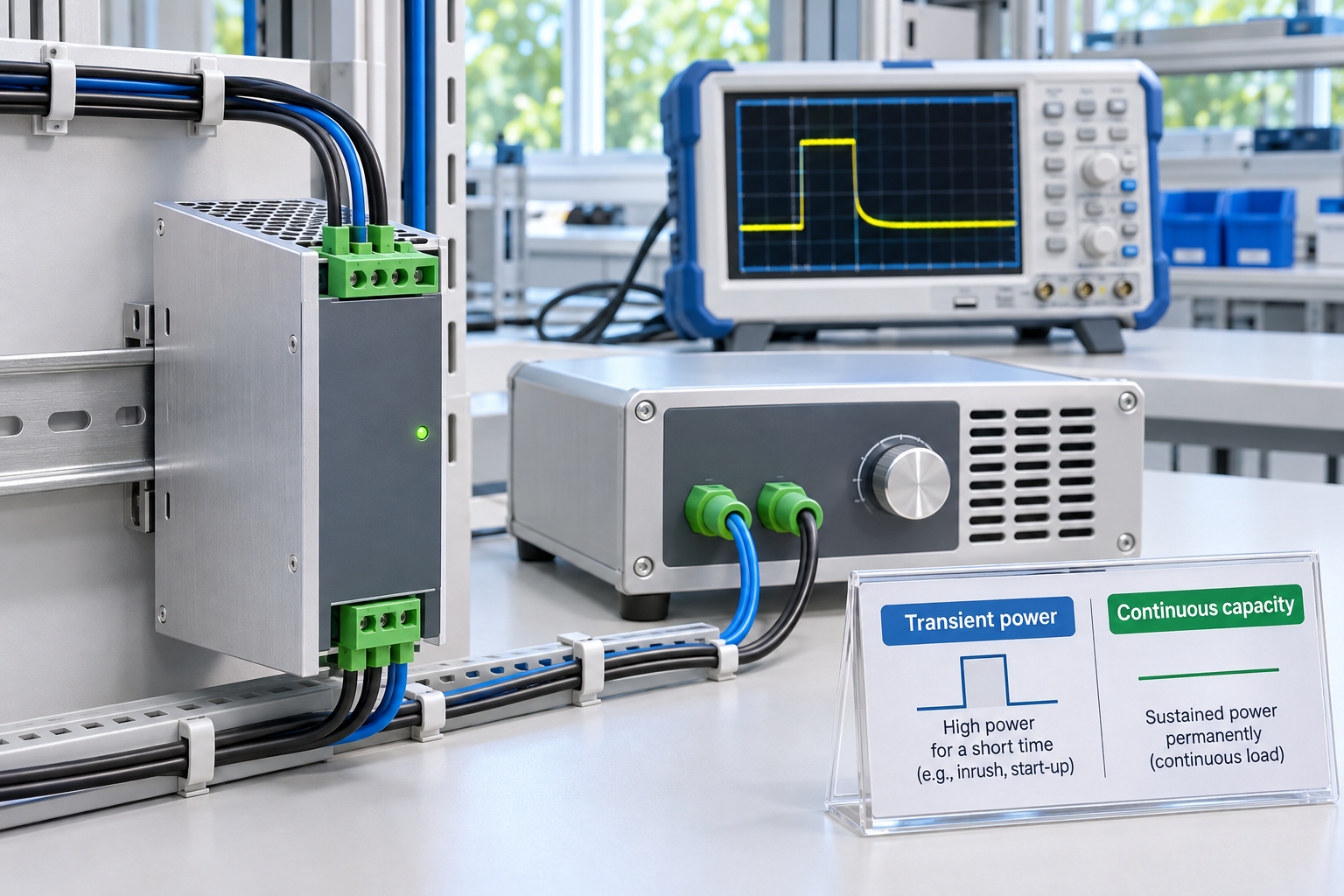
A control cabinet can have a modest average DC load and still experience demanding current peaks. Conversely, a supply that tolerates a brief peak may be unsuitable for a continuously expanded load. When ordering a SITOP spare, those two cases must remain separate. A boost feature is not a permanent increase in the supply’s rated capacity.
The practical purchasing problem is incomplete evidence. A request may contain a photograph and a current value, but omit whether that current is continuous, a startup peak or a short fault-clearing event. Before comparing alternatives, establish what the number represents and which manufacturer conditions apply to it.
Start with the exact order code and rating
Use the full Siemens order number as the identity anchor. For example, Siemens identifies 6EP1334-3BA10 as a SITOP PSU200M supply with a 24 V DC, 10 A output. The manufacturer’s product record is the authority for that basic classification. A shortened family name or an inconsistent distributor description should not replace the OEM data.
When enquiring about the 6EP1334-3BA10 supply, state the complete code and attach the installed label. Verify the offer against Siemens documentation before accepting ratings quoted elsewhere. Treat conflicting descriptions as an open clarification, not as evidence that two different ratings are interchangeable.
A related enquiry for 6EP1334-3BA00 should remain a separate line item. Similar order-number characters do not prove identical overload behavior, dimensions or installation conditions. Request the exact documentation for the offered version rather than copying specifications from another member of the family.
Split the load into three records
First record the sustained load under the most demanding normal operating condition that the plant has established. Include the operating state and the evidence source. A value measured while most devices are idle is not a substitute for the approved full-load requirement.
Next record transient demand. Useful information includes peak magnitude, duration, repetition and what machine event causes it. A brief startup event occurring once after a shutdown is different from a pulse repeated throughout every production cycle. Both need an application-specific comparison with the exact supply’s permissible behavior.
Finally separate fault behavior from usable operating capacity. Current supplied during a short circuit is not a production-load allowance. Protective coordination, fault isolation and recovery behavior belong in the electrical design review, not in a purchasing calculation that adds a percentage to the nameplate rating.
Read boost figures together with their conditions
Siemens’ SITOP catalogue distinguishes rated operation from additional short-duration capability in relevant product families. The essential engineering lesson is to retain the time and recovery conditions attached to any extra-current figure. Do not transfer a family-level feature to every order code or interpret a momentary allowance as continuous output.
The review should also include the input supply, cabinet temperature, mounting conditions and ventilation requirements from the applicable manual. A proposed replacement cannot be assessed solely from its nominal output current. The evidence must describe the actual installation and the conditions under which the manufacturer publishes its ratings.
For an illustrative purchasing scenario, imagine a load report that says only maximum current: 12 A. It is incomplete. The reviewer still needs to know whether that is sustained, how it was obtained and which operating event it represents. This example is not a claim that a particular 10 A supply is approved for that load.
Make the request for quotation testable
A useful enquiry contains enough detail to identify both the hardware and the acceptance boundary. Keep these items together:
- Installed order code, revision and a readable label photograph.
- Required DC voltage and documented sustained-load condition.
- Transient magnitude, duration, repetition and associated machine event.
- Input-supply and cabinet-environment information already approved by engineering.
- Required alarm or status behavior and the relevant drawing reference.
- Exact manufacturer document and the person responsible for technical acceptance.
A supplier can then confirm the offered identity and documentation, or list differences explicitly. An answer such as same voltage and enough boost is not adequate evidence. Ask which specification supports each important claim and whether it refers to the exact unit being offered.
Keep commercial condition separate as well. New, unused, repaired and previously installed units require different evidence and acceptance arrangements. Neither an attractive photograph nor a general functional claim establishes the unit’s history. Request the information relevant to the agreed purchasing condition without assuming availability or remaining service life.
Acceptance should preserve the load profile
Have qualified personnel define an approved acceptance method before the unit is needed for production. Record identity, documentation and the results of any authorized bench or installation checks. Testing must use suitable equipment and the site’s electrical safety procedures; this article is not an instruction to probe an energized cabinet or deliberately overload a supply.
If a test is performed, preserve the operating conditions with the result. A pass statement without load, duration or environmental context is difficult to reuse during a later failure investigation. Where the installed load has changed, treat capacity reassessment as a separate engineering task rather than quietly substituting a larger device.
Send SiemensPLC the exact code, label evidence and your sustained-versus-transient load summary. Ask for the offered unit’s identity and documentation to be checked against that scope. This keeps sourcing practical while leaving installation approval and protective coordination with the responsible plant engineers.
Frequently asked questions
Can boost current be used as the continuous rating?
No. Use the rated capacity and applicable derating conditions for sustained demand. Any additional short-duration capability must be assessed with its specific timing and recovery restrictions.
Why is an average-current reading insufficient?
It can hide both sustained worst-case demand and short peaks. Preserve the operating state and time behavior so the reviewer knows what was actually measured.
Are similar SITOP order codes automatically interchangeable?
No. Compare the exact documentation and the approved installation. Similar naming does not close differences in electrical behavior, mechanical requirements or status interfaces.
What should happen when a listing conflicts with Siemens data?
Hold the disputed specification for clarification and use the manufacturer’s exact-code documentation. Do not resolve the disagreement by assuming the more convenient rating is correct.
Image: AI-generated editorial illustration, not an exact product photograph or installation reference.
© 2026 SiemensPLC. All rights reserved. Official Website: https://siemensplc.com Inquiry: [email protected] | WhatsApp/Tel: +86 18359268345