ABB
RFQ Ready
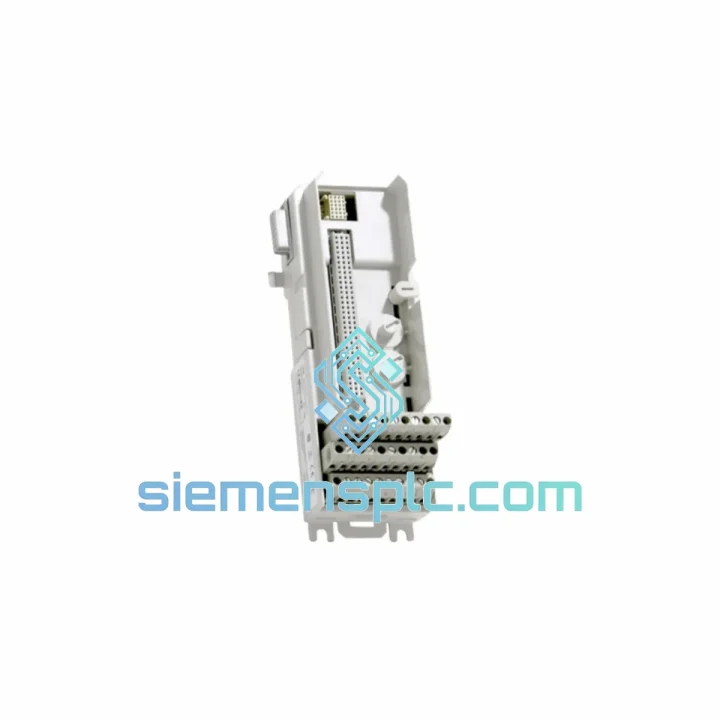
ABB HAC807B102 Analog Input Termination Unit – AC800M Series
AC800M
Origin SE
Analog Input Termination Unit
Request verified availability, condition, replacement risk review, packing options and courier lead time for 3BSE013231R1 TU811V1.
Click Request Quote and the part number is inserted into the inquiry form automatically.
Core fields for model confirmation and RFQ routing. Detailed product narrative remains below.
The ABB 3BSE013231R1 (TU811V1) is a compact module termination unit designed for the S800 I/O family within ABB’s AC800M distributed control system platform. Its primary function is to provide a structured, mechanically stable field-wiring interface between process instrumentation cables and the pluggable S800 I/O signal modules. Rather than routing field wires directly to module connectors — a practice that introduces mechanical stress and commissioning risk — the TU811V1 decouples the field wiring layer from the electronics layer. This separation is architecturally significant: it allows S800 I/O modules (AI810, AO810, DI810, DO810, and variants) to be removed and reinserted without disturbing a single field terminal, which is a non-trivial operational advantage in live process environments where unplanned downtime carries measurable financial cost.
In the AC800M control loop hierarchy, the TU811V1 sits at the physical boundary between the field instrument network and the ModuleBus segment. Each termination unit mounts on a standard 35 mm DIN rail and integrates an internal ModuleBus connector that daisy-chains to adjacent units, eliminating the need for discrete inter-module bus cables. The mechanical locking mechanism for the I/O module is tool-free: the module slides into the TU811V1 guide rails and engages a positive-retention latch, ensuring consistent backplane contact pressure across the full operating temperature range of 0 °C to +55 °C. This design eliminates the connector fretting corrosion that can develop in vibration-prone installations when module-to-termination contact is maintained only by friction.
From a system architecture standpoint, the TU811V1 supports up to 12 S800 I/O modules per ModuleBus segment, consistent with ABB’s AC800M Hardware Configuration guidelines (document reference 3BSE041434). Each segment is powered and supervised by a TB820V2 ModuleBus Modem, which handles optical isolation of the ModuleBus signal from the controller backplane — a design choice that limits ground-loop propagation between the controller cabinet and remote I/O stations. The TU811V1 itself operates passively within this segment: it does not contain active electronics, which means it contributes zero failure modes related to firmware, memory, or processing logic. Its reliability profile is governed entirely by mechanical and contact-resistance specifications.
Field wiring connects via screw-clamp terminals rated for conductors from 0.5 mm² to 2.5 mm² (AWG 20–14), accommodating both solid and stranded wire without ferrule requirements, though ferrule use is recommended in high-vibration environments per IEC 60947-7-1 installation practice. Terminal labeling is printed on the unit body and corresponds directly to the channel numbering of the mated I/O module, reducing wiring documentation errors during commissioning. The IP20 protection class is appropriate for panel-mounted installations within sealed control cabinets; the unit is not rated for open-air or wash-down environments without additional enclosure protection.
Weight is 940 g, reflecting the robust zinc-alloy and engineering-plastic construction. Storage temperature range extends to −40 °C, making the unit suitable for cold-climate warehousing and transportation without risk of material embrittlement. Compliance certifications include CE (EU Low Voltage Directive 2014/35/EU and EMC Directive 2014/30/EU), cULus (UL 508), and IEC 61131-2, covering the full scope of electrical safety and immunity requirements for industrial control equipment in North American and European markets.
Real-time Stock & RFQ: [email protected] | WhatsApp: +86 18359268345
| Parameter | Value |
|---|---|
| ABB Part Number | 3BSE013231R1 |
| Model Designation | TU811V1 |
| Product Series | AC800M / S800 I/O |
| Function | Compact Module Termination Unit |
| Compatible I/O Modules | AI810, AO810, DI810, DO810, DI811, DI814, DO814, AI820, AO820 (S800 family) |
| DIN Rail Mounting | 35 mm (EN 60715) |
| Field Terminal Type | Screw-clamp, 0.5–2.5 mm² (AWG 20–14) |
| ModuleBus Interface | Integrated internal connector, daisy-chain topology |
| Max Modules per Segment | 12 (per AC800M Hardware Configuration manual 3BSE041434) |
| Operating Temperature | 0 °C to +55 °C |
| Storage Temperature | −40 °C to +70 °C |
| Relative Humidity | 5–95 % RH, non-condensing |
| Protection Class | IP20 (IEC 60529) |
| Weight | 940 g |
| Compliance | CE, cULus (UL 508), IEC 61131-2, RoHS |
| Country of Origin | Germany |
| Warranty | 12 months from date of dispatch |
Passive Architecture and Zero Active Failure Modes. The TU811V1 contains no microcontrollers, firmware, or active signal-conditioning circuitry. All electrical paths between field terminals and the I/O module connector are purely conductive. This passive architecture means the unit cannot contribute to systematic software failures, firmware corruption, or watchdog faults — failure modes that account for a significant proportion of unplanned shutdowns in active termination designs. Mean time between failures (MTBF) for passive termination hardware of this class typically exceeds 500,000 hours under rated conditions.
ModuleBus Optical Isolation Boundary. While the TU811V1 itself is passive, it operates within a segment whose ModuleBus signal is optically isolated at the TB820V2 modem. This isolation boundary prevents ground potential differences between the controller cabinet and remote I/O stations from coupling noise onto the ModuleBus data lines. In installations where field cable runs exceed 30 m or cross power distribution zones, this isolation is the primary defense against common-mode interference that would otherwise corrupt I/O scan data.
Mechanical Locking and Contact Integrity. The positive-retention latch mechanism maintains consistent contact pressure between the I/O module’s backplane connector and the TU811V1’s mating socket across the full thermal expansion range of the assembly. In environments with ambient temperature cycling (e.g., outdoor substations with day/night ΔT of 30 °C or more), differential thermal expansion between dissimilar materials can cause fretting corrosion at connector interfaces. The TU811V1’s latch design compensates for this by maintaining a defined normal force independent of thermal state.
EMC Design Considerations. The screw-clamp terminal block layout on the TU811V1 follows ABB’s recommended cable segregation practice: analog signal terminals are physically separated from digital I/O terminals by the module’s internal layout, reducing capacitive crosstalk between high-frequency digital switching signals and low-level analog measurement circuits. For installations in high-EMI environments (variable-frequency drives, large contactors), ABB recommends shielded cable with shield grounded at the TU811V1 terminal block using the dedicated PE terminal, providing a low-impedance return path for induced RF currents.
Every ABB 3BSE013231R1 TU811V1 unit dispatched from our Xiamen, China facility is sourced through verified industrial distribution channels with full traceability to ABB’s authorized supply chain. Pre-shipment inspection covers physical integrity (housing, terminal blocks, latch mechanism, ModuleBus connector pins), label and revision verification against ABB’s current product documentation, and anti-static packaging with humidity indicator card. Units are packed in original or equivalent ESD-protective packaging with foam cushioning rated for air freight vibration profiles per ISTA 2A.
Logistics from Xiamen covers all major global destinations: DHL Express, FedEx International Priority, and UPS Worldwide Express are standard carriers for urgent orders, with transit times of 3–5 business days to Europe and North America. Sea freight consolidation is available for bulk project orders. Export documentation includes commercial invoice, packing list, and certificate of origin. HS Code 8538.90 applies for customs classification in most jurisdictions. A 12-month warranty from dispatch date covers manufacturing defects; warranty claims are processed with ABB documentation support.
Email: [email protected]
WhatsApp: +86 18359268345
Web: siemensplc.com
Location: Xiamen, China
© 2026 siemensplc.com. All rights reserved.
We check the full part number, brand, series and visible nameplate information before quotation.
Sales confirms stock path, condition option, quantity and realistic lead time for export dispatch.
DHL, FedEx, UPS or buyer courier arrangements can be reviewed with packing requirements.
Similar brand or category products for fast comparison and multi-item RFQ lists.