Allen-Bradley
RFQ Ready
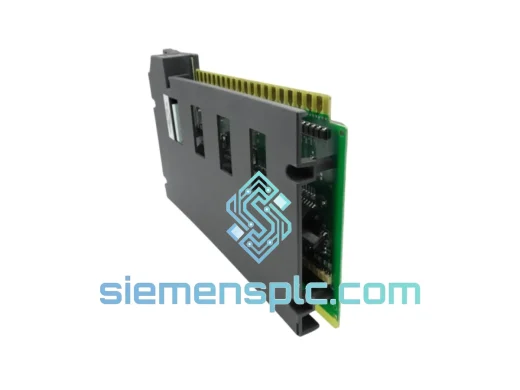
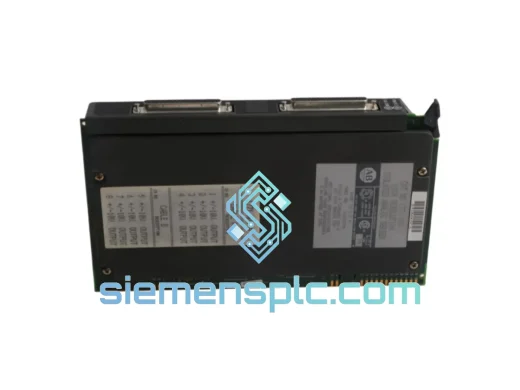
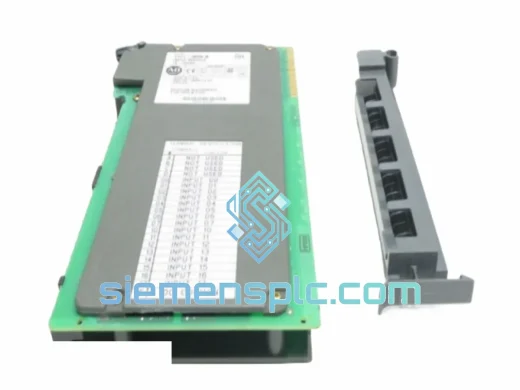
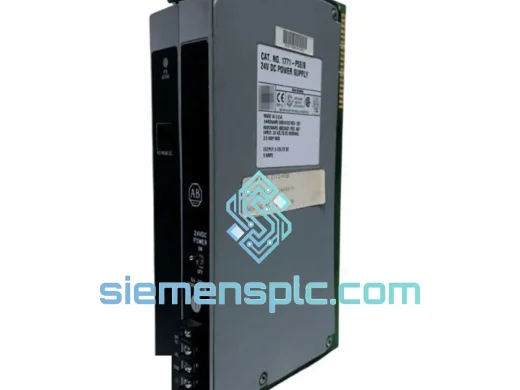
Allen-Bradley 1771-P5E Power Supply Interface Module – PLC-5
PLC-5
Origin US
Power Supply Interface Module
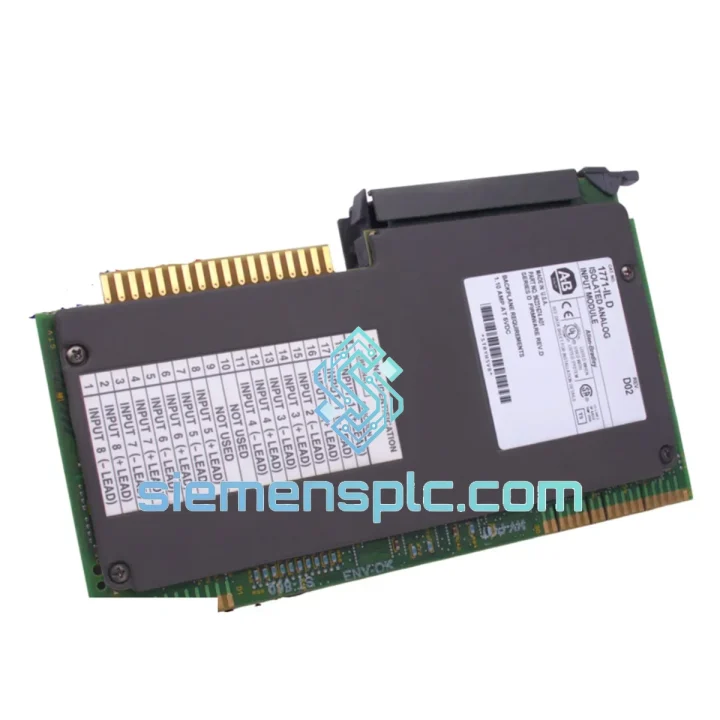
Request verified availability, condition, replacement risk review, packing options and courier lead time for 1771-IL.
Click Request Quote and the part number is inserted into the inquiry form automatically.
Core fields for model confirmation and RFQ routing. Detailed product narrative remains below.
The 1771-IL occupies a structurally non-negotiable position in any PLC-5 analog control loop. Its function is signal acquisition: it receives low-level field signals — 4–20 mA current loops and 1–5 V DC voltage outputs — from process transmitters, converts them through a 12-bit successive approximation ADC, and delivers scaled integer values to the PLC-5 processor’s analog input data file (N-file or F-file, depending on ladder configuration). Without this conversion stage, the processor has no quantitative awareness of the physical process it governs. Temperature, pressure, flow, level — all of these process variables arrive at the 1771-IL first.
Deployed since the mid-1980s across continuous process industries, the 1771-IL has accumulated a field record that spans oil refinery SCADA systems, chemical reactor feed-forward loops, paper machine basis weight controls, and municipal water treatment dosing stages. Its persistence in active service is not a function of inertia — it reflects the 20–30 year design lifecycle of process-critical installations and the engineering discipline required to maintain backward compatibility across that span. Facilities that standardized on the PLC-5 platform made a long-term infrastructure commitment, and the 1771-IL is the analog front-end that commitment depends on.
📦 Real-time Stock & RFQ: [email protected] | WhatsApp: +86 18359268345
| Parameter | Specification |
|---|---|
| Part Number | 1771-IL |
| Manufacturer | Allen-Bradley / Rockwell Automation |
| Module Type | Analog Input Module |
| Compatible Platform | 1771 I/O Chassis (PLC-5 family) |
| Number of Input Channels | 4 differential analog input channels |
| Input Signal Range (Current) | 4–20 mA |
| Input Signal Range (Voltage) | 1–5 V DC |
| ADC Resolution | 12-bit (4,096 discrete counts) |
| Conversion Method | Successive approximation register (SAR) ADC |
| Input Impedance (Current Mode) | < 250 Ω |
| Input Impedance (Voltage Mode) | > 10 MΩ |
| Backplane Current Draw | 800 mA @ 5 V DC (typical) |
| Channel Isolation | Optical isolation, channel-to-backplane |
| Common-Mode Rejection | Up to 120 V AC (differential input architecture) |
| Chassis Slot Requirement | Single slot, 1771 I/O chassis |
| Backplane Connector | 40-pin keyed I/O chassis connector |
| Operating Temperature | 0°C to 60°C (32°F to 140°F) |
| Storage Temperature | -40°C to 85°C |
| Relative Humidity | 5% to 95%, non-condensing |
| Vibration Compliance | IEC 68-2-6 |
| Certifications | UL Listed, CSA Certified, CE Marked (EMC Directive) |
| Programming Software | RSLogix 5 (Rockwell Automation) |
| Module Weight | Approximately 700 g |
| Warranty | 12 months from date of shipment |
The 1771-IL’s internal architecture is built around four independent differential input channels, each feeding a shared multiplexed SAR ADC. The multiplexer cycles through all four channels sequentially, presenting each signal to the ADC in turn. This architecture trades simultaneous sampling for cost and board-space efficiency — an acceptable trade-off in process control applications where scan rates are measured in tens of milliseconds rather than microseconds.
Optical Isolation Architecture: The channel-to-backplane optical isolation barrier is the module’s primary EMC defense mechanism. Each channel’s analog front-end operates on a floating ground reference, galvanically separated from the 1771 backplane logic ground. Optocouplers transfer the digitized signal across this barrier, breaking the conductive path that would otherwise allow ground loop currents — common in industrial environments where field instruments and control panels share imperfect ground references — to inject noise into the ADC input stage. In motor control center environments, where variable frequency drives generate high-frequency common-mode voltages on cable shields, this isolation is not optional; it is the difference between stable process data and corrupted analog values that trigger nuisance alarms or false control actions.
Differential Input Topology: Each channel accepts a true differential signal pair (IN+ and IN-), rejecting common-mode voltages up to 120 V AC. This specification is directly relevant to installations where analog signal cables run in the same conduit as power wiring, or where long cable runs (exceeding 100 m) accumulate induced noise from adjacent electromagnetic sources. The differential rejection ratio ensures that only the intended signal — the voltage or current difference between IN+ and IN- — reaches the ADC, while induced common-mode interference is suppressed at the input stage.
Backplane Communication Protocol: The 1771-IL communicates with the PLC-5 processor via the 1771 parallel backplane bus. The processor’s I/O scanner reads the module’s output data table at each I/O scan, transferring the 12-bit ADC results into the processor’s analog input data file. The module does not perform any autonomous scaling or engineering unit conversion — that computation occurs in the PLC-5 ladder program via SCP (Scale with Parameters) or SCL (Scale) instructions. This design keeps the module’s firmware simple and deterministic, with no embedded microcontroller that could introduce variable latency into the data path.
EMC Design Compliance: The module’s CE marking under the EMC Directive confirms compliance with EN 61000-4 series immunity tests, including electrostatic discharge (ESD), radiated RF immunity, electrical fast transient (EFT) burst, and surge immunity. These tests simulate the electromagnetic environment of an industrial switchgear room or process plant control panel, where the module must maintain data integrity without requiring additional external filtering.
Every Allen-Bradley 1771-IL module dispatched from our Xiamen, China facility undergoes a structured four-stage inspection protocol before shipment authorization is issued.
Stage 1 — Visual and Physical Inspection: Board-level examination under magnification for component damage, corrosion on connector pins, PCB trace integrity, and label authenticity. Modules showing evidence of unauthorized repair, re-marking, or counterfeit indicators are rejected and quarantined at this stage. Only modules with intact original Allen-Bradley labeling and unmodified hardware proceed.
Stage 2 — Functional Power-On Verification: The module is installed in a calibrated 1771 test chassis energized by a verified 1771-series power supply. Backplane communication is confirmed, LED status indicators are checked against factory-documented behavior, and the module’s internal diagnostics are polled via RSLogix 5 to confirm no latent fault codes are present.
Stage 3 — Analog Channel Signal Verification: Each of the four input channels is exercised with calibrated reference signals: a precision 4–20 mA current source and a 1–5 V DC voltage reference traceable to NIST standards. The digital output values read by the PLC-5 processor are compared against expected counts at 0%, 25%, 50%, 75%, and 100% of the input range. Channels that deviate beyond ±0.1% of full scale are flagged for further investigation.
Stage 4 — Documentation, Packaging, and Dispatch: Modules that pass all three prior stages are assigned a unique inspection record number, anti-static bagged, cushion-packed in double-wall cartons, and prepared for international shipment. Export documentation — including commercial invoice, packing list, and certificate of conformance — is prepared for all international orders. Shipments from Xiamen reach major industrial hubs in Southeast Asia within 3–5 business days, Europe within 5–8 business days, and North America within 5–7 business days via DHL Express, FedEx International Priority, or UPS Worldwide Express, depending on destination and customer preference. All shipments include full tracking from dispatch to delivery confirmation.
The 12-month warranty covers functional failure under normal operating conditions. Warranty claims are processed with priority turnaround: replacement modules are dispatched within 48 hours of fault confirmation for customers with active orders.
Email: [email protected]
WhatsApp: +86 18359268345
Web: siemensplc.com
Location: Xiamen, China
© 2026 siemensplc.com. All rights reserved.
We check the full part number, brand, series and visible nameplate information before quotation.
Sales confirms stock path, condition option, quantity and realistic lead time for export dispatch.
DHL, FedEx, UPS or buyer courier arrangements can be reviewed with packing requirements.
Similar brand or category products for fast comparison and multi-item RFQ lists.