Allen-Bradley
RFQ Ready
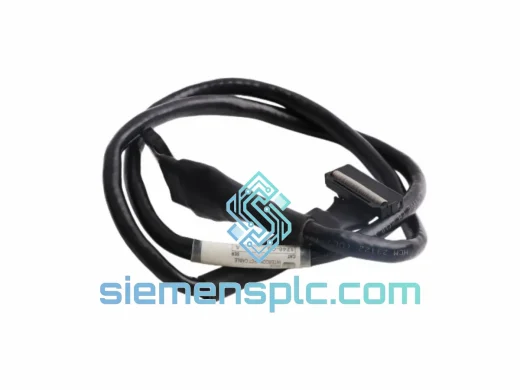
Allen-Bradley 1786-RG6F ControlNet Coaxial Cable – 1786 Series
1786 Series
Origin US
Industrial Network Cable
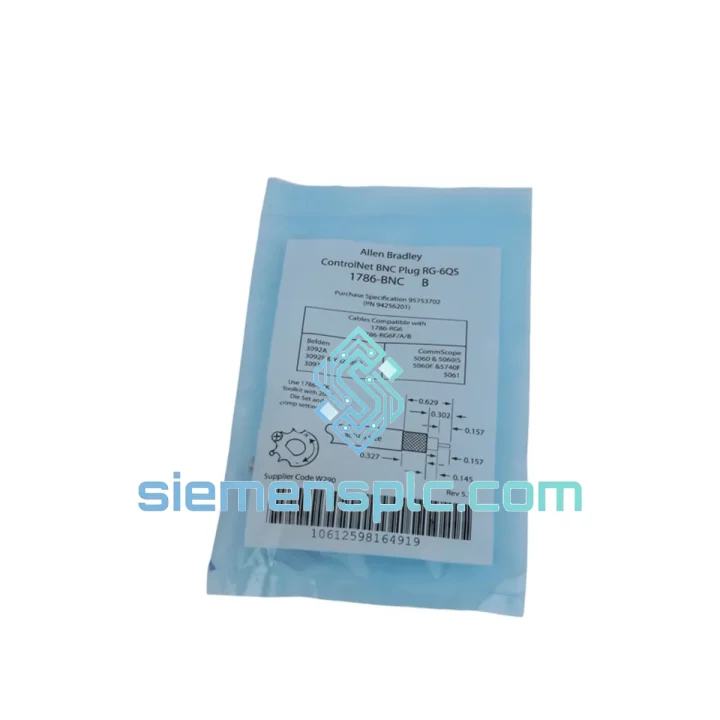
Request verified availability, condition, replacement risk review, packing options and courier lead time for 1786-TPS.
Click Request Quote and the part number is inserted into the inquiry form automatically.
Core fields for model confirmation and RFQ routing. Detailed product narrative remains below.
The Allen-Bradley 1786-TPS is a 1-meter coaxial straight T-tap connector engineered for Rockwell Automation ControlNet networks operating under the ANSI/IEC 61158 deterministic protocol standard. Within the 1786 series media product line, the T-tap occupies the most mechanically critical position in the network topology: it is the sole physical interface between the high-impedance coaxial trunk and each individual node’s BNC port. Any impedance discontinuity, mechanical looseness, or dielectric degradation at this junction directly degrades the signal-to-noise ratio across the entire segment, manifesting as NUT (Node Unreachable) faults or intermittent scheduled-data loss in the ControlNet scheduler table.
ControlNet’s time-division multiplexing architecture divides each 5 ms network update time (NUT) into a scheduled interval — reserved for I/O and motion data — and an unscheduled interval for messaging and configuration traffic. The physical layer must sustain a 5 Mbps data rate with a maximum allowable signal attenuation of 3 dB across the full trunk span. The 1786-TPS drop cable, constructed from RG-6 equivalent coaxial stock with a 75 Ω characteristic impedance, is matched to the trunk’s impedance profile to prevent reflections that would corrupt the CTDMA (Concurrent Time Domain Multiple Access) arbitration mechanism. A mismatched or degraded tap introduces standing waves that can cause multiple nodes to misread the bus-idle state, triggering simultaneous transmission attempts and collapsing network throughput.
Real-time Stock & RFQ: [email protected] | WhatsApp: +86 18359268345
| Parameter | Value |
|---|---|
| Part Number | 1786-TPS |
| Manufacturer | Allen-Bradley / Rockwell Automation |
| Series | 1786 ControlNet Media |
| Connector Type | Coaxial Straight T-Tap |
| Drop Cable Length | 1 meter (RG-6 equivalent, 75 Ω) |
| Network Protocol | ControlNet (ANSI/IEC 61158) |
| Data Rate | 5 Mbps |
| Characteristic Impedance | 75 Ω |
| Max Trunk Attenuation | 3 dB (per segment) |
| Connector Interface | BNC (trunk side) / BNC (node side) |
| Body Orientation | Straight (inline) |
| Operating Temperature | 0 °C to +60 °C |
| Storage Temperature | -40 °C to +85 °C |
| Weight | 80 g |
| Compatible Platforms | ControlLogix, PLC-5, SLC 500 (any ControlNet BNC node) |
| Max Nodes per Segment | 48 (per CNET-UM001) |
| Warranty | 12 months from date of shipment |
The 1786-TPS straight-body design addresses a specific mechanical failure mode common in high-vibration environments: torsional stress at the BNC barrel. Right-angle tap variants (1786-TPYR) redirect cable egress perpendicular to the trunk axis, which concentrates bending stress at the connector body junction under sustained vibration. The straight configuration of the 1786-TPS distributes cable tension along the drop cable’s longitudinal axis, reducing the moment arm acting on the BNC crimp termination. In environments with continuous vibration profiles — such as press lines, compressor rooms, or conveyor drive enclosures — this geometry difference measurably extends connector service life.
The internal T-junction of the 1786-TPS uses a passive resistive-capacitive coupling network rather than an active repeater. This is architecturally significant: the tap introduces no propagation delay beyond the physical cable length, preserving the deterministic timing budget of the ControlNet NUT. The coupling network is designed to present a high impedance to the trunk at DC while maintaining a controlled low impedance at 5 MHz, ensuring that the node’s BNC port does not load the trunk signal below the 3 dB attenuation threshold even when multiple taps are distributed across the segment.
EMC performance is governed by the coaxial shield continuity through the tap body. The 1786-TPS maintains 360° shield coverage at both the trunk and drop cable terminations, preventing common-mode noise ingress from adjacent power cables, VFD switching transients, or welding equipment. In environments where ControlNet cables are routed in proximity to 480 VAC motor feeders — a common constraint in panel-wiring practice — this shield integrity is the primary defense against induced noise that would otherwise appear as bit errors in the ControlNet frame check sequence (FCS) layer.
Every 1786-TPS unit supplied by siemensplc.com is sourced through traceable procurement channels with full documentation of origin. Each connector undergoes visual inspection of the BNC barrel geometry, shield termination integrity, and label authenticity against Allen-Bradley OEM packaging standards before dispatch. Part numbers, date codes, and revision markings are cross-referenced against Rockwell Automation’s published product database to confirm authenticity prior to shipment.
Logistics operations are based in Xiamen, China — a major export hub with direct access to international freight forwarders serving North America, Europe, Southeast Asia, the Middle East, and Australia. Standard export documentation includes commercial invoice, packing list, and certificate of origin. Certificates of conformance are available upon request for quality-critical MRO procurement processes. Anti-static, moisture-resistant packaging with individual part identification is used for all shipments to prevent transit damage to connector contacts and cable terminations.
Typical dispatch lead time is 1–3 business days from order confirmation. Express air freight options (DHL, FedEx, UPS) are available for urgent requirements. Sea freight consolidation is available for bulk orders. All shipments include full tracking and customs export documentation compliant with destination country import regulations.
Email: [email protected]
WhatsApp: +86 18359268345
Web: siemensplc.com
Location: Xiamen, China
© 2026 siemensplc.com. All rights reserved.
We check the full part number, brand, series and visible nameplate information before quotation.
Sales confirms stock path, condition option, quantity and realistic lead time for export dispatch.
DHL, FedEx, UPS or buyer courier arrangements can be reviewed with packing requirements.
Similar brand or category products for fast comparison and multi-item RFQ lists.