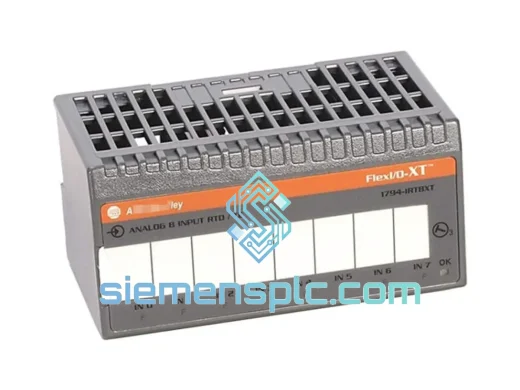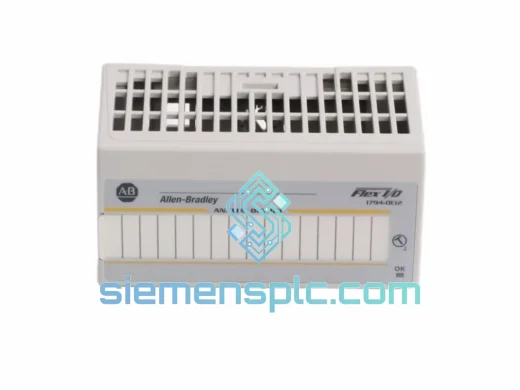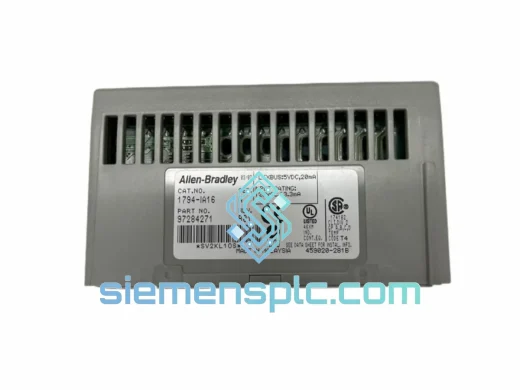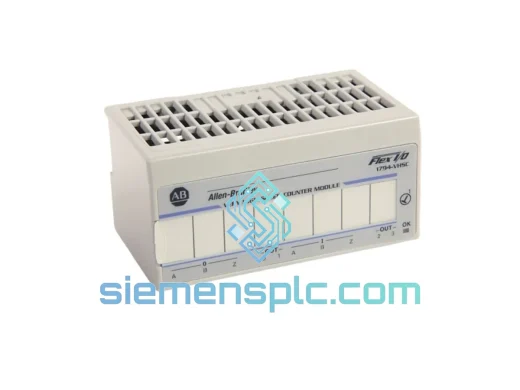
Allen-Bradley
RFQ Ready
Allen-Bradley 1794-VHSC High Speed Counter Module – FLEX I/O
Flex I/O
Origin US
High Speed Counter Module
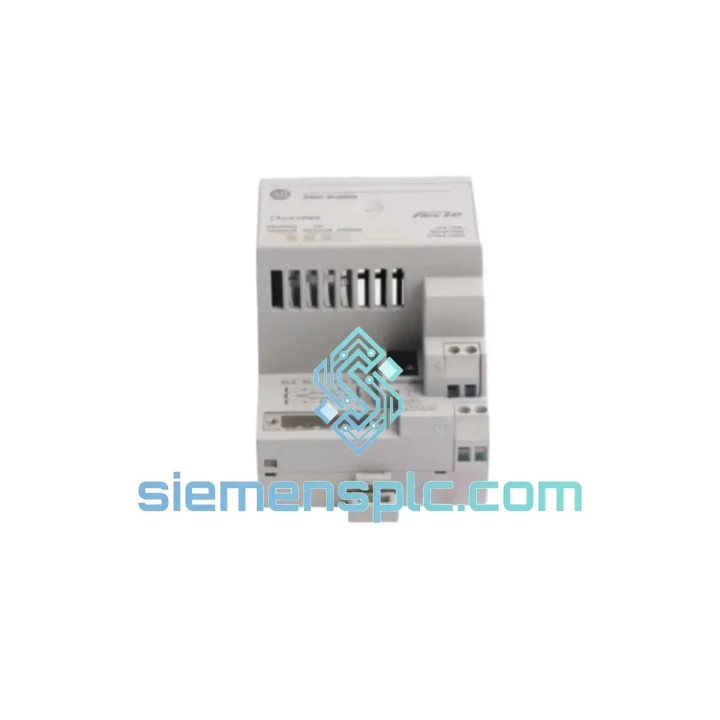
Request verified availability, condition, replacement risk review, packing options and courier lead time for 1794-AD.
Click Request Quote and the part number is inserted into the inquiry form automatically.
Core fields for model confirmation and RFQ routing. Detailed product narrative remains below.
The Allen-Bradley 1794-AD is a dedicated DeviceNet communication adapter engineered for the FLEX I/O platform. Mounted at the leftmost position of a FLEX I/O terminal base assembly, it functions as the sole network interface node for up to eight downstream I/O modules sharing a common backplane. Unlike a passive bridge, the 1794-AD maintains an independent MAC ID on the DeviceNet segment, manages the I/O data table mapping between the backplane and the upstream network scanner, and executes local node diagnostics autonomously — without consuming CPU scan cycles or requiring ladder-logic intervention.
In distributed control topologies where panel space is constrained and field-wiring reduction is a primary design objective, the 1794-AD consolidates up to 128 discrete I/O points or 8 analog channels per node onto a single DeviceNet drop. The adapter supports all three standard DeviceNet data rates — 125 Kbps, 250 Kbps, and 500 Kbps — with auto-baud detection, eliminating manual rate configuration during commissioning and reducing the probability of segment mismatch errors during system expansion or hot-swap maintenance.
The architectural separation between field-level communication and controller logic that the 1794-AD enforces reduces scan jitter, isolates network faults from the control program execution cycle, and provides a deterministic I/O update path that is essential in process and discrete manufacturing environments operating under IEC 61131-3 execution models.
Real-time Stock & RFQ: [email protected] | WhatsApp: +86 18359268345
| Parameter | Specification |
|---|---|
| Part Number | 1794-AD |
| Platform | Allen-Bradley FLEX I/O |
| Network Protocol | DeviceNet (CAN-based, IEC 62026-3) |
| Supported Data Rates | 125 Kbps / 250 Kbps / 500 Kbps (auto-baud) |
| Node Address (MAC ID) | 0–63, configurable via rotary switches |
| Max I/O Modules per Node | 8 FLEX I/O modules |
| Max Discrete I/O per Node | 128 points (64 in / 64 out) |
| Max Analog Channels per Node | 8 channels |
| Backplane Current Draw | 800 mA @ 5 VDC |
| Network Supply Voltage | 11–25 VDC (DeviceNet bus power) |
| Network Current Consumption | 40 mA @ 24 VDC (network side) |
| Operating Temperature | 0 °C to +55 °C (IEC 60068-2-1/2) |
| Storage Temperature | -40 °C to +85 °C |
| Relative Humidity | 5–95% non-condensing |
| Vibration Resistance | 2 g @ 10–500 Hz (IEC 60068-2-6) |
| Shock Resistance | 30 g operational (IEC 60068-2-27) |
| Enclosure Rating | IP20 (panel-mount, DIN-rail) |
| Dimensions (H × W × D) | 94 mm × 45 mm × 87 mm |
| Weight | Approx. 0.18 kg |
| Certifications | UL, CE, C-Tick, DeviceNet Conformance Tested |
| Country of Origin | United States |
| Warranty | 12 months from date of shipment |
The 1794-AD implements a dual-bus architecture that physically separates the DeviceNet media access layer from the FLEX I/O backplane communication layer. On the network side, the adapter’s CAN controller handles bit-level arbitration, error frame detection, and acknowledgment signaling in hardware — not firmware — which guarantees sub-microsecond error response latency independent of the adapter’s application processor load.
The backplane interface uses a proprietary synchronous serial protocol operating at a fixed clock rate, ensuring that I/O data transfers between the adapter and downstream modules complete within a bounded time window. This determinism is critical when the 1794-AD node is polled by a 1756-DNB or 1771-SDN scanner operating in a time-critical motion or process control loop.
EMC Design: The 1794-AD’s PCB layout employs ground-plane segmentation between the CAN transceiver section and the backplane logic section, with ferrite bead filtering on all inter-section signal lines. The CAN transceiver (compliant with ISO 11898-2) includes slope-control circuitry that limits dV/dt on the bus lines to reduce radiated emissions — a design choice that extends reliable network cable runs beyond the theoretical 500 m limit at 125 Kbps in environments with moderate conducted interference.
Node Address Locking: Rotary switch-based MAC ID assignment provides a hardware-enforced node address that cannot be overwritten by software commands, preventing address conflicts caused by accidental firmware downloads or network configuration tools operating on live segments.
Fault Isolation Logic: The adapter implements a watchdog timer that monitors backplane communication integrity. If a downstream I/O module fails to respond within the configured timeout window, the 1794-AD sets the corresponding module fault bit in its I/O status table and continues normal operation for all remaining modules — preventing a single module failure from taking the entire node offline.
Every 1794-AD unit supplied by siemensplc.com is sourced directly from authorized Allen-Bradley / Rockwell Automation distribution channels. Each module undergoes incoming inspection that includes visual examination of the housing, connector integrity verification, label and date-code authentication, and functional power-on testing against the manufacturer’s published I/O specification. Units that do not pass inspection are quarantined and returned — no refurbished or remarked components enter the inventory.
Our warehouse is located in Xiamen, China — a major logistics hub with direct access to international freight forwarding services via Xiamen Gaoqi International Airport and Xiamen Port. Standard export packaging uses anti-static foam inserts and moisture-barrier bags compliant with IEC 60068-2-30 humidity cycling requirements, ensuring the module arrives at its destination in the same condition it left our facility.
Typical dispatch time for in-stock units is 1–2 business days from order confirmation. International shipment options include DHL Express (3–5 business days to most destinations), FedEx International Priority, and sea freight for bulk orders. All shipments include a commercial invoice, packing list, and certificate of origin. Export classification and HS code documentation are prepared as standard for customs clearance in the EU, US, Southeast Asia, and Middle East markets.
A 12-month warranty covers all units against manufacturing defects and premature component failure under normal operating conditions as defined in the Allen-Bradley 1794-AD installation instructions (publication 1794-IN006). Warranty claims are processed within 5 business days of receipt of the returned unit.
Email: [email protected]
WhatsApp: +86 18359268345
Web: siemensplc.com
Location: Xiamen, China
© 2026 siemensplc.com. All rights reserved.
We check the full part number, brand, series and visible nameplate information before quotation.
Sales confirms stock path, condition option, quantity and realistic lead time for export dispatch.
DHL, FedEx, UPS or buyer courier arrangements can be reviewed with packing requirements.
Similar brand or category products for fast comparison and multi-item RFQ lists.