Mitsubishi Electric
RFQ Ready
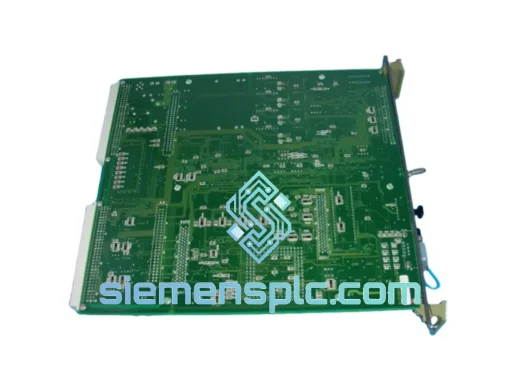
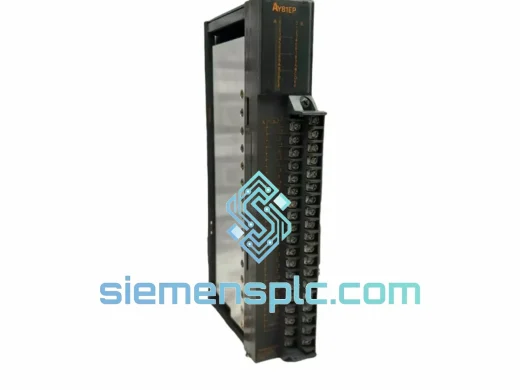
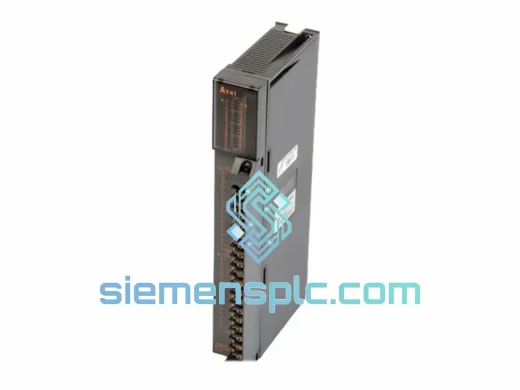
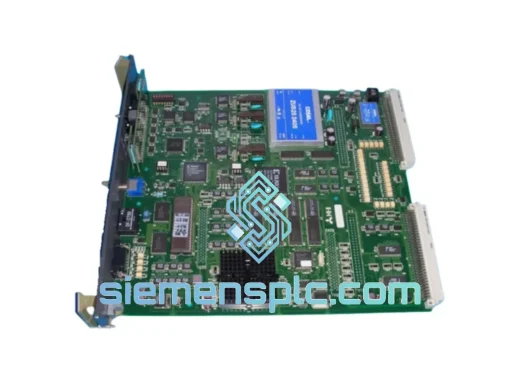
Mitsubishi Electric DOIOC11 DCS Digital Output Module
MELSEC-A
Origin JP
DCS Digital Output Module
Request verified availability, condition, replacement risk review, packing options and courier lead time for MELSEC-A.
Click Request Quote and the part number is inserted into the inquiry form automatically.
Core fields for model confirmation and RFQ routing. Detailed product narrative remains below.
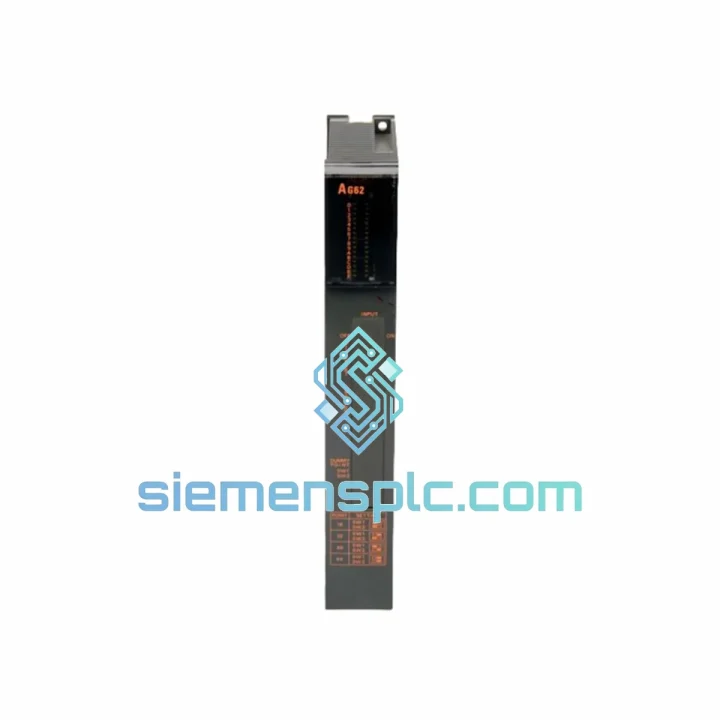
The AG62 occupies a well-defined functional position within the MELSEC-A Series backplane ecosystem: it serves as the analog signal boundary between field instrumentation and the CPU’s discrete data registers. Each of its two input channels accepts either a voltage signal (0–5 V DC, 0–10 V DC) or a current loop (4–20 mA), converting the analog value through a 12-bit successive-approximation ADC into a signed integer word that the CPU reads via the backplane bus. The two output channels perform the inverse operation — the CPU writes a 12-bit digital word, and the module’s DAC reconstructs a proportional analog signal to drive actuators, positioners, or variable-frequency drives. This bidirectional signal path makes the AG62 a compact, self-contained process interface for closed-loop PID control, ratio control, and cascade control strategies without requiring external signal conditioners.
The module draws its 5 V DC operating power directly from the MELSEC-A backplane, eliminating the need for a dedicated field-side power supply for the conversion circuitry. Field-side signal wiring connects to a removable terminal block, which allows module replacement without disturbing field wiring — a practical advantage during scheduled maintenance windows in continuous-process environments.
Real-time Stock & RFQ: [email protected] | WhatsApp: +86 18359268345
| Parameter | Specification |
|---|---|
| Model / SKU | AG62 |
| Brand | Mitsubishi Electric |
| Series | MELSEC-A |
| Module Category | Analog Input / Output (Mixed) |
| Analog Input Channels | 2 channels (individually configurable) |
| Analog Output Channels | 2 channels (individually configurable) |
| Input Signal Range | 0–5 V DC / 0–10 V DC / 4–20 mA (jumper-selectable per channel) |
| Output Signal Range | 0–5 V DC / 0–10 V DC / 4–20 mA (jumper-selectable per channel) |
| A/D Resolution | 12-bit (4,096 steps) |
| D/A Resolution | 12-bit (4,096 steps) |
| Input Impedance (Voltage) | ≥ 1 MΩ |
| Load Resistance (Current Output) | ≤ 600 Ω |
| Conversion Speed | Synchronous with CPU scan cycle |
| Isolation Method | Photocoupler (optical) isolation between field and backplane |
| Operating Temperature | 0 °C to +55 °C |
| Storage Temperature | –20 °C to +75 °C |
| Relative Humidity | 10 % to 90 % RH (non-condensing) |
| Internal Power Consumption | 5 V DC via backplane (no external supply required) |
| Applicable CPU Modules | A1CPU, A2CPU, A3CPU, A1SCPU, A2SCPU, A3NCPU |
| Compatible Base Units | A1S38B, A1S55B, A1S65B, A1S68B and standard MELSEC-A extension bases |
| Country of Origin | Japan |
| Compliance | CE, RoHS |
| Warranty | 12 months from date of dispatch |
The AG62’s internal architecture separates the field-side analog circuitry from the backplane-side digital logic through a photocoupler isolation barrier. This galvanic separation is the module’s primary EMC defense mechanism: ground loops that form between field instruments and the control cabinet chassis cannot propagate common-mode noise into the CPU’s data bus. In industrial environments where variable-frequency drives, arc welders, or large inductive loads share the same electrical infrastructure, this isolation boundary prevents the high-frequency conducted emissions from those loads from corrupting the 12-bit conversion result.
On the input path, the analog front-end uses a differential amplifier stage before the ADC. Differential measurement rejects common-mode interference that appears equally on both signal conductors — a characteristic noise pattern in long cable runs through electrically noisy cable trays. The 12-bit successive-approximation ADC samples the conditioned signal and produces a binary word that maps linearly across the configured input range. At 4,096 discrete steps over a 20 mA span, the minimum resolvable current increment is approximately 4.88 µA — sufficient for most process control applications where sensor accuracy itself is the limiting factor rather than ADC resolution.
On the output path, the 12-bit DAC reconstructs the analog signal from the CPU-written register value. The output stage includes a low-pass reconstruction filter that attenuates DAC switching artifacts before the signal reaches the field terminal. For current output mode, an internal voltage-to-current converter drives the 4–20 mA loop, maintaining loop compliance across load resistances up to 600 Ω. This compliance range accommodates most standard field devices — transmitters, I/P converters, and valve positioners — without requiring an external loop power supply booster.
The module’s conversion timing is synchronous with the CPU scan cycle. The CPU reads the input registers and writes the output registers during the END processing phase of each scan. This synchronous architecture ensures that the analog values the CPU operates on are consistent within a single scan — there is no asynchronous interrupt from the analog module that could create data coherency issues in multi-loop control programs.
Every AG62 unit dispatched from our Xiamen, China facility is a genuine Mitsubishi Electric component sourced through verified industrial supply channels. Each module undergoes a structured pre-shipment inspection: physical label and housing integrity check, connector pin alignment verification, and functional power-on confirmation where test equipment permits. Units are packed in anti-static ESD shielding bags, placed in rigid corrugated cartons with foam cushioning rated for international air freight handling, and accompanied by a dispatch inspection record.
Xiamen’s port and air freight infrastructure supports direct export to all major industrial markets. Standard shipping options include DHL Express (2–4 business days to Europe and North America), FedEx International Priority, and EMS for cost-sensitive shipments. For time-critical plant shutdowns or emergency maintenance scenarios, same-day dispatch is available for in-stock units when orders are confirmed before 14:00 CST. Export documentation — commercial invoice, packing list, and certificate of origin — is prepared for each shipment. HS Code 8537.10 applies to this module category; customs pre-clearance documentation is available on request for EU, US, AU, and Southeast Asian import requirements. Bulk order pricing and consolidated freight arrangements are available for orders of five or more units.
Email: [email protected]
WhatsApp: +86 18359268345
Web: siemensplc.com
Location: Xiamen, China
© 2026 siemensplc.com. All rights reserved.
We check the full part number, brand, series and visible nameplate information before quotation.
Sales confirms stock path, condition option, quantity and realistic lead time for export dispatch.
DHL, FedEx, UPS or buyer courier arrangements can be reviewed with packing requirements.
Similar brand or category products for fast comparison and multi-item RFQ lists.