Mitsubishi Electric
RFQ Ready
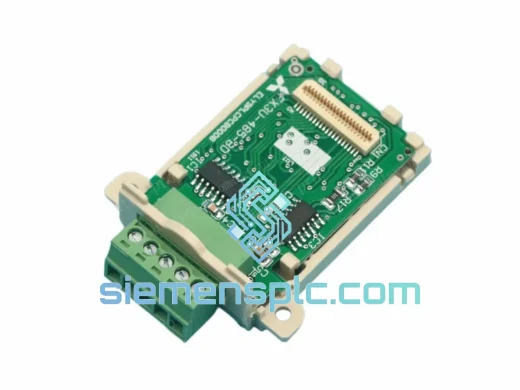
Mitsubishi FX3U-485-BD Communication Board – FX3U Series
MELSEC FX
Origin JP
Communication Board
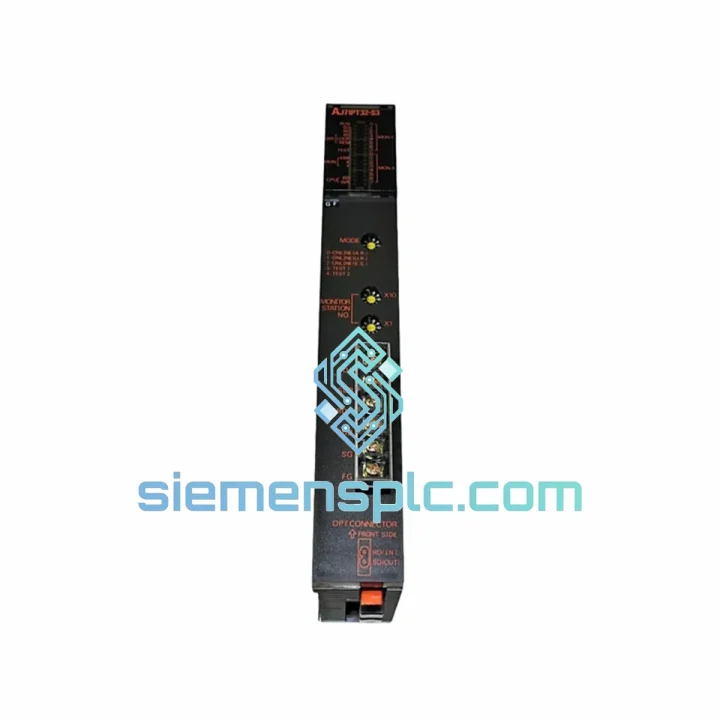
Request verified availability, condition, replacement risk review, packing options and courier lead time for AJ71PT32-S3.
Click Request Quote and the part number is inserted into the inquiry form automatically.
Core fields for model confirmation and RFQ routing. Detailed product narrative remains below.
In a distributed I/O topology built on the Mitsubishi MELSEC A-Series platform, the AJ71PT32-S3 occupies the most critical position in the communication hierarchy: the master station. Every cyclic data exchange between the CPU and up to 16 remote slave nodes passes through this module. Its token-passing arbitration logic determines the determinism of the entire field network — a 1 ms deviation in token rotation directly propagates into the CPU scan cycle as a stale input condition. Understanding this module’s internal architecture is not optional for engineers responsible for uptime.
This page provides a structured technical reference for procurement engineers, maintenance teams, and system integrators sourcing a replacement or expansion unit for an existing A-Series MELSECNET/MINI-S3 installation.
Real-time Stock & RFQ: [email protected] | WhatsApp: +86 18359268345
| Parameter | Specification |
|---|---|
| Model Number | AJ71PT32-S3 |
| Manufacturer | Mitsubishi Electric Corporation |
| Platform / Series | MELSEC A-Series |
| Module Function | MELSECNET/MINI-S3 Master Station |
| Network Protocol | MELSECNET/MINI-S3 (token-passing bus) |
| Station Role | Master only (not configurable as slave) |
| Max. Slave Stations | 16 remote I/O slave stations per master |
| Remote I/O Capacity | 256 input points / 256 output points |
| Transmission Speed | 1 Mbps |
| Transmission Medium | Coaxial cable (75 Ω, 3C-2V or equivalent) |
| Max. Segment Length | 500 m per coaxial segment at 1 Mbps |
| Backplane Power Draw | 5 VDC, 0.55 A (supplied by A-Series base unit) |
| Slot Occupancy | 1 slot in A-Series base unit |
| Operating Temperature | 0 °C to +55 °C |
| Storage Temperature | −20 °C to +75 °C |
| Relative Humidity | 10% to 90% RH, non-condensing |
| Vibration Resistance | IEC 68-2-6 compliant |
| Shock Resistance | IEC 68-2-27 compliant |
| Dielectric Withstand | 500 VAC, 1 minute (between signal and FG) |
| Weight | Approx. 0.5 kg |
| Country of Origin | Japan |
| Warranty | 12 months — covers manufacturing defects and functional failure under normal operating conditions |
Backplane Bus Interface & CPU Data Mapping
The AJ71PT32-S3 interfaces with the A-Series CPU exclusively through the internal backplane bus — a parallel, synchronous bus operating at the base unit’s native clock. The module maintains two independent data buffers in its onboard SRAM: an output image buffer (populated by the CPU’s Y-device writes via backplane DMA) and an input image buffer (written by the master’s network receive logic and read by the CPU’s X-device scan). This dual-buffer architecture decouples the CPU scan cycle from the network token rotation cycle, preventing network jitter from directly stalling the CPU ladder execution. The critical design constraint is that the CPU scan period must be shorter than the MELSECNET/MINI-S3 link scan time to guarantee data freshness; if the link scan time exceeds the CPU scan, the CPU will read the same input image twice before it is refreshed — a condition that must be accounted for in safety-critical interlock logic.
Token-Passing Arbitration Logic
MELSECNET/MINI-S3 uses a deterministic token-passing protocol on a bus topology. The master module holds the token generator: it initiates the token frame, transmits output data to slave 1, waits for the slave’s input data response, then passes the token to slave 2, and so on through all configured stations. The total link scan time is therefore a linear function of the number of active slave stations and the per-station transaction time. With 16 slaves at 1 Mbps, the worst-case link scan time is typically in the range of 3–8 ms depending on I/O point count per slave. Engineers must verify this against the CPU scan time during system commissioning using GX Developer’s network parameter diagnostics.
EMC Design & Signal Integrity
The coaxial transmission interface on the AJ71PT32-S3 uses a 75 Ω impedance-matched driver/receiver circuit. The coaxial medium provides inherent common-mode noise rejection due to its shielded geometry — the outer conductor acts as a Faraday shield, attenuating radiated EMI from adjacent VFDs, contactors, and high-current bus bars. The module’s internal signal processing includes Manchester encoding on the transmitted data stream, which embeds clock information within the data signal and eliminates DC bias accumulation on the cable — a critical property for long-segment installations approaching the 500 m limit. The module’s PCB layout isolates the high-frequency network transceiver section from the backplane bus logic using a ground plane partition, reducing conducted noise coupling between the two domains.
Onboard Diagnostics Hardware
The module provides hardware-level diagnostic visibility through a set of front-panel LED indicators: RUN (master active), ERR (network error detected), and per-station DATA LEDs where applicable. The ERR LED latches on detection of a token timeout, CRC error, or slave station dropout — conditions that are simultaneously written to the module’s error register, accessible by the CPU via special relay (M9xxx) and data register (D9xxx) areas in the A-Series system. This allows ladder logic to implement station-level fault isolation without requiring an HMI or SCADA layer.
Genuine Mitsubishi Electric Origin
Every AJ71PT32-S3 unit supplied through siemensplc.com is sourced from verified Mitsubishi Electric authorized distribution channels and authenticated OEM inventory. Each unit carries the original Mitsubishi Electric part label with date code and serial number traceable to the manufacturing batch. Before dispatch, each module undergoes a structured pre-shipment inspection protocol: visual examination of PCB, connectors, and housing for physical damage or counterfeit indicators; label and date code verification against known-good reference samples; and a power-on functional test confirming backplane communication and network port initialization.
Packaging & ESD Protection
Units are packed in anti-static ESD shielding bags, placed in foam-lined inner cartons, and sealed in double-wall corrugated outer cartons rated for international air freight handling. Moisture barrier desiccant packs are included for shipments to high-humidity destinations. Original Mitsubishi Electric packaging is preserved where available.
Export Documentation
Standard export documentation includes commercial invoice, packing list, and certificate of origin. HS Code 8537.10 is declared on all customs documents. Additional documentation — including test reports, material safety data, and end-user certificates — is available upon request for regulated-destination shipments.
Global Express Logistics from Xiamen, China
Our logistics hub is located in Xiamen, Fujian Province — a major international cargo gateway with direct DHL, FedEx, and UPS express service to over 220 countries. In-stock units are dispatched within 1–2 business days of order confirmation. Typical transit times: Southeast Asia 2–4 days, Europe 3–5 days, North America 3–6 days, Middle East 3–5 days, South America 5–8 days. Tracking numbers are provided at the time of dispatch. Expedited same-day dispatch is available for orders confirmed before 14:00 CST.
Email: [email protected]
WhatsApp: +86 18359268345
Web: siemensplc.com
Location: Xiamen, China
© 2026 siemensplc.com. All rights reserved.
We check the full part number, brand, series and visible nameplate information before quotation.
Sales confirms stock path, condition option, quantity and realistic lead time for export dispatch.
DHL, FedEx, UPS or buyer courier arrangements can be reviewed with packing requirements.
Similar brand or category products for fast comparison and multi-item RFQ lists.