Mitsubishi Electric
RFQ Ready
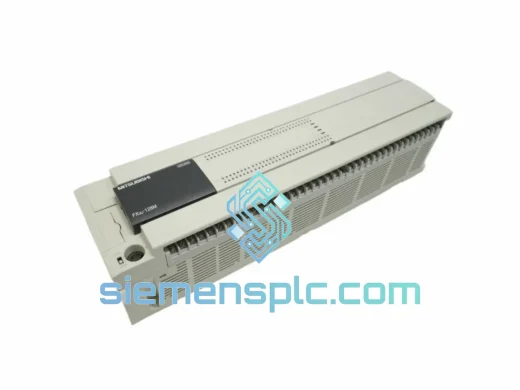
Mitsubishi FX3U-128MR/ESS PLC Module – MELSEC FX3U Series
MELSEC FX
Origin JP
PLC Main Unit
Request verified availability, condition, replacement risk review, packing options and courier lead time for FX3U-485-BD.
Click Request Quote and the part number is inserted into the inquiry form automatically.
Core fields for model confirmation and RFQ routing. Detailed product narrative remains below.
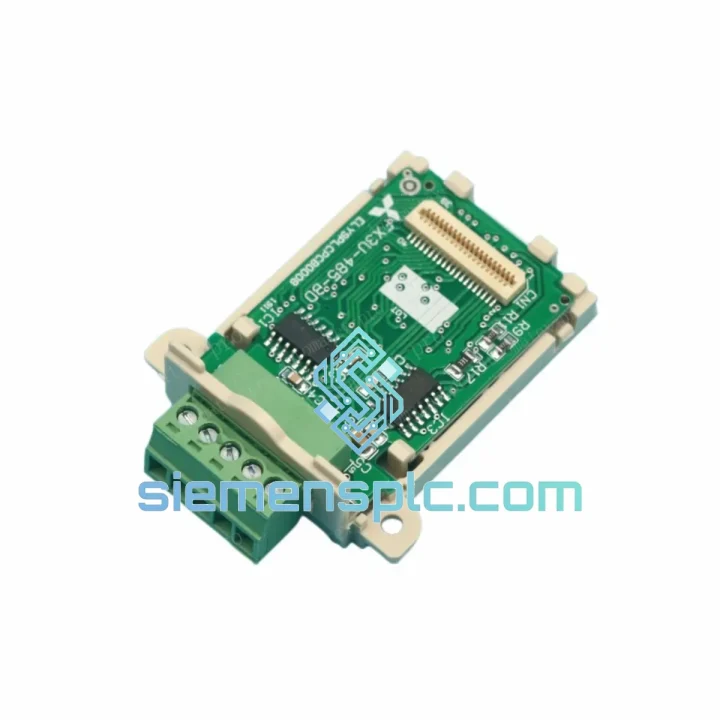
The Mitsubishi FX3U-485-BD is a plug-in RS-485 serial communication expansion board engineered for direct integration with the MELSEC FX3U programmable logic controller platform. Within a distributed control architecture, this board occupies the dedicated BD slot on the FX3U main unit and extends the CPU’s native communication capability to a balanced, differential RS-485 physical layer — enabling deterministic, noise-immune data exchange across multi-drop field bus topologies. Unlike external communication adapters that introduce additional wiring complexity and latency, the FX3U-485-BD draws its 5 VDC operating power directly from the FX3U backplane, eliminating auxiliary power supply requirements and reducing panel footprint.
In process control environments where multiple variable-frequency drives, remote I/O stations, or third-party instruments must be coordinated under a single PLC master, the FX3U-485-BD provides the physical and protocol foundation for that integration. Its support for Modbus RTU, Mitsubishi inverter communication protocol, N:N peer-to-peer network, and non-protocol (free-format) serial communication makes it applicable across a broad spectrum of industrial field bus scenarios — from simple point-to-point inverter speed reference transmission to multi-node Modbus RTU polling networks with up to 16 addressable slave devices.
Real-time Stock & RFQ: [email protected] | WhatsApp: +86 18359268345
| Model Number | FX3U-485-BD |
| Manufacturer | Mitsubishi Electric Corporation |
| Product Series | MELSEC FX3U |
| Interface Standard | RS-485 (EIA/TIA-485-A), 2-wire half-duplex / 4-wire full-duplex selectable |
| Supported Protocols | Modbus RTU (master/slave), Mitsubishi Inverter Protocol, N:N Network, Non-protocol (free format) |
| Baud Rate Range | 300 bps – 115,200 bps (software configurable) |
| Maximum Network Nodes | 16 stations (N:N Network mode); 32 nodes (Modbus RTU physical layer) |
| Connector Type | Screw-type terminal block (M3 screws) |
| Termination Resistor | Built-in switchable 110 Ω termination resistor |
| Power Source | 5 VDC from FX3U main unit backplane (no external supply required) |
| Current Consumption | 20 mA (from FX3U 5 V internal bus) |
| Operating Temperature | 0 °C to +55 °C |
| Storage Temperature | −20 °C to +70 °C |
| Relative Humidity | 5 % to 95 % RH (non-condensing) |
| Vibration Resistance | 10–57 Hz: 0.075 mm amplitude; 57–150 Hz: 9.8 m/s² (IEC 60068-2-6) |
| Shock Resistance | 147 m/s², 3 times per axis (IEC 60068-2-27) |
| Dimensions (W × H × D) | Approx. 40 mm × 90 mm × 18 mm |
| Weight | Approx. 20 g |
| Compatible PLC | FX3U series (all I/O configurations); FX3UC with FX3UC-1PS-5V adapter |
| Certifications | CE (EMC Directive 2014/30/EU), RoHS 2011/65/EU, UL 508 (as part of FX3U system) |
| Warranty | 12 months from date of shipment |
The FX3U-485-BD interfaces with the FX3U CPU module through the dedicated BD expansion connector, which provides a direct 5 V power rail and a serial data path managed by the CPU’s built-in SIO (Serial I/O) controller. This architecture means the communication timing is governed by the FX3U scan cycle and the SIO interrupt handler — not by an external UART chip with its own clock domain — which results in tighter synchronization between PLC ladder logic execution and serial frame transmission.
Differential Signal Integrity: RS-485 uses a balanced differential pair (A/B lines) with a common reference (SG). The FX3U-485-BD’s transceiver maintains a minimum differential output voltage of ±1.5 V across a 54 Ω load, well above the ±200 mV receiver threshold defined by EIA-485. This 7.5× margin provides robust noise immunity in environments with high-frequency switching noise from variable-frequency drives and servo amplifiers operating in the same panel.
Built-in Switchable Termination: Long RS-485 cable runs (typically above 10–15 m at 115,200 bps) require line termination to suppress signal reflections. The FX3U-485-BD incorporates a hardware-selectable 110 Ω termination resistor matched to the characteristic impedance of standard shielded twisted-pair cable. Enabling this resistor at the physical bus endpoints eliminates standing wave reflections that would otherwise corrupt frame parity and cause CRC errors at high baud rates.
2-Wire vs. 4-Wire Configuration: In 2-wire half-duplex mode, the board uses a single differential pair for both transmit and receive, with automatic direction control managed by the SIO controller’s RTS signal. This is the standard configuration for Modbus RTU master-slave polling. In 4-wire full-duplex mode, separate TX and RX pairs allow simultaneous bidirectional data flow, which is required for certain Mitsubishi dedicated protocols and point-to-point full-duplex links. The wiring configuration is selected at the terminal block without any firmware change.
EMC Design: The board’s PCB layout routes the RS-485 differential pair with controlled impedance traces and places decoupling capacitors at the transceiver power pins to suppress high-frequency switching transients. The terminal block includes a functional earth (FE) terminal for cable shield grounding, which, when connected to the panel earth at a single point, forms a Faraday shield that attenuates common-mode interference induced by nearby power cables.
Every Mitsubishi FX3U-485-BD unit supplied by siemensplc.com is sourced through verified industrial distribution channels with full supply chain traceability. Each unit undergoes a structured incoming inspection protocol: label and date-code verification against Mitsubishi Electric’s published part marking standards, PCB visual inspection for solder joint integrity and component placement conformance, and a functional communication handshake test at 9,600 bps and 115,200 bps to confirm transceiver operation within specification. Units that do not pass all inspection stages are quarantined and not offered for sale.
Our warehouse is located in Xiamen, Fujian Province, China — a major international logistics hub with direct access to DHL Express, FedEx International Priority, UPS Worldwide Express, and SF International services. In-stock orders placed before 15:00 CST are typically dispatched the same business day. Transit times to major destinations: Europe 3–5 business days (DHL Express), North America 3–5 business days (FedEx IP), Southeast Asia 2–3 business days (SF International). Full export documentation — commercial invoice, packing list, and certificate of origin — is provided with every shipment. HS Code: 8537.10.90. A 12-month warranty covers manufacturing defects from the date of shipment.
Email: [email protected]
WhatsApp: +86 18359268345
Web: siemensplc.com
Location: Xiamen, China
© 2026 siemensplc.com. All rights reserved.
We check the full part number, brand, series and visible nameplate information before quotation.
Sales confirms stock path, condition option, quantity and realistic lead time for export dispatch.
DHL, FedEx, UPS or buyer courier arrangements can be reviewed with packing requirements.
Similar brand or category products for fast comparison and multi-item RFQ lists.