Bently Nevada
RFQ Ready
Bently Nevada 330196-05-30-10-00 Proximity Probe – 3300 XL ETR
3301
Origin US
Proximity Probe
Request verified availability, condition, replacement risk review, packing options and courier lead time for 330104-05-15-05-02-00.
Click Request Quote and the part number is inserted into the inquiry form automatically.
Core fields for model confirmation and RFQ routing. Detailed product narrative remains below.
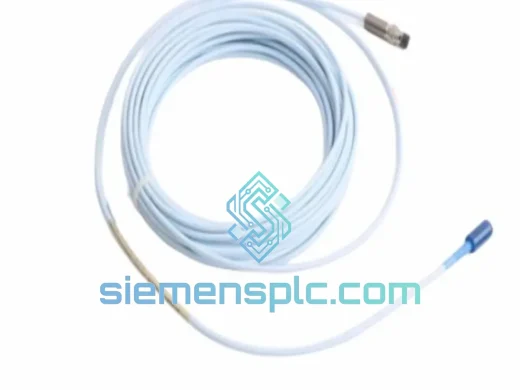
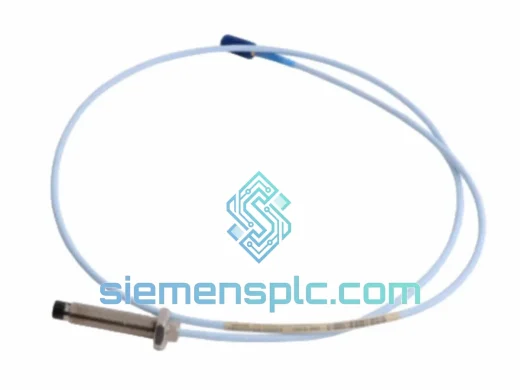
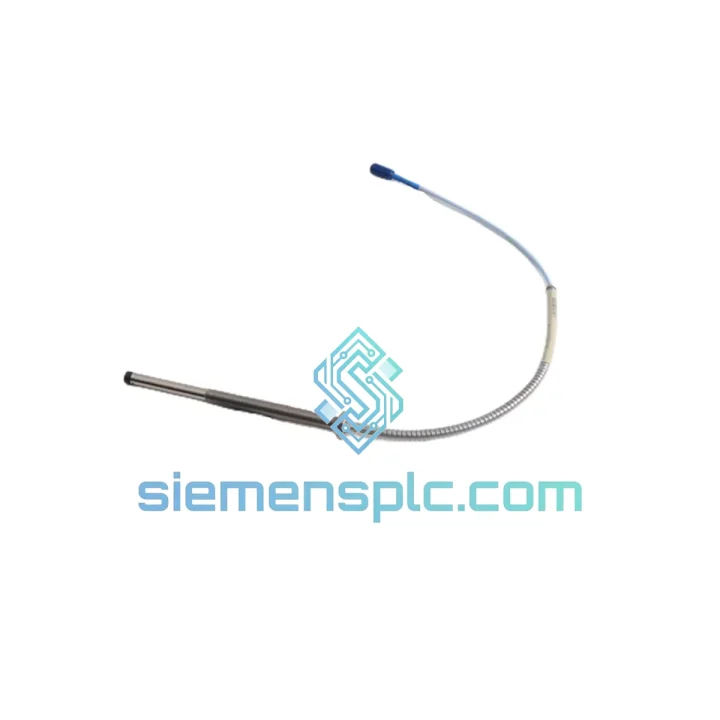
The 330104-05-15-05-02-00 is an 8 mm eddy-current proximity probe manufactured by Bently Nevada under the 3300 XL transducer platform. Its primary function within a machinery protection architecture is to generate a continuous, gap-proportional DC voltage that represents the instantaneous radial position of a rotating shaft relative to its bearing centerline. This signal is the foundational input for vibration vector computation, eccentricity trending, and trip logic execution in turbomachinery protection systems.
Unlike accelerometer-based sensing, the eddy-current proximity probe measures absolute shaft displacement — not casing-referenced velocity or acceleration. This distinction is operationally significant: in large steam turbines and centrifugal compressors, the shaft can execute sub-synchronous orbital motion at amplitudes that never exceed the casing vibration threshold, yet still indicate imminent bearing failure. The 330104-05-15-05-02-00 captures this motion with a flat frequency response from DC to 10,000 Hz, covering the full spectrum from slow-roll runout (typically 0.1–2 Hz) through high-order harmonic components associated with gear mesh or blade-pass excitation.
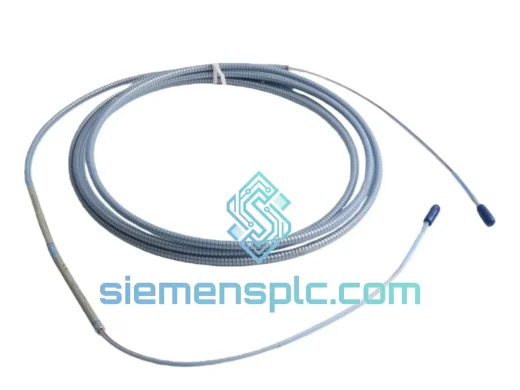
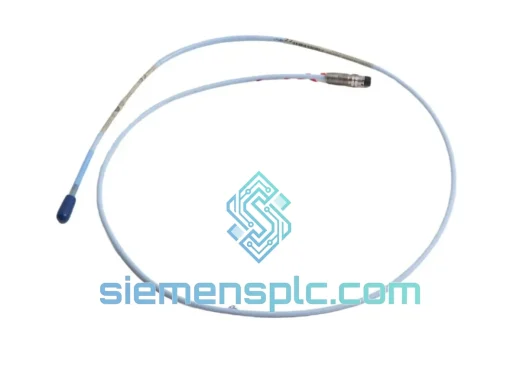
The probe integrates into the 3300 XL system as the field-mounted sensing element, paired with a 330180-series Proximitor sensor that provides oscillator drive, demodulation, and signal buffering. The Proximitor’s output — a calibrated DC voltage at 7.87 V/mm (200 mV/mil) scale factor — feeds the 3500-series monitor rack for alarm processing, OK status monitoring, and 4–20 mA retransmission to the plant DCS. This three-component chain (probe → Proximitor → monitor) is certified as a complete measurement system, and substituting any element with a non-OEM equivalent invalidates the system’s published measurement uncertainty specification.
📦 Real-time Stock & RFQ: [email protected] | WhatsApp: +86 18359268345
| Parameter | Specification |
| Part Number | 330104-05-15-05-02-00 |
| Manufacturer | Bently Nevada (Baker Hughes) |
| Product Series | 3300 XL |
| Sensing Principle | Eddy-current, non-contact inductive |
| Probe Tip Diameter | 8 mm |
| Integral Cable Length | 5 m (16.4 ft) |
| Compatible Extension Cable | 330130-050-00-00 (5 m) |
| Thread Specification | M10 × 1.0 mm pitch |
| Linear Measurement Range | 0.25 mm – 2.54 mm (10 – 100 mil) |
| Output Scale Factor | 7.87 V/mm (200 mV/mil) nominal |
| Nominal Bias Voltage (center gap) | −12.0 VDC ± 0.5 VDC |
| Supply Voltage (via Proximitor) | −24 VDC |
| Frequency Response (−3 dB point) | DC to 10,000 Hz |
| Probe Tip Operating Temperature | −35°C to +177°C |
| Cable Temperature Rating | −35°C to +121°C |
| Housing Material | 316L stainless steel |
| Tip Encapsulant | PEEK (polyether ether ketone) |
| Connector Interface | 3-pin MIL-C-5015 style |
| Calibration Target Material | AISI 4140 steel (correction factors available for other alloys) |
| Ingress Protection Rating | IP67 (probe body) |
| Hazardous Area Certification | ATEX Ex ia IIC T4 (Zone 1); FM Intrinsically Safe; CE |
| Approximate Weight | 220 g (probe body + 5 m cable assembly) |
| Warranty | 12 months from confirmed shipment date |
The operating principle of the 330104-05-15-05-02-00 is grounded in Faraday’s law of electromagnetic induction applied to a lossy conductive medium. The paired Proximitor sensor drives the probe coil with a sinusoidal oscillator signal at approximately 1 MHz. This excitation establishes a near-field electromagnetic zone extending roughly one probe diameter (8 mm) ahead of the tip face. When a ferromagnetic or conductive shaft surface enters this zone, the induced eddy currents dissipate energy from the oscillator circuit, reducing the coil’s Q-factor and shifting its resonant impedance. The Proximitor’s amplitude demodulator converts this impedance shift into a monotonically decreasing DC voltage as the gap narrows — the fundamental transduction mechanism that makes gap-to-voltage conversion linear within the specified 0.25–2.54 mm range.
Triaxial Cable Shielding and Guard Drive: The integral 5 m cable employs a triaxial conductor geometry. The center conductor carries the high-frequency oscillator signal to the coil. An inner shield, driven by the Proximitor’s guard amplifier at the same potential as the center conductor, eliminates the distributed cable capacitance as a signal-loading element. This guard drive technique is essential for maintaining measurement accuracy at frequencies above 1 kHz, where an unguarded cable of 5 m length would introduce capacitive loading equivalent to a low-pass filter with a corner frequency well below the probe’s rated 10 kHz bandwidth. The outer shield provides conventional electrostatic and electromagnetic interference rejection, referenced to system ground.
PEEK Tip Body — Dimensional and Chemical Stability: The choice of PEEK as the tip encapsulant is not incidental. PEEK exhibits a glass transition temperature of approximately 143°C and retains mechanical stiffness up to 177°C — the probe’s rated tip temperature limit. Its coefficient of thermal expansion (CTE) of ~50 µm/m·°C is substantially lower than epoxy-based alternatives (~60–80 µm/m·°C), which means the effective sensing depth of the coil shifts by less than 12 µm across the full operating temperature range. In turbine startup sequences where bearing housing temperatures rise 80–100°C within 15–20 minutes, this dimensional stability prevents thermally induced gap offset errors that would otherwise appear as false vibration amplitude increases in the monitor’s 1× vector computation.
316L Stainless Steel Housing and Corrosion Resistance: The M10 × 1 threaded housing is machined from 316L stainless steel, selected for its resistance to chloride-induced pitting corrosion in offshore and coastal installations. The low carbon content of 316L (≤0.03% C) prevents sensitization during welding or elevated-temperature exposure, maintaining corrosion resistance in the heat-affected zone around the probe mounting boss. The housing’s thread pitch of 1.0 mm provides a gap adjustment resolution of 1.0 mm per full rotation, allowing installation technicians to set the nominal −12 VDC bias point with a positioning precision of approximately ±0.05 mm using a standard spanner and digital multimeter.
Intrinsic Safety Entity Parameters: The ATEX Ex ia IIC T4 certification defines the probe’s entity parameters: maximum input voltage (Ui), maximum input current (Ii), maximum input power (Pi), and maximum internal capacitance and inductance (Ci, Li). These parameters must be compared against the Proximitor’s output entity parameters to verify that the interconnecting cable’s distributed capacitance and inductance remain within the certified safe limits. For the standard 5 m integral cable plus 5 m extension cable configuration, Bently Nevada’s published entity parameter analysis confirms compliance without additional Zener barriers, provided the cable routing does not introduce additional capacitance through parallel runs with power conductors exceeding 1 kV.
All 330104-05-15-05-02-00 units offered through siemensplc.com are procured through traceable industrial supply channels with documentation linking each unit to Bently Nevada’s manufacturing batch records. Incoming inspection at our Xiamen facility follows a three-stage protocol: (1) physical examination of the PEEK tip body for surface cracks, delamination, or connector pin deformation; (2) cable continuity and insulation resistance verification at 500 VDC (minimum acceptance threshold: 100 MΩ); and (3) bias voltage output check against the Proximitor reference to confirm the probe’s scale factor is within the ±2% factory tolerance band. Units failing any stage are segregated and returned to the supply chain — no rework or re-labeling is performed.
Dispatch originates from our warehouse in Xiamen, China, with direct access to DHL Express, FedEx International Priority, TNT, and SF International freight services. In-stock orders confirmed before 14:00 CST are typically dispatched the same business day. Export documentation is prepared in full compliance with Chinese customs regulations and destination-country import requirements, including commercial invoice, packing list, Certificate of Origin (Form A or CO), and — upon request — ATEX Declaration of Conformity and material traceability certificates. HS Code classification is 9031.80 for customs declaration purposes.
Packaging uses anti-static foam-lined cartons with sealed moisture-barrier inner bags. Probe tips are protected by machined polypropylene tip guards to prevent PEEK surface damage during transit. Shipments to the EU, Middle East, Southeast Asia, Australia, and the Americas typically arrive within 3–7 business days via express courier. For urgent requirements, same-day dispatch with next-flight-out freight options is available upon request.
📧 Email: [email protected]
📱 WhatsApp: +86 18359268345
🌐 Web: siemensplc.com
📍 Location: Xiamen, China
© 2026 siemensplc.com. All rights reserved.
We check the full part number, brand, series and visible nameplate information before quotation.
Sales confirms stock path, condition option, quantity and realistic lead time for export dispatch.
DHL, FedEx, UPS or buyer courier arrangements can be reviewed with packing requirements.
Similar brand or category products for fast comparison and multi-item RFQ lists.