Moxa
RFQ Ready
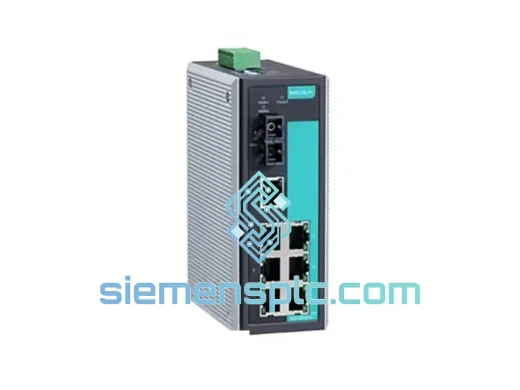
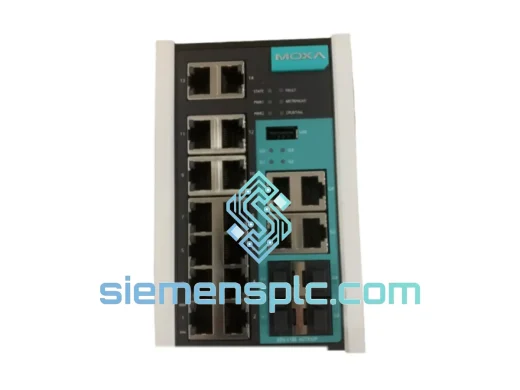
MOXA EDS-518E-4GTXSFP-T Industrial Ethernet Switch
Origin TW
Industrial Ethernet Switch
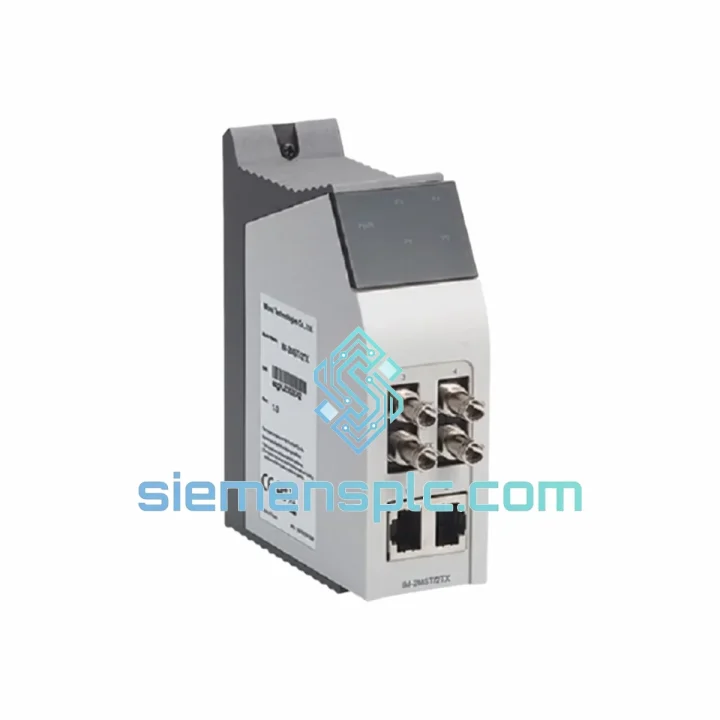
Request verified availability, condition, replacement risk review, packing options and courier lead time for IM-2MSC/2TX.
Click Request Quote and the part number is inserted into the inquiry form automatically.
Core fields for model confirmation and RFQ routing. Detailed product narrative remains below.
The MOXA IM-2MSC/2TX is a slot-in expansion module designed exclusively for MOXA’s EDS series modular managed switch chassis. Its fixed port configuration — two 100BaseFX SC multi-mode fiber ports and two 10/100BaseT(X) RJ45 copper ports — addresses a structural requirement that appears repeatedly in industrial network design: the simultaneous need for long-distance fiber backbone connectivity and short-reach copper device access within a single managed switching node, without introducing additional standalone hardware into the signal path.
In process control, discrete manufacturing, and substation automation environments, network topology decisions are constrained by cable routing distances, electromagnetic interference (EMI) exposure zones, and the physical geometry of control cabinets. The IM-2MSC/2TX resolves these constraints at the hardware level. The SC fiber ports extend segment reach to 5 km over 50/125 µm or 62.5/125 µm multi-mode fiber at a 1300 nm center wavelength. The RJ45 copper ports handle local device connections — PLCs, HMIs, remote I/O nodes, servo drives — within the same cabinet or adjacent panel. Both port types operate within the EDS switch’s unified managed forwarding plane: VLAN segmentation, QoS priority marking, RSTP ring topology participation, and port-level diagnostics apply uniformly across fiber and copper interfaces without distinction.
The module is rated for continuous operation from −40 °C to +75 °C. This specification reflects the thermal demands of outdoor enclosures, substation relay panels, and plant-floor junction boxes where ambient temperatures fluctuate well beyond the tolerance of commercial-grade networking hardware. Storage temperature extends to +85 °C, accommodating warehouse and transit conditions in tropical or desert logistics corridors. Passive thermal management — conductive heat transfer through the backplane and convective airflow within the EDS chassis — eliminates fan failure as a reliability variable in sealed enclosures where maintenance access is infrequent.
The IM-2MSC/2TX is not a standalone device. It draws power and management context entirely from the host EDS chassis. There is no separate power supply, no independent management IP address, and no additional configuration interface to maintain. All four ports appear natively within the EDS switch’s management plane — CLI, web GUI, SNMP, and RMON — as standard managed interfaces, indistinguishable in capability from the chassis’s built-in ports.
Real-time Stock & RFQ: [email protected] | WhatsApp: +86 18359268345
| Part Number / SKU | IM-2MSC/2TX |
| Brand | MOXA Technologies |
| Series | EDS Modular Expansion Module |
| Module Type | Fiber-Copper Combo Slot-in Expansion Card |
| Fiber Port Count | 2 × 100BaseFX |
| Fiber Connector | SC (duplex) |
| Fiber Mode | Multi-mode — 50/125 µm or 62.5/125 µm |
| Fiber Wavelength | 1300 nm |
| Max Fiber Segment Distance | 5 km (without repeater) |
| Copper Port Count | 2 × 10/100BaseT(X) |
| Copper Connector | RJ45 |
| Copper Speed Negotiation | Auto — 10/100 Mbps, full/half duplex |
| Auto MDI/MDI-X | Yes (copper ports) |
| Operating Temperature | −40 °C to +75 °C (−40 °F to +167 °F) |
| Storage Temperature | −40 °C to +85 °C |
| Relative Humidity | 5% to 95% RH, non-condensing |
| Module Form Factor | Slot-in expansion card for MOXA EDS modular chassis |
| Compatible Chassis | MOXA EDS-728, EDS-828 series (verify slot type before ordering) |
| Certifications | CE (EMC Directive), FCC Part 15 Class A, UL, cUL |
| Thermal Management | Passive — conductive backplane + chassis convection |
| Power Source | Supplied by host EDS chassis backplane (no external PSU) |
| Packaged Weight | Approx. 4,460 g |
| Country of Origin | China |
| Warranty | 12 months from date of dispatch |
Backplane Switching Fabric Integration: The IM-2MSC/2TX connects to the EDS chassis internal switching ASIC via the module backplane connector. Frame forwarding between fiber and copper ports occurs within the ASIC at wire speed — there is no external bridge, no protocol conversion delay, and no additional MAC address table lookup crossing a device boundary. This architecture is architecturally distinct from inserting a standalone media converter between a switch port and a fiber run: the converter adds a Layer 1 device with its own link negotiation timing and a potential single point of failure. The IM-2MSC/2TX eliminates both concerns by design.
Optical Isolation and Ground Loop Elimination: The 100BaseFX SC fiber ports provide inherent galvanic isolation between network segments. In large industrial facilities with distributed earthing systems, ground potential differences between cabinets can reach tens of volts. These potentials drive common-mode currents on copper cable shields that corrupt data and damage NIC hardware over time. Fiber interconnects carry no electrical signal between endpoints, making ground loop current physically impossible on the fiber segment. The 1300 nm wavelength on multi-mode fiber also exhibits lower modal dispersion than 850 nm alternatives at 100 Mbps, supporting the full 5 km segment distance without optical amplification or dispersion compensation.
EMC Design Posture: The module’s metal housing maintains shielding continuity with the EDS chassis enclosure. In environments with high-frequency switching noise from variable frequency drives (VFDs), servo amplifiers, or arc welding equipment, chassis-level shielding combined with the fiber ports’ immunity to conducted and radiated EMI provides a measurable reduction in bit error rate compared to all-copper topologies. The copper RJ45 ports include transformer-coupled isolation at the PHY layer, providing common-mode rejection for conducted noise arriving on the cable shield from external sources.
Passive Thermal Architecture and MTBF Implications: The −40 °C to +75 °C operating range is achieved without active cooling. Heat generated by the module’s PHY and optical transceiver circuits is conducted through the backplane into the chassis frame and dissipated by natural convection. Eliminating fans removes the highest-failure-rate mechanical component from the thermal management system. In sealed outdoor enclosures — where fan filter maintenance is impractical and fan failure may go undetected for extended periods — this passive architecture directly improves mean time between failures (MTBF) and reduces unplanned downtime risk.
Per-Port Management Granularity: Each of the four ports on the IM-2MSC/2TX is individually addressable within the EDS switch management plane. Port-level configuration — speed/duplex locking, flow control enable/disable, storm control thresholds, 802.1Q VLAN membership, 802.1p QoS priority assignment, and port mirroring — is applied per interface. This granularity allows network engineers to assign fiber uplink ports to a dedicated VLAN carrying SCADA or PROFINET traffic while placing copper ports in a separate VLAN for HMI or engineering workstation access, all within the same physical chassis and managed through a single configuration session.
Every MOXA IM-2MSC/2TX unit supplied through siemensplc.com is sourced from authenticated supply channels with traceable procurement documentation. Units are not modified, relabeled, or repackaged in any manner that alters their original factory condition. Pre-dispatch physical inspection covers label integrity, housing condition, SC connector ferrule cleanliness and end-face condition, RJ45 port contact pin alignment, and serial number consistency against MOXA’s published production records.
Functional verification includes fiber TX/RX optical power level measurement against the 100BaseFX specification window, copper port auto-negotiation confirmation at both 10 Mbps and 100 Mbps in full and half duplex modes, and backplane connector pin continuity inspection. Units that do not pass all verification steps are quarantined and not dispatched under any circumstances.
Logistics operations are based in Xiamen, Fujian Province, China, with direct access to Xiamen Gaoqi International Airport cargo facilities and Xiamen Port container terminals. Standard export shipments are dispatched via DHL Express, FedEx International Priority, or UPS Worldwide Expedited, with typical transit times of 3–7 business days to Europe, North America, Southeast Asia, the Middle East, and Oceania. Sea freight consolidation is available for bulk orders. All shipments include a commercial invoice, packing list, and certificate of origin. HS code documentation and export compliance records are provided on request for customs clearance purposes. Dangerous goods declarations are not required for this product category.
A 12-month warranty applies from the date of dispatch. Warranty claims are processed with photographic evidence of the defect and the original order reference number. Replacement units are dispatched within 3 business days of claim confirmation for in-stock SKUs. Return shipping arrangements for warranty claims are coordinated on a case-by-case basis depending on destination country customs regulations.
Email: [email protected]
WhatsApp: +86 18359268345
Web: siemensplc.com
Location: Xiamen, China
© 2026 siemensplc.com. All rights reserved.
We check the full part number, brand, series and visible nameplate information before quotation.
Sales confirms stock path, condition option, quantity and realistic lead time for export dispatch.
DHL, FedEx, UPS or buyer courier arrangements can be reviewed with packing requirements.
Similar brand or category products for fast comparison and multi-item RFQ lists.