SAIA-Burgess Controls
RFQ Ready
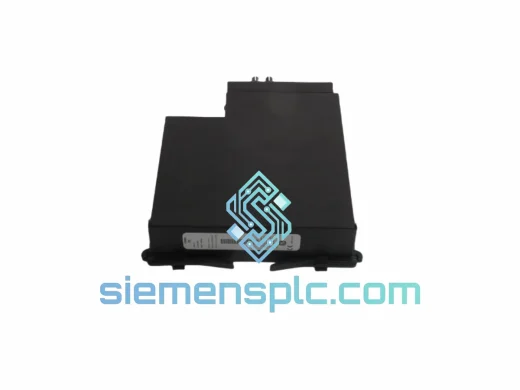
SAIA PCA1.M41M4 PLC Processor Module
Emergency Stock
Origin US
PLC Processor Module
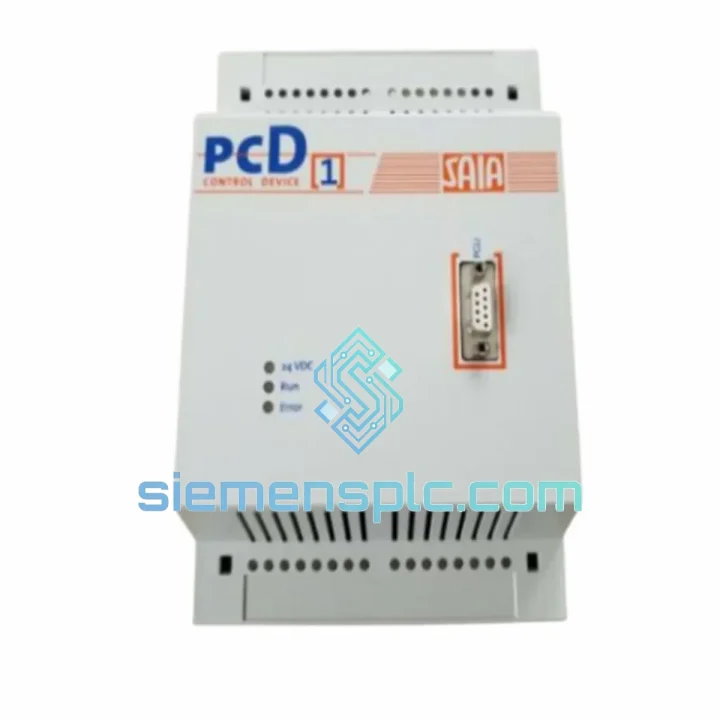
Request verified availability, condition, replacement risk review, packing options and courier lead time for PCD1.M110.
Click Request Quote and the part number is inserted into the inquiry form automatically.
Core fields for model confirmation and RFQ routing. Detailed product narrative remains below.
The SAIA PCD1.M110 is a standalone CPU processor module within the PCD1 compact controller family, manufactured by SAIA-Burgess Controls (SBC). It occupies the role of the central execution engine in a distributed control node: it fetches, decodes, and executes the user program stored in its onboard flash memory, manages the cyclic I/O scan across the local expansion bus, and arbitrates all serial communication transactions on its integrated RS-232 and RS-485 ports. Unlike larger rack-based PLCs that rely on a passive backplane for power distribution and data routing, the PCD1.M110 integrates the bus controller, power regulation, and communication front-end into a single DIN-rail-mounted housing — a design decision that reduces panel footprint and eliminates inter-board connector failure modes common in multi-slot chassis architectures.
The module operates from a 24 V DC supply rail, drawing a nominal load consistent with compact controller-class hardware. Its CPU executes the IEC 61131-3 user program in a deterministic scan cycle, with the watchdog timer providing hardware-level protection against software lockup conditions. The real-time clock (RTC), backed by an onboard lithium cell, maintains calendar time across power interruptions — a prerequisite for time-scheduled control sequences in HVAC and energy management applications.
Real-time Stock & RFQ: [email protected] | WhatsApp: +86 18359268345
| Part Number | PCD1.M110 |
| Brand / Manufacturer | SAIA-Burgess Controls (SBC) |
| Series | PCD1 Compact Controller |
| Module Classification | CPU Processor Module (standalone PLC) |
| Supply Voltage | 24 V DC (18–31.2 V DC permissible range) |
| Program Memory | 512 KB Flash (non-volatile, retains program on power loss) |
| Data Memory (RAM) | 256 KB SRAM (battery-backed for data retention) |
| Memory Expansion | Via PCD7.Mxxx memory card slot (up to 512 KB additional) |
| Serial Port 1 | RS-232, programmable baud rate up to 38,400 bps |
| Serial Port 2 | RS-485, half-duplex, up to 115,200 bps; supports S-Bus and Modbus RTU/ASCII |
| Supported Protocols | SAIA S-Bus (master/slave), Modbus RTU, Modbus ASCII |
| Onboard I/O | None (I/O via PCD1 expansion modules on local bus) |
| Max. Expansion Modules | Up to 8 PCD1 I/O modules on local expansion bus |
| Real-Time Clock | Yes — battery-backed, ±1 min/month accuracy class |
| Watchdog Timer | Hardware watchdog, configurable timeout |
| Programming Standard | IEC 61131-3 (LD, FBD, IL, ST, SFC) via SAIA PG5 IDE |
| Operating Temperature | 0 °C to +55 °C |
| Storage Temperature | −20 °C to +70 °C |
| Relative Humidity | 5–95 % RH, non-condensing |
| Protection Rating | IP20 (IEC 60529) |
| Mounting | 35 mm DIN rail (EN 60715) |
| Country of Origin | Germany |
| Warranty | 12 months from date of dispatch |
Local Expansion Bus Architecture: The PCD1.M110 drives the PCD1 local bus — a proprietary parallel bus that connects the CPU module to up to eight downstream I/O modules. The bus operates synchronously with the CPU scan cycle: at the end of each program scan, the CPU performs a single-pass I/O update, writing output image data to the output modules and reading input image data from the input modules in a fixed, deterministic sequence. This synchronous update model eliminates the race conditions that can arise in asynchronous distributed I/O architectures, making the PCD1.M110 well-suited for control loops where input-to-output latency must be bounded and predictable.
Serial Communication Front-End and Protocol Arbitration: The RS-485 port on the PCD1.M110 implements a half-duplex transceiver with automatic direction control, removing the need for external RS-232-to-RS-485 converters in multi-drop network topologies. The module’s firmware handles Modbus RTU framing — CRC-16 generation and verification, function code dispatch, and exception response generation — in a dedicated communication task that runs independently of the main user program scan. This task-level separation ensures that a slow or unresponsive Modbus slave device does not extend the user program scan cycle beyond its configured watchdog threshold.
EMC Design and Noise Immunity: The PCD1.M110 is CE-marked under the EMC Directive (2014/30/EU), tested to EN 61000-6-2 (industrial immunity) and EN 61000-6-4 (industrial emissions). The module’s PCB layout employs ground plane partitioning to isolate the digital logic domain from the communication transceiver circuits, reducing conducted and radiated emissions at the RS-485 bus interface. The 24 V DC input is filtered by an onboard LC network that attenuates high-frequency transients injected from the supply rail — a common interference source in panels where variable-frequency drives share the same DC bus.
Non-Volatile Program Retention: User programs are stored in onboard Flash memory, which retains data without battery backup for the rated lifetime of the Flash array (typically >10 years at rated erase/write cycles). This is architecturally distinct from older EEPROM-based controllers where program retention depended on the health of a backup battery. The SRAM data memory, which holds runtime variable values and retentive data registers, is separately battery-backed, allowing the controller to resume execution from its last known state after a power interruption without requiring a cold-start initialization sequence.
Every SAIA PCD1.M110 unit dispatched from our Xiamen, China facility is sourced through verified industrial automation supply channels and subjected to a structured pre-shipment inspection protocol. Each module undergoes visual examination for physical integrity — housing condition, connector pin alignment, label legibility, and absence of corrosion or mechanical damage. Part number and revision markings are cross-referenced against SAIA-Burgess Controls documentation to confirm authenticity and specification compliance. Where test equipment is available, a functional power-on verification confirms that the module initializes correctly and that the communication ports respond to diagnostic queries.
Units are packed in anti-static bags, placed in foam-lined cartons, and sealed with tamper-evident tape. Each shipment is accompanied by a commercial invoice, packing list, and — upon request — a certificate of conformity. We support all major international Incoterms (EXW, FOB Xiamen, CIF, DDP) and work with DHL Express, FedEx International Priority, and UPS Worldwide for time-critical shipments. Standard transit times to Europe and North America are 3–5 business days via express courier. All units carry a 12-month warranty from the date of dispatch, covering manufacturing defects and confirmed functional failures under normal operating conditions.
For bulk orders, project-based procurement, or urgent requirements with same-day response, contact our technical sales team directly.
Email: [email protected]
WhatsApp: +86 18359268345
Web: siemensplc.com
Location: Xiamen, China
© 2026 siemensplc.com. All rights reserved.
We check the full part number, brand, series and visible nameplate information before quotation.
Sales confirms stock path, condition option, quantity and realistic lead time for export dispatch.
DHL, FedEx, UPS or buyer courier arrangements can be reviewed with packing requirements.
Similar brand or category products for fast comparison and multi-item RFQ lists.