SST
RFQ Ready
SST ST-PFB-PLC5 PLC Communication Module – PLC5 Series
Origin CA
PLC Communication Module
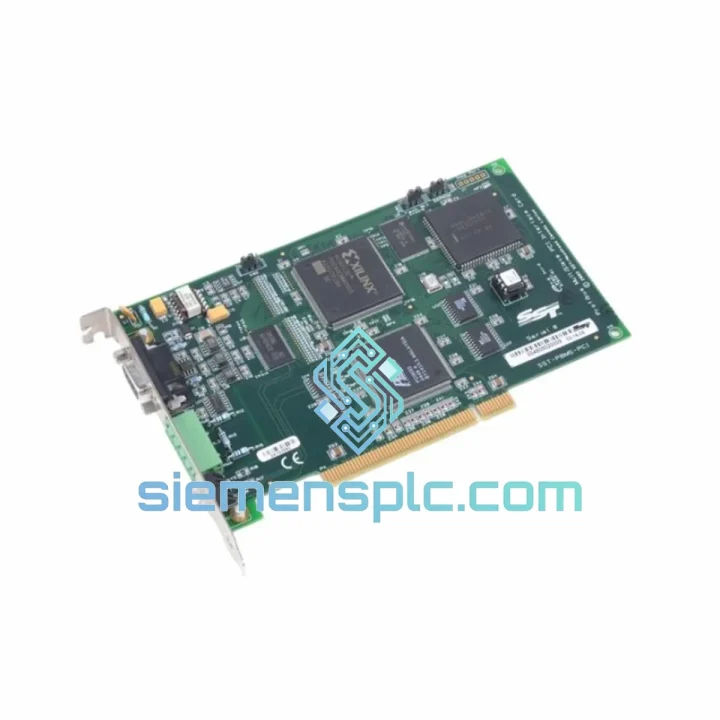
Request verified availability, condition, replacement risk review, packing options and courier lead time for SST-PBMS-PCI.
Click Request Quote and the part number is inserted into the inquiry form automatically.
Core fields for model confirmation and RFQ routing. Detailed product narrative remains below.
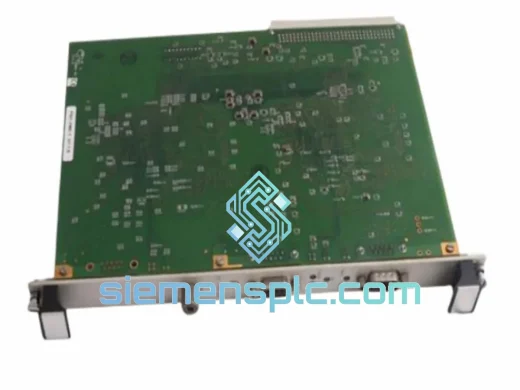
The SST-PBMS-PCI is a 32-bit PCI form-factor fieldbus interface card engineered to operate as up to eight independent PROFIBUS DP slave nodes from a single host PC slot. Unlike conventional single-slave adapters, this card embeds a dedicated PROFIBUS ASIC that handles all token-ring timing, address arbitration, and cyclic data exchange autonomously — decoupling fieldbus determinism from host OS scheduling latency. The result is a compact, cost-effective gateway architecture for PC-based SCADA, DCS integration, and HIL simulation platforms where multiple slave identities must coexist on one PROFIBUS DP segment.
Real-time Stock & RFQ: [email protected] | WhatsApp: +86 18359268345
| Parameter | Specification |
|---|---|
| Manufacturer | SST (Woodhead / Molex) |
| Part Number | SST-PBMS-PCI |
| Series | SST-PBMS (PROFIBUS Multi-Slave) |
| Form Factor | PCI 32-bit, 5 V / 3.3 V universal keying |
| Fieldbus Protocol | PROFIBUS DP (EN 50170 / IEC 61158 Type 3 / IEC 61784-1 CP 3/1) |
| Operating Mode | Slave only — up to 8 independent DP slave addresses per card |
| Supported Baud Rates | 9.6 kbps, 19.2 kbps, 45.45 kbps, 93.75 kbps, 187.5 kbps, 500 kbps, 1.5 Mbps, 3 Mbps, 6 Mbps, 12 Mbps (auto-detect) |
| Physical Interface | DB-9 female (RS-485), per PROFIBUS connector standard |
| Bus Isolation | 500 V DC galvanic (opto-isolation on RS-485 transceiver) |
| Max I/O Data per Slave | 244 bytes input + 244 bytes output (per DP slave address) |
| Host API | SST PROFIBUS DLL (C/C++, .NET wrapper); optional OPC DA server |
| OS Compatibility | Windows XP / 7 / 10 / 11 (32 & 64-bit, signed driver); Linux kernel module |
| Power Draw | ≤ 2.5 W from PCI 5 V rail |
| Operating Temperature | 0 °C to +60 °C |
| Storage Temperature | −20 °C to +85 °C |
| Relative Humidity | 5 % to 95 % non-condensing |
| PCB Dimensions | Standard PCI half-length (174.63 mm × 106.68 mm) |
| Weight | 280 g |
| Certifications | CE (EN 55032 Class A, EN 61000-4 series), FCC Part 15 Class A, RoHS 2011/65/EU |
| Warranty | 12 months from date of shipment (new stock) |
The SST-PBMS-PCI is built around a purpose-designed PROFIBUS ASIC rather than a generic UART or FPGA soft-core. This architectural choice has measurable consequences for system behavior:
On-board token-ring state machine. The ASIC maintains the PROFIBUS DP token-passing protocol entirely in silicon. When the master polls a slave address managed by this card, the ASIC responds within the protocol-mandated Tset (station delay) window without any interrupt round-trip to the host CPU. Under Windows 10 with default interrupt latency of 1–15 ms, a software-only implementation would routinely miss Tset at baud rates above 1.5 Mbps. The hardware state machine eliminates this failure mode.
Multi-slave address arbitration. Each of the eight slave addresses is maintained as an independent logical entity in the ASIC’s internal register map. The card time-multiplexes responses across addresses within a single PROFIBUS bus cycle, presenting each address to the master as a physically distinct device. The host PC reads and writes each slave’s I/O data buffer via DMA-mapped memory regions, keeping PCI bus transactions off the critical timing path.
Galvanic isolation architecture. The RS-485 transceiver is separated from the PCI logic domain by a 500 V DC opto-isolation barrier. This barrier interrupts ground-loop currents that arise when the host PC chassis ground differs from the field device reference potential — a common condition in large industrial plants where cable runs span multiple electrical panels. The isolation also clamps fast transients (IEC 61000-4-4 EFT/Burst) before they reach the PCI bus, protecting the host motherboard.
EMC design. The PCB uses a four-layer stackup with dedicated ground planes separating the digital PCI domain from the RS-485 analog domain. Ferrite beads on the DB-9 signal lines attenuate common-mode noise above 25 MHz. The card meets EN 55032 Class A radiated and conducted emission limits, making it suitable for installation in industrial control cabinets without additional shielding enclosures.
DMA data transfer. I/O data buffers for all eight slave addresses are mapped into a contiguous PCI BAR (Base Address Register) window. The host application reads process data via direct memory access, avoiding repeated port I/O calls that would serialize access and increase latency. This design keeps host CPU overhead below 2 % even when all eight slave addresses are active at 12 Mbps.
Every SST-PBMS-PCI unit dispatched from our Xiamen, China facility is sourced through verified industrial distribution channels and subjected to a structured pre-shipment verification process. Visual inspection confirms PCB integrity, connector seating, and label authenticity against manufacturer reference samples. A functional power-on test verifies PCI bus enumeration and driver recognition under Windows 10. A PROFIBUS loopback communication test at both 1.5 Mbps and 12 Mbps confirms ASIC operation and bus isolation integrity. Units are packed in anti-static ESD bags with foam inserts and a humidity indicator card, then placed in double-wall corrugated cartons rated for international air freight handling.
Shipments originate from Xiamen, China and are dispatched via DHL Express, FedEx International Priority, or UPS Worldwide Expedited depending on destination and customer preference. Standard transit times are 3–5 business days to Europe, 4–6 business days to North America, and 2–3 business days to Southeast Asia. All shipments include a commercial invoice, packing list, and HS code 8537.10 export declaration. Dual-use export compliance is confirmed prior to dispatch for all destinations. A 12-month warranty covers manufacturing defects on new-stock units, with advance replacement available for qualified accounts.
Email: [email protected]
WhatsApp: +86 18359268345
Web: siemensplc.com
Location: Xiamen, China
© 2026 siemensplc.com. All rights reserved.
We check the full part number, brand, series and visible nameplate information before quotation.
Sales confirms stock path, condition option, quantity and realistic lead time for export dispatch.
DHL, FedEx, UPS or buyer courier arrangements can be reviewed with packing requirements.
Similar brand or category products for fast comparison and multi-item RFQ lists.