Phoenix Contact
RFQ Ready
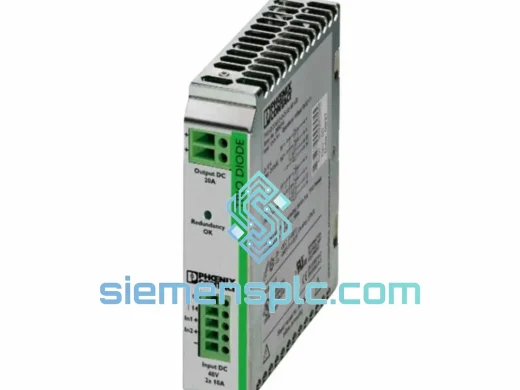
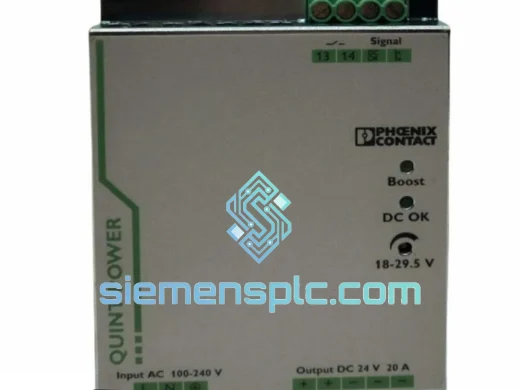
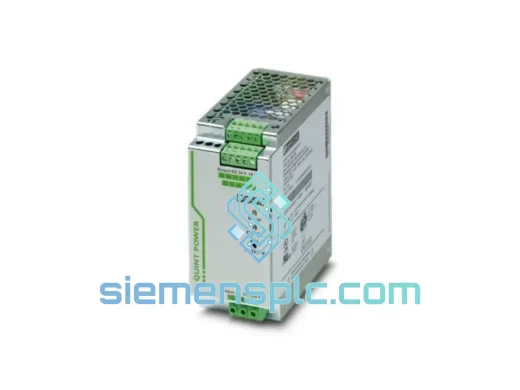
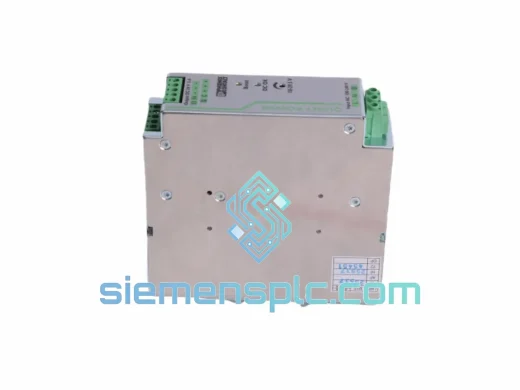
Phoenix Contact QUINT-PS/1AC/24DC/5 DIN Rail Power Supply
Origin DE
DIN Rail Power Supply
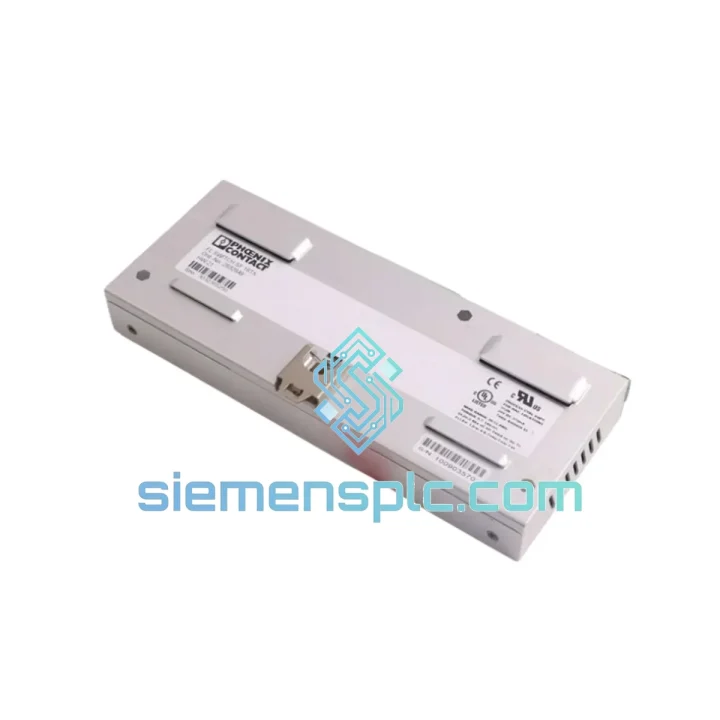
Request verified availability, condition, replacement risk review, packing options and courier lead time for STEP-PS.
Click Request Quote and the part number is inserted into the inquiry form automatically.
Core fields for model confirmation and RFQ routing. Detailed product narrative remains below.
The Phoenix Contact 2320157 belongs to the STEP-PS product family — a line of compact, DIN-rail-mounted DC/DC converters designed for secondary voltage conditioning within 24 V DC industrial panel architectures. Its functional role is precise: it accepts a regulated 24 V DC bus as its input and steps that voltage down to a lower sub-rail setpoint, supplying discrete load groups — field sensors, 4–20 mA current loop transmitters, low-power I/O interface cards, and HMI auxiliary inputs — without drawing those loads directly from the primary supply bus. The input acceptance window spans 18 V DC to 32 V DC, covering the full tolerance envelope of industrial 24 V DC systems including voltage sag during motor inrush events and transient dips during UPS switchover sequences.
In a two-stage distributed power architecture, the 2320157 occupies the second tier. A primary isolated supply — a Phoenix Contact QUINT-PS, TRIO-PS, or equivalent unit — feeds the 24 V DC bus at panel level. The 2320157 then derives a conditioned sub-rail from that bus for a specific load group, allowing the primary supply to serve the full panel while individual branches receive voltage levels matched to their load requirements. This arrangement avoids deploying a full isolated converter at each branch point, reducing bill-of-materials cost, panel volume, and grounding complexity simultaneously. The sub-rail is electrically independent from other branches in terms of voltage level but shares a common negative rail with the primary bus — a deliberate design choice that simplifies EMC bonding and eliminates floating ground documentation requirements.
The non-isolated synchronous buck topology is the correct architectural selection for this application class. In a common-ground 24 V DC panel domain — the standard configuration for the overwhelming majority of PLC-based machine control and process automation installations — galvanic isolation between input and output rails introduces unnecessary complexity: transformer copper and core losses, a floating secondary ground requiring explicit bonding, and additional thermal mass inside an already thermally constrained enclosure. The 2320157 eliminates all three. Input negative and output negative rails are electrically continuous, the efficiency curve is measurably flatter across the rated load range, and the EMC bonding scheme requires no secondary ground documentation. For panel designers working within IEC 60204-1 or NFPA 79 frameworks, this structural simplicity translates directly into reduced commissioning time and a cleaner grounding topology diagram.
Mechanical integration follows Phoenix Contact’s CLIPLINE complete ecosystem. The housing snaps directly onto EN 60715 TH 35 DIN rail via a tool-free snap-lock mechanism, aligning flush with adjacent terminal blocks, miniature circuit breakers, and other STEP-PS units without supplementary brackets or spacers. Housing width is dimensioned to preserve DIN rail space for additional components — a practical constraint in enclosures where rail length is fixed by cabinet dimensions or retrofit requirements. The UL 94 V-0 rated thermoplastic housing satisfies the flammability classification required for components installed inside industrial control panels per IEC 60204-1 and NFPA 79. IP20 protection class is appropriate for panel-mounted applications where the enclosure provides the primary environmental barrier against particulate and moisture ingress.
Regulatory compliance covers CE marking under the applicable Low Voltage and EMC Directives, UL recognition for North American markets, and RoHS conformity for restricted substance compliance. These three certifications collectively satisfy the compliance requirements for machine builders targeting EU, North American, and Asian export markets from a single component selection, eliminating the need for market-specific power supply variants in the panel design. All units supplied through siemensplc.com originate from verified procurement channels with full lot traceability to the Phoenix Contact manufacturing facility in Blomberg, Germany. A 12-month warranty from invoice date covers manufacturing defects and confirmed functional failures under rated operating conditions.
Real-time Stock & RFQ: [email protected] | WhatsApp: +86 18359268345
| Parameter | Specification |
|---|---|
| Manufacturer | Phoenix Contact |
| Part Number / SKU | 2320157 |
| Product Family | STEP-PS |
| Conversion Topology | Non-Isolated Synchronous Buck (DC/DC) |
| Nominal Input Voltage | 24 V DC |
| Input Voltage Range | 18 V DC – 32 V DC |
| Output Voltage Regulation | ±1% under dynamic load transients |
| Switching Frequency | Ultrasonic PWM — above audible range, acoustic-noise-free operation |
| Grounding Architecture | Common ground — input (−) and output (−) electrically continuous |
| Mounting Standard | EN 60715 TH 35 DIN rail, tool-free snap-lock |
| Housing Flammability Rating | UL 94 V-0 thermoplastic |
| Protection Class | IP20 |
| Operating Temperature | −25 °C to +70 °C (linear derating above 60 °C) |
| Storage Temperature | −40 °C to +85 °C |
| Thermal Management | Passive convection — no forced airflow required |
| Unit Weight | Approx. 400 g |
| Certifications | CE, UL, RoHS |
| Country of Origin | Germany |
| Warranty | 12 months from invoice date |
The 2320157 implements a synchronous buck switching architecture with a high-side N-channel MOSFET connecting the input rail to the output LC filter network at an ultrasonic switching frequency. A synchronous low-side MOSFET replaces the conventional freewheeling diode, recovering body-diode conduction loss and improving conversion efficiency at partial loads — a measurable advantage in sensor-supply sub-rail applications where the converter operates below 50% rated load for extended periods. The synchronous rectifier maintains efficiency in the range where a diode-based topology exhibits its steepest efficiency drop, reducing heat generation per watt delivered inside the panel enclosure.
The PWM controller continuously samples the output voltage through a precision resistive divider feedback network and adjusts the high-side MOSFET duty cycle in real time to maintain the regulated output setpoint. Control loop bandwidth is tuned to respond to step-load transients within microseconds, preventing output voltage excursions that would otherwise affect the measurement accuracy of 4–20 mA current loop transmitters or 0–10 V analog sensors sharing the same sub-rail. This deterministic transient response is the primary electrical argument for deploying a dedicated sub-rail converter rather than relying on the primary supply’s output regulation alone — particularly in panels where the primary supply must simultaneously manage large inductive load switching events on other branches.
EMC performance is addressed at two points in the signal chain. On the input side, a differential-mode LC filter attenuates conducted switching emissions before they propagate back onto the 24 V DC bus — critical in panels where the same bus supplies both the 2320157 and sensitive analog input modules on a Siemens S7-1500, S7-300, or equivalent PLC rack. On the output side, a low-ESR bulk capacitor bank suppresses residual switching ripple, keeping output noise below the threshold that degrades 12-bit or 16-bit analog input resolution. The housing geometry incorporates internal shielding ribs that reduce radiated emissions from the switching node, supporting compliance with EN 55011 Class A limits without external shielding enclosures or ferrite suppression components on the output wiring.
Thermal management is entirely passive. The ribbed outer surface of the thermoplastic housing acts as a natural convection radiator, dissipating junction heat through surface area rather than forced airflow. The absence of a transformer core removes the dominant source of core-loss heating present in isolated topologies, allowing the 2320157 to sustain full rated output at ambient temperatures up to 60 °C. Above 60 °C, the datasheet specifies a linear output current derating curve that must be incorporated into panel thermal calculations — particularly relevant for enclosures installed in outdoor cabinets or in proximity to variable-frequency drives generating significant radiated heat. The non-isolated common-ground architecture further simplifies the panel’s EMC bonding scheme: because input and output negative rails are electrically continuous, there is no floating secondary ground to bond, and the risk of ground potential differences generating common-mode interference on analog signal cables is eliminated by design rather than by mitigation.
Every Phoenix Contact 2320157 unit dispatched from siemensplc.com is a genuine factory-manufactured component procured through verified supply channels with full lot traceability to the Phoenix Contact production facility in Blomberg, Germany. Pre-shipment verification follows a structured four-stage protocol: (1) procurement documentation review confirming lot number, factory origin, and import records; (2) physical inspection of label typography, housing mould geometry, connector contact finish, and date code against known-genuine reference samples held in our quality library; (3) output voltage functional check under a calibrated resistive load, confirming regulation within datasheet tolerance bands; (4) anti-static bag packaging with desiccant insert and tamper-evident outer seal to maintain component integrity during international transit.
Dispatch originates from our Xiamen, China operations centre. Xiamen Gaoqi International Airport (XMN) and Xiamen Port provide direct air and sea freight connections to industrial procurement hubs across Southeast Asia, Northeast Asia, the Middle East, Europe, and the Americas. Standard lead time for stocked units is 1–3 business days from order confirmation to dispatch. DHL Express, FedEx International Priority, and UPS Worldwide Express services are available for time-critical requirements. Project-volume orders exceeding 10 units qualify for consolidated shipment arrangements and dedicated freight quotations on request. Certificate of Conformance (CoC) documentation is available for qualified orders — specify the requirement at the time of enquiry to ensure inclusion with the shipment. Dead-on-arrival (DOA) units are replaced on a priority basis with expedited re-shipment at no additional freight cost to the buyer. Warranty claims are processed through direct communication with our technical team — no third-party RMA portal or extended processing queue.
Email: [email protected]
WhatsApp: +86 18359268345
Web: siemensplc.com
Location: Xiamen, China
© 2026 siemensplc.com. All rights reserved.
We check the full part number, brand, series and visible nameplate information before quotation.
Sales confirms stock path, condition option, quantity and realistic lead time for export dispatch.
DHL, FedEx, UPS or buyer courier arrangements can be reviewed with packing requirements.
Similar brand or category products for fast comparison and multi-item RFQ lists.