
ABB
In Stock OK
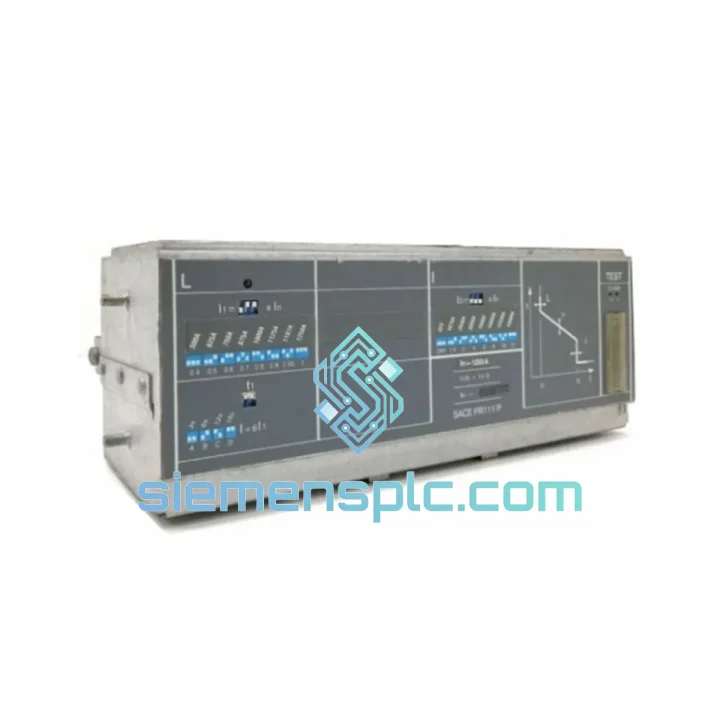
ABB SACE-PR111/P Electronic Trip Unit
Request verified availability, condition, replacement risk review, packing options and courier lead time for SACE-PR111/P.
BrandABB
Part NumberSACE-PR111/P
ConditionAvailability Check
Lead TimeRFQ Confirmation
DocumentsDatasheet / photos by RFQ
ShippingExport packing available
Auto-filled RFQ
SACE-PR111/P
Click Request Quote and the part number is inserted into the inquiry form automatically.
- Reply by email: [email protected]
- WhatsApp / Tel: +86 18359268345
- Mon-Sat 9:00-18:00 GMT+8
Procurement Data
Key Product Information
Core fields for model confirmation and RFQ routing. Detailed product narrative remains below.
- Brand
- ABB
- Primary Part Number
- SACE-PR111/P
- Product Type
- Electronic Trip Unit
- Series / Family
- SACE
- Manufacturer
- ABB (Asea Brown Boveri)
- Country of Origin
- SE
- Catalog Category
- PLCs & Controllers
Model confirmed for inquiry
SACE-PR111/P
Send quantity, destination and urgency. The RFQ form keeps this part number attached.
Request Quote
Product Overview
ABB SACE-PR111/P — Every Minute Your Emax Breaker Is Down, You’re Bleeding Money
The panel is dead. The Emax frame is sitting open. Your maintenance crew is standing around waiting for a protection release that your local distributor says is “4–6 weeks on order.” That’s not a lead time — that’s a production loss figure that will show up on next quarter’s P&L. We’ve been in that switchroom with you, metaphorically speaking, and we built our entire operation around one objective: get the right module into your hands before the situation becomes a crisis that can’t be contained.
The ABB SACE-PR111/P is a microprocessor-based electronic trip unit designed for the full Emax open-air low-voltage circuit breaker family — E1, E2, E3, E4, and E6 frames. It handles overload (L), short-circuit with time delay (S), and instantaneous (I) protection functions via hardware DIP switches, with no auxiliary power supply required. Self-powered through internal current transformers, it’s one less failure point in your protection chain. We hold verified stock in Xiamen. Confirmed orders placed before 14:00 CST ship same day via DHL Express or FedEx International Priority.
⚡ URGENT REQUIREMENT? Don’t wait for a quote form. Contact us directly:
📧 [email protected] | 💬 WhatsApp: +86 18359268345
Quick Technical Datasheet
| Part Number | SACE-PR111/P |
| Manufacturer | ABB (Asea Brown Boveri) |
| Product Series | SACE Emax — Open-Air LV Circuit Breakers |
| Device Category | Microprocessor-Based Electronic Trip Unit (ETU) |
| Compatible Frames | Emax E1 / E2 / E3 / E4 / E6 |
| Protection Functions | L — Overload (long delay) | S — Short-circuit (short delay) | I — Instantaneous |
| Parameter Setting | Hardware DIP switches — Ir, tr, Isd, tsd, Ii (two switch banks, A and B) |
| Power Supply | Self-powered via internal CTs — zero auxiliary supply dependency |
| Applicable Standard | IEC 60947-2 |
| Unit Weight | Approx. 2,040 g |
| Country of Origin | Germany |
| Stock Status | ✅ Ready to Ship — Xiamen Warehouse |
Troubleshooting & Replacement Tips
These are the failure patterns that actually appear on site — not the sanitized version in the instruction manual. If you’ve worked Emax installations for any length of time, at least two of these will look familiar.
Failure Pattern 1 — Nuisance Tripping on L-Function
The overload threshold Ir has either drifted internally or was set too tight during original commissioning. Before writing off the release, pull the actual load current from your power meter and compare it against the Ir DIP setting. A PR010/T portable test unit will tell you in under five minutes whether the release is genuinely defective or simply misconfigured. Replacing a correctly functioning release because of a wrong DIP setting is an expensive mistake.
Failure Pattern 2 — Release Powers Up, Breaker Refuses to Close
The PR111/P runs an internal self-diagnostic on every power-up cycle. If it detects a CT secondary imbalance or an internal analog fault, it will assert a close-inhibit signal — the breaker physically cannot close. This is routinely misdiagnosed as a mechanical breaker fault, leading to unnecessary frame overhauls. Swap the release first. It’s a 10-minute job and it eliminates the most likely cause before you start pulling the breaker out of the cubicle.
Failure Pattern 3 — No Trip Response on Fault Injection
Open CT secondary circuit. The most common cause is corrosion on the gold-plated plug-in connector contacts — particularly prevalent in coastal industrial environments with salt-laden air. Inspect the connector interface on both the release and the breaker frame before inserting the replacement unit. A corroded pin on the frame side will damage the new release within minutes of energization.
Failure Pattern 4 — Intermittent Spurious Trips Under Load
Vibration-induced connector loosening. The PR111/P uses a keyed plug-in connector with a locking tab. Confirm the tab is fully engaged — it should click audibly. On installations near large compressors, presses, or other high-vibration machinery, add a cable tie anchor point to the release body as a secondary retention measure.
Step-by-Step Replacement Procedure:
- Isolate the breaker and apply LOTO. Verify dead with a calibrated voltage tester — the breaker position indicator is not a substitute for a live test.
- Remove the Emax front cover (four Torx T20 screws).
- Photograph the DIP switch positions on the failed release before removal. If commissioning records are unavailable, this is your only reference for the original protection settings.
- Depress the locking tab and extract the PR111/P straight out from the plug-in connector. No twisting — the contacts are keyed but not indestructible.
- Inspect the frame-side connector for bent pins, debris, or corrosion. Address any issues before proceeding. A damaged frame connector will destroy the replacement release.
- Configure the DIP switches on the new PR111/P to match your protection coordination study values before insertion. If no study is available, use conservative defaults: Ir = 1.0×In, tr = 12s, Isd = 6×In, tsd = 0.1s, Ii = 12×In.
- Insert the replacement release firmly until the locking tab engages with an audible click. Refit the front cover.
- Perform a functional injection test using the PR010/T before re-energizing. This step is mandatory on any feeder supplying critical loads.
- Re-energize, monitor for 15 minutes, and update your maintenance log with the new release serial number and DIP switch configuration.
Configuration Note: The PR111/P is a pure hardware-configured device — there is no software upload, no fieldbus interface, no firmware to match. All protection parameters are set via the two DIP switch banks on the front face of the release. Bank A governs the L and S functions (Ir, tr, Isd, tsd). Bank B governs the I function (Ii) and the S time delay selection. This simplicity is a deliberate design choice: fewer software dependencies means fewer failure modes in the protection chain.
Reliability in Harsh Conditions
The PR111/P was not engineered for a temperature-controlled equipment room. Its design envelope covers the environments where industrial switchgear actually operates: offshore platform switchrooms with persistent salt fog, steel mill MCC rooms running at 55°C ambient, petrochemical substation buildings where vibration from rotating machinery is a continuous background condition.
The PCB assembly carries a conformal coating that provides a continuous barrier against condensation, airborne particulates, and mild chemical exposure. In practical terms, this means the release can tolerate the kind of switchroom atmosphere that accumulates over years of deferred cleaning schedules — the fine carbon dust from brush-type motors, the hydraulic mist from nearby presses, the humidity spikes that follow every monsoon season.
The self-powered architecture eliminates an entire category of failure modes. There is no auxiliary power supply board, no electrolytic capacitor bank to dry out over a decade of service, no switching regulator generating localized heat. The release draws its operating energy directly from the load current via internal CTs. When the load is flowing, the release is powered. The architecture is deliberately minimal, and that minimalism translates directly into mean time between failures.
Vibration immunity is validated to IEC 60068-2-6 sine sweep profiles. The locking plug-in connector is a functional part of this specification — a release that can vibrate loose in service is a release that will generate a spurious trip at the moment of maximum consequence. The connector design addresses this at the mechanical level rather than relying on installation practice alone.
Units dispatched from our Xiamen stock are stored in a climate-controlled warehouse, individually packaged in anti-static foam-lined enclosures, and physically inspected before dispatch. Connector pins are checked for straightness. DIP switch covers are verified present. Housing integrity is confirmed. These are the details that matter when the replacement is going into a panel at 02:00 on a Sunday morning.
Global Express Logistics
Our dispatch hub operates out of Xiamen, Fujian — a primary export gateway with direct DHL Express, FedEx International Priority, and UPS Worldwide Express access. Orders confirmed before 14:00 CST ship same day. The following transit windows are based on actual shipment history, not carrier marketing materials:
- Southeast Asia (Singapore, Malaysia, Thailand, Vietnam, Indonesia): DHL Express — 24 to 36 hours door-to-door.
- Middle East (UAE, Saudi Arabia, Qatar, Kuwait, Oman): FedEx International Priority — 48 to 72 hours.
- Europe (Germany, Netherlands, UK, France, Italy, Spain, Poland): DHL Express Worldwide — 48 to 72 hours.
- South Asia (India, Pakistan, Bangladesh, Sri Lanka): FedEx or DHL — 48 to 60 hours.
- Americas (USA, Canada, Brazil, Mexico, Chile): FedEx International Priority — 72 to 96 hours.
- Africa (South Africa, Nigeria, Egypt, Kenya, Ghana): DHL Express — 72 to 96 hours.
- Oceania (Australia, New Zealand): DHL Express — 48 to 60 hours.
Every shipment is accompanied by a commercial invoice, packing list, and certificate of origin. For orders requiring import clearance documentation, we provide HS code classification support and, where applicable, a certificate of conformity. We have executed emergency shipments to active offshore platforms, remote mining operations, and construction sites in locations that most suppliers won’t quote. If there is a DHL or FedEx collection point within 200 km of your facility, we can reach you.
Tracking numbers are issued within two hours of dispatch. For time-critical shipments, we provide direct WhatsApp status updates at each logistics milestone — departure scan, origin customs clearance, destination customs release, out-for-delivery — so your maintenance team can have the work permit prepared and the panel access arranged before the courier arrives.
Contact Information
📧 Email: [email protected]
💬 WhatsApp: +86 18359268345
🌐 Website: siemensplc.com
© 2026 siemensplc.com. All rights reserved.
Ready to quote
[email protected]
Send This Part Number to Sales
RFQ workflow
Quality workflow ->
Confirmation Process
01Model confirmation
We check the full part number, brand, series and visible nameplate information before quotation.
02Availability reply
Sales confirms stock path, condition option, quantity and realistic lead time for export dispatch.
03Packing & courier
DHL, FedEx, UPS or buyer courier arrangements can be reviewed with packing requirements.
Continue sourcing
Browse full catalog ->
Related Automation Parts
Similar brand or category products for fast comparison and multi-item RFQ lists.
ABB
RFQ Ready
ABB NXE100-1608DBW Motion Controller – ACS880 Series
ACS880
Origin SE
Motion Controller
ABB
RFQ Ready
ABB DSQC669 3HAC027652-001-02 Main Computer Unit – IRC5
IRC5
Origin SE
PLC & Robot Controller Module