
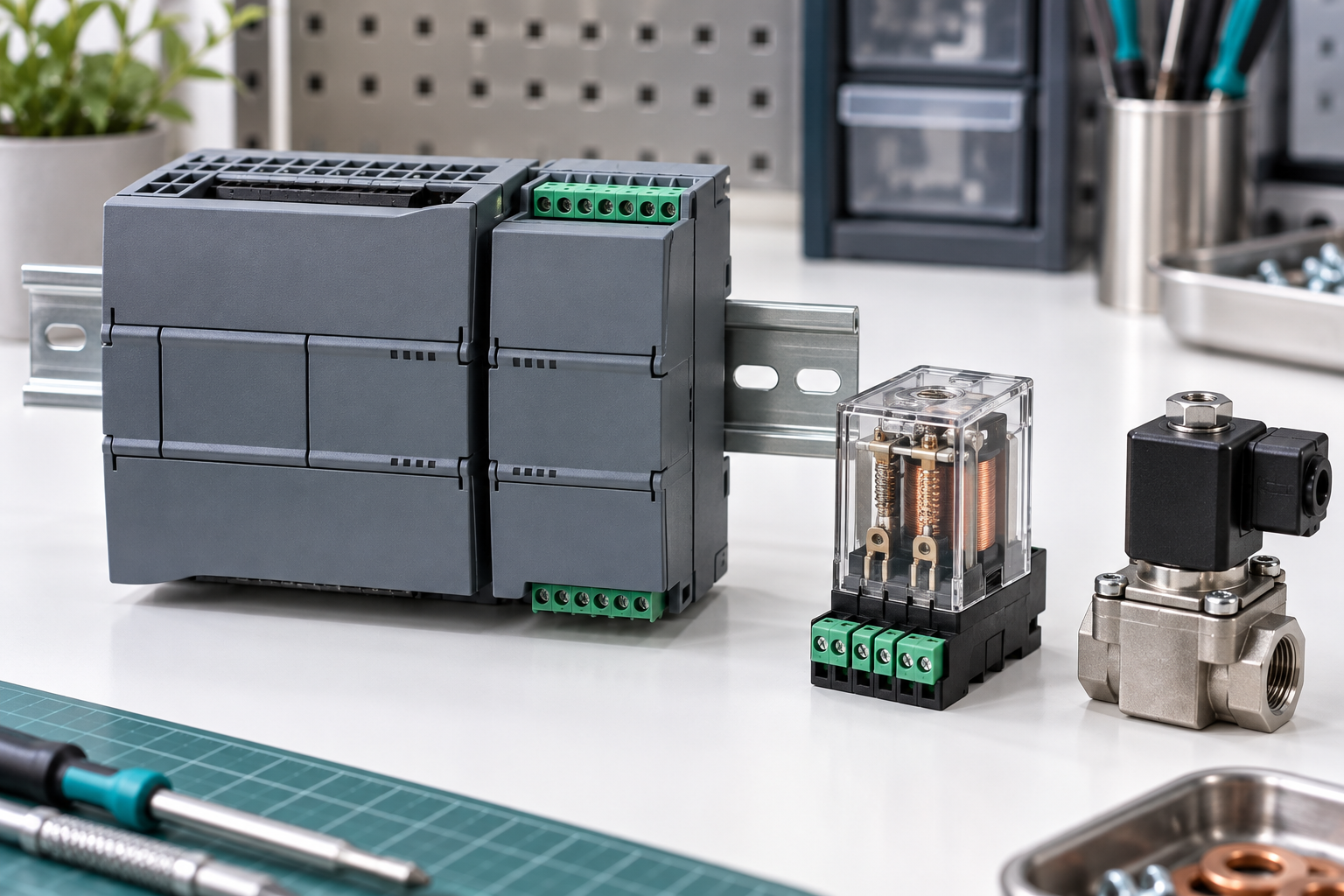
“SM 1222 output module” is not a complete spare specification. Within the SIMATIC S7-1200 family, that description can refer to different channel counts and output technologies. A module that fits the expected product family can still be wrong for the load circuit. The difference between relay and transistor outputs belongs at the beginning of the purchasing decision, not in the commissioning team’s discovery list.
The practical objective is simple: retain the behavior of the approved machine circuit. That means checking what is switched, how it is supplied, how often it operates and what happens when the output is off. A larger current figure on a product headline does not settle those questions.
Two real references, not two interchangeable choices
Siemens identifies 6ES7222-1BH32-0XB0 as an SM 1222 with sixteen 24 V DC transistor outputs. The 6ES7222-1HF32-0XB0 datasheet describes eight relay outputs. Both carry the SM 1222 designation, but their headline functions already demonstrate why the full order number matters.
If the installed machine uses the sixteen-channel transistor version, an enquiry for the 6ES7222-1BH32-0XB0 digital output module should preserve that exact reference and the existing circuit requirements. If the installed design instead calls for the 6ES7222-1HF32-0XB0 relay output module, specify it explicitly. These links are sourcing references, not an approved substitution pair.
Describe the load before comparing the module
Begin with the controlled device: a contactor coil, solenoid, indicator or external interface input. Record its rated supply and relevant switching characteristics from the device data. A steady-state current alone may not describe starting demand or the effect of an inductive load. The external circuit also determines what protective and suppression components are required.
Next, identify how many outputs operate together. A permitted per-channel current does not erase group limits or environmental restrictions. The complete datasheet and system manual should be checked for the exact module and installation orientation. Do not multiply a headline channel rating by the number of terminals to invent a total module capacity.
Finally, record switching frequency and the required response. A relay contact is a mechanical switching element with application-dependent life. A transistor output has different electrical behavior and limitations. Neither technology should be selected by the assumption that “solid state is always better” or “a relay is always more flexible.”
The off state matters too
Machine functions depend on more than an output turning on. Review how the connected equipment behaves when the command is removed, when power is interrupted and during a fault or restart. A device that is sensitive to residual current or a changed circuit reference may not behave as expected after an unreviewed technology change.
Do not treat this as permission to modify the wiring until the machine appears to work. An output change can affect external protection, suppression, diagnostics and timing. Any redesign requires the responsible engineer’s approval and the appropriate machine validation. Standard outputs must not be assumed to implement a safety-rated function.
For a repair, matching the approved installed reference is normally a much narrower task than converting the circuit to another output technology. Keep those two scopes separate in the purchase request. A supplier offering an alternative should identify it as a deviation requiring review, not simply as a stronger replacement.
Keep electrical scope and software scope together
A change in channel count can also change the hardware configuration and allocation of signals. Preserve the approved project and the installed module identification before maintenance. The person approving the spare should know whether the work is an identical replacement or a hardware configuration change.
For a planned conversion, build a channel-by-channel mapping from the existing circuit to the proposed arrangement. Identify unused channels, common groups and dependencies on external devices. Have the integration team define the required commissioning tests and expected results. A clean online diagnostic view does not demonstrate that every field device is connected to the intended command.
When the original project is unavailable, escalate that limitation early. Buying a physically suitable module does not recover missing engineering knowledge. Allocate time to establish the approved configuration rather than forcing the shutdown team to reconstruct it under pressure.
What a useful spare record contains
The stores description should include the complete Siemens order number, output technology, channel count, required condition and any approved revision constraints. Link it to the machine and the controlled circuit documentation. Include a clear label photograph so receiving inspection can compare the supplied item without relying on a shortened invoice.
For quotation review, separate the requested part from any offered alternative. Ask for current availability, delivery, warranty and supplied condition; a product page alone is not a stock commitment. If several machines use different SM 1222 versions, keep distinct stock records. A shared family label is useful for searching, but unsuitable as the sole issue-control field.
Frequently asked purchasing questions
Can an eight-output relay module replace a sixteen-output transistor module?
Not as a like-for-like spare. Channel count, electrical behavior and configuration differ. Any proposed conversion is an engineering change requiring a reviewed circuit and commissioning scope.
Does the relay’s current rating make it suitable for every smaller load?
No. Check load type, switching duty, contact requirements and the complete permitted operating conditions. A single current figure is not a complete compatibility assessment.
Can we select a module from a cabinet photograph?
Use the full label and approved equipment record. Similar housings and the SM 1222 family name do not identify output technology or every order-code difference.
What information should accompany an urgent request?
Send the full order number, label image, quantity, condition preference and destination. State whether the job is an identical replacement or a proposed conversion and identify unresolved engineering requirements.
Contact the SiemensPLC team with the installed reference for a targeted quotation. Keeping the full output identity in the enquiry helps preserve the machine’s approved electrical design and avoids buying a different project by accident.
Image: AI-generated editorial illustration, not an exact product photograph or installation reference.
© 2026 SiemensPLC. All rights reserved. Official Website: https://siemensplc.com Inquiry: [email protected] | WhatsApp/Tel: +86 18359268345