ABB
In Stock OK
ABB GJR2396200R1210 83SR51R1210 PLC CPU Module – AC500 Series
Request verified availability, condition, replacement risk review, packing options and courier lead time for GJR2396200R1210 83SR51R1210.
BrandABB
Part NumberGJR2396200R1210 83SR51R1210
ConditionAvailability Check
Lead TimeRFQ Confirmation
DocumentsDatasheet / photos by RFQ
ShippingExport packing available
Auto-filled RFQ
GJR2396200R1210 83SR51R1210
Click Request Quote and the part number is inserted into the inquiry form automatically.
- Reply by email: [email protected]
- WhatsApp / Tel: +86 18359268345
- Mon-Sat 9:00-18:00 GMT+8
Procurement Data
Key Product Information
Core fields for model confirmation and RFQ routing. Detailed product narrative remains below.
- Brand
- ABB
- Primary Part Number
- GJR2396200R1210 83SR51R1210
- Product Type
- PLC CPU Module
- Series / Family
- AC500
- Country of Origin
- SE
- Catalog Category
- PLCs & Controllers
- Operating Temp.
- -25 °C to +60 °C
- Warranty
- 12 months from dispatch date
Model confirmed for inquiry
GJR2396200R1210 83SR51R1210
Send quantity, destination and urgency. The RFQ form keeps this part number attached.
Request Quote
Product Overview
ABB GJR2396200R1210 83SR51R1210 — AC500 Series CPU Control Module: Role in the Control Loop
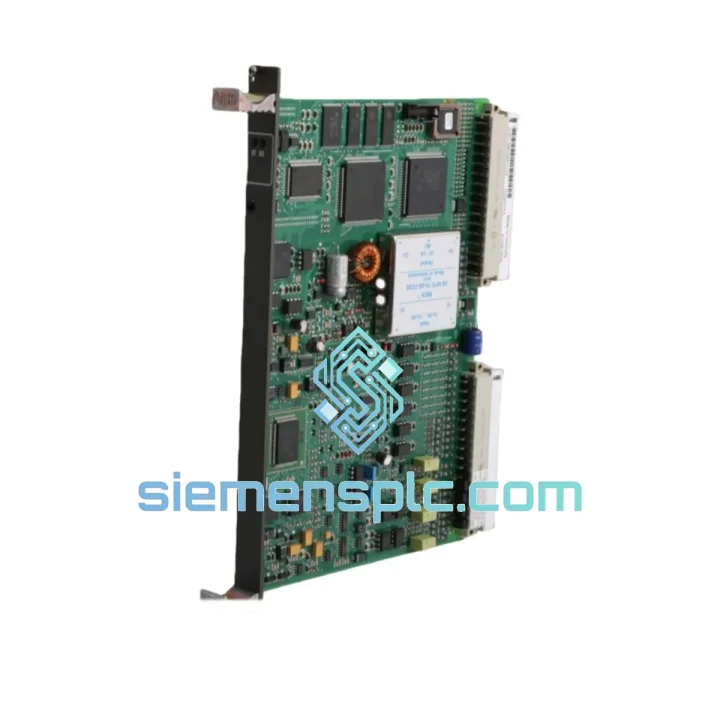
The ABB GJR2396200R1210, catalog order code 83SR51R1210, is a CPU-class programmable logic controller module within ABB’s AC500 platform. Its function in a control loop is not peripheral — it is the deterministic execution engine that arbitrates all I/O scan cycles, fieldbus communication scheduling, and application task preemption. In a distributed control architecture, this module occupies the position of the primary processing node: it reads physical process values from attached I/O modules via the internal S500 bus, executes the user application compiled under IEC 61131-3, and writes actuator commands back within a bounded cycle time. The module’s internal watchdog timer enforces scan-cycle integrity; any overrun triggers a controlled fault state rather than allowing undefined output behavior — a design requirement for process-critical installations.
Unlike general-purpose embedded controllers, the GJR2396200R1210 is architected for deterministic real-time response. Its task scheduler supports multi-tasking with configurable priority levels, allowing time-critical motion or safety-adjacent routines to preempt lower-priority communication tasks without jitter accumulation. This characteristic makes it suitable for applications where output latency directly affects process quality — for example, dosing control in pharmaceutical batch reactors or tension regulation in web-handling machinery.
Real-time Stock & RFQ: [email protected] | WhatsApp: +86 18359268345
Technical Parameters
| Parameter | Specification |
|---|---|
| Part Number | GJR2396200R1210 |
| Order / Catalog Code | 83SR51R1210 |
| Brand | ABB |
| Series | AC500 |
| Module Classification | CPU / Central Processing Unit Module |
| Mounting | 35 mm DIN rail (EN 60715) |
| Supply Voltage | 24 V DC (via AC500 power supply module) |
| Operating Temperature | -25 °C to +60 °C |
| Storage Temperature | -40 °C to +70 °C |
| Relative Humidity | 5 % to 95 %, non-condensing |
| Protection Degree | IP20 (module body) |
| Programming Standard | IEC 61131-3 (LD, FBD, ST, IL, SFC) |
| Programming Environment | ABB Automation Builder (CoDeSys-based) |
| Fieldbus Interfaces | CS31, PROFIBUS DP, Modbus RTU/TCP, Ethernet/IP (via CM modules) |
| Internal Bus | S500 I/O expansion bus |
| Weight | Approx. 380 g |
| Certifications | CE, UL 508, RoHS 2011/65/EU |
| EMC Standards | EN 61000-6-2 (immunity), EN 61000-6-4 (emission) |
| Warranty | 12 months from dispatch date |
Hardware Logical Analysis
S500 Backplane Bus Architecture: The GJR2396200R1210 communicates with attached I/O modules through ABB’s proprietary S500 local bus. This parallel bus architecture provides deterministic data transfer between the CPU and up to 10 local I/O modules per station without the arbitration overhead inherent in serial fieldbus topologies. The bus cycle is synchronous with the CPU scan cycle, eliminating the asynchronous latency that would otherwise introduce jitter into time-sensitive control loops. Engineers designing high-speed packaging or press-brake control benefit directly from this synchronous coupling.
EMC and Electrical Isolation Design: The module’s I/O interface circuitry incorporates optocoupler-based galvanic isolation between the field-side signals and the CPU logic domain. This isolation barrier — typically rated at 500 V AC or higher in ABB’s AC500 I/O modules — prevents ground-loop currents and transient voltage spikes originating from inductive field devices (contactors, solenoid valves, motor starters) from propagating into the processor’s logic supply rail. The PCB layout follows IEC 61000-4-4 burst immunity requirements, with dedicated ground planes and filter capacitors at all field-side entry points. In environments with variable-frequency drives or arc welding equipment operating in proximity, this isolation architecture is not optional — it is the primary defense against spurious CPU resets.
Watchdog and Fault Containment Logic: An independent hardware watchdog timer monitors the CPU’s main execution loop. If the application task fails to service the watchdog within the configured timeout window (typically 10–500 ms, user-configurable), the watchdog asserts a hardware reset and drives all digital outputs to their defined safe state (de-energized by default). This fail-safe behavior is implemented in hardware, independent of the application firmware, ensuring that a software hang cannot leave field actuators in an indeterminate state. For process applications where an energized output represents a hazardous condition, this architecture provides a measurable layer of risk reduction.
Non-Volatile Memory and Retain Variables: Application programs and configuration data are stored in internal flash memory, eliminating battery dependency for program retention. Retain variables — process setpoints, counters, and accumulated values that must survive a power cycle — are stored in a dedicated FRAM (ferroelectric RAM) region. FRAM provides byte-level write granularity with endurance exceeding 10¹⁰ write cycles, far exceeding the EEPROM technology used in earlier PLC generations. This is particularly relevant for applications with frequent power interruptions, such as mobile equipment or remote pump stations on unreliable grid supplies.
System Integration Benefits
- Deterministic Multi-Task Scheduling: The CPU supports configurable task priorities with preemptive scheduling. Time-critical tasks (e.g., 1 ms cycle for position control) execute without interference from lower-priority communication or diagnostic tasks, maintaining output timing accuracy across varying system loads.
- Transparent Diagnostic Reporting: The module exposes structured diagnostic data — CPU load percentage, task cycle times, communication error counters, and I/O module fault codes — via the programming interface and fieldbus. Maintenance engineers can interrogate these values from a SCADA HMI without interrupting production, reducing mean time to diagnose (MTTD) for intermittent faults.
- Modular Scalability Without Re-Engineering: The AC500 platform allows I/O expansion from a single local station to distributed remote I/O via CS31 or PROFIBUS without modifying the CPU hardware. A machine initially built with 64 I/O points can be expanded to 512+ points by adding I/O modules and updating the software configuration, protecting the original engineering investment.
- IEC 61131-3 Code Portability: Application logic written in Structured Text or Function Block Diagram for this module can be migrated to other IEC 61131-3 compliant platforms with minimal rework. This reduces vendor lock-in risk and simplifies multi-site standardization for OEMs supplying machines to customers with diverse PLC preferences.
- Integrated Fieldbus Gateway Capability: By adding ABB CM communication modules to the same DIN rail station, the GJR2396200R1210 can simultaneously master a PROFIBUS DP network and act as a Modbus TCP slave — enabling bidirectional data exchange between legacy serial devices and modern Ethernet-based SCADA systems without an external protocol converter.
- Hot-Swap Compatible I/O Expansion: AC500 S500 I/O modules support replacement under power in certain configurations, allowing maintenance teams to swap a failed analog input card without a full system shutdown. The CPU detects the module reinsertion, re-initializes the channel configuration, and resumes normal operation — a capability that directly reduces unplanned downtime in continuous-process facilities.
- Wide Operating Temperature Tolerance: The -25 °C to +60 °C operating range accommodates outdoor enclosures in temperate and sub-arctic climates without supplemental heating, and high-ambient industrial environments such as foundries or glass plants without forced cooling. This eliminates the cost and maintenance burden of thermal management accessories in many installations.
- Long-Term Platform Availability Commitment: ABB’s AC500 platform has maintained backward hardware and software compatibility across multiple generations. Spare parts and replacement modules remain available for systems commissioned over a decade ago, reducing the total cost of ownership for OEMs and end-users who cannot afford mid-lifecycle platform migrations.
Quality Assurance & Global Logistics
Every ABB GJR2396200R1210 unit dispatched from our Xiamen, China facility is sourced through established industrial supply channels and subjected to a structured pre-shipment verification process. Physical inspection confirms label integrity, part number accuracy, and absence of mechanical damage. Where applicable, firmware version is recorded and matched against the customer’s specified revision. Units are packaged in anti-static bags with desiccant and humidity indicator cards, then secured in double-wall corrugated cartons rated for international air freight handling.
Export documentation — commercial invoice, packing list, and certificate of origin — is prepared to the importing country’s customs requirements, minimizing clearance delays. Shipments are dispatched via DHL Express, FedEx International Priority, or UPS Worldwide Expedited, with tracking numbers provided within 24 hours of dispatch. Transit times to major industrial hubs: Europe 3–5 business days, North America 4–6 business days, Southeast Asia 2–3 business days. For project orders requiring phased delivery or consolidated shipment with other automation components, our logistics team coordinates multi-line BOM fulfillment from a single Xiamen dispatch point.
All units carry a 12-month warranty from the dispatch date. Warranty claims are processed with a target response time of 48 hours. Defective units are replaced or credited; no-fault-found returns are accepted within 30 days of delivery subject to inspection.
Contact Information
Email: [email protected]
WhatsApp: +86 18359268345
Web: siemensplc.com
Location: Xiamen, China
© 2026 siemensplc.com. All rights reserved.
Ready to quote
[email protected]
Send This Part Number to Sales
RFQ workflow
Quality workflow ->
Confirmation Process
01Model confirmation
We check the full part number, brand, series and visible nameplate information before quotation.
02Availability reply
Sales confirms stock path, condition option, quantity and realistic lead time for export dispatch.
03Packing & courier
DHL, FedEx, UPS or buyer courier arrangements can be reviewed with packing requirements.
Continue sourcing
Browse full catalog ->
Related Automation Parts
Similar brand or category products for fast comparison and multi-item RFQ lists.
ABB
RFQ Ready
ABB 1SVR427075R0000 CP-A CM PLC CPU Module – AC500 Compact Series
AC500
Origin SE
PLC CPU Module