ABB
In Stock OK
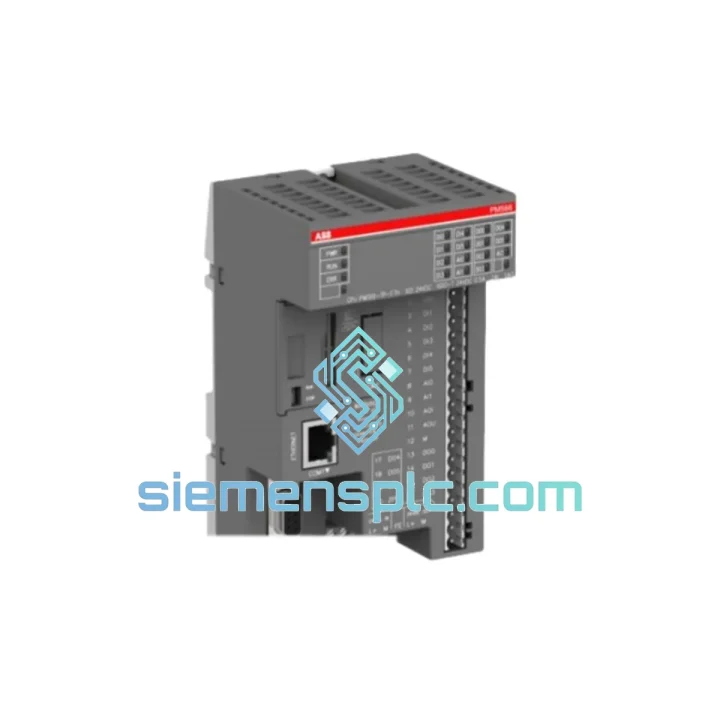
ABB PM566-TP-ETH 1SAP121500R0071 PLC CPU Module – AC500 Series
Request verified availability, condition, replacement risk review, packing options and courier lead time for PM566-TP-ETH.
BrandABB
Part NumberPM566-TP-ETH
ConditionAvailability Check
Lead TimeRFQ Confirmation
DocumentsDatasheet / photos by RFQ
ShippingExport packing available
Auto-filled RFQ
PM566-TP-ETH
Click Request Quote and the part number is inserted into the inquiry form automatically.
- Reply by email: [email protected]
- WhatsApp / Tel: +86 18359268345
- Mon-Sat 9:00-18:00 GMT+8
Procurement Data
Key Product Information
Core fields for model confirmation and RFQ routing. Detailed product narrative remains below.
- Brand
- ABB
- Primary Part Number
- PM566-TP-ETH
- Product Type
- PLC CPU Module
- Series / Family
- AC500
- Country of Origin
- SE
- Catalog Category
- PLCs & Controllers
- Warranty
- 12 months from dispatch date
Model confirmed for inquiry
PM566-TP-ETH
Send quantity, destination and urgency. The RFQ form keeps this part number attached.
Request Quote
Product Overview
ABB PM566-TP-ETH 1SAP121500R0071 — Ethernet-Integrated CPU Module for AC500 Scalable PLC Platforms
The ABB PM566-TP-ETH (order code 1SAP121500R0071) is a mid-range CPU module within ABB’s AC500 programmable logic controller family. It occupies the central position in a modular control architecture: executing the user program, arbitrating I/O data exchange across the internal S-Bus backplane, and maintaining a native 10/100 Mbit/s Ethernet port for peer-to-peer and SCADA-level communications — all without requiring an external communication processor. For system architects specifying deterministic control with network transparency, this module eliminates a discrete communication layer and its associated latency budget.
The AC500 platform uses a terminal-base mounting concept. The PM566-TP-ETH seats into a TB561 terminal base, which provides the 24 V DC power rail, the S-Bus signal routing to adjacent I/O modules, and the field-wiring terminals for the CPU’s onboard I/O. This mechanical arrangement allows the CPU to be replaced without disturbing field wiring — a maintenance advantage that reduces mean time to repair in production environments.
Real-time Stock & RFQ: [email protected] | WhatsApp: +86 18359268345
Technical Parameters
| Parameter | Value |
|---|---|
| Part Number | PM566-TP-ETH |
| Order Code | 1SAP121500R0071 |
| Platform | ABB AC500 |
| CPU Architecture | 32-bit RISC processor |
| Program Memory (Flash) | 4 MB |
| Data Memory (RAM) | 4 MB |
| Retentive Memory | 256 KB (battery-backed SRAM) |
| Typical Instruction Execution | 0.08 µs per Boolean instruction |
| Onboard Digital Inputs | 8 × 24 V DC (via TB561 terminal base) |
| Onboard Digital Outputs | 8 × 24 V DC, 0.5 A transistor |
| Onboard Analog Inputs | 2 × 0–10 V / 4–20 mA, 12-bit resolution |
| Onboard Analog Outputs | 2 × 0–10 V / 4–20 mA, 12-bit resolution |
| Communication Port 1 | Ethernet RJ45, 10/100 Mbit/s, auto-negotiation |
| Communication Port 2 | RS-232 / RS-485 (COM1, configurable) |
| Supported Protocols | Modbus TCP, Modbus RTU, CS31, FTP, SNTP, DHCP |
| Max. Expandable I/O Modules | Up to 7 S500 I/O modules per CPU (local rack) |
| S-Bus Cycle Time | < 1 ms for 128 I/O points |
| Supply Voltage | 24 V DC (–15% / +20%) |
| Power Consumption | ≤ 4.5 W (CPU only, excluding I/O load) |
| Operating Temperature | –25 °C to +60 °C |
| Storage Temperature | –40 °C to +70 °C |
| Relative Humidity | 5–95%, non-condensing |
| Degree of Protection | IP20 (IEC 60529) |
| Mounting | DIN rail EN 60715 (35 mm) via TB561 |
| Dimensions (W × H × D) | 72 mm × 90 mm × 56 mm (module only) |
| Weight | 282 g |
| Certifications | CE, UL 508, cUL, ATEX Zone 2 (IIC T4), RoHS |
| Programming Standard | IEC 61131-3 (LD, FBD, ST, IL, SFC) |
| Programming Software | ABB Automation Builder (PS501 Control Builder Plus) |
| Warranty | 12 months from dispatch date |
Hardware Logical Analysis
S-Bus Backplane Architecture. The PM566-TP-ETH communicates with adjacent S500 I/O modules via ABB’s proprietary S-Bus, a synchronous serial backplane operating at 1.5 Mbit/s. The CPU acts as the sole bus master; I/O modules respond as slaves within a fixed polling cycle. Because the bus topology is point-to-multipoint with a deterministic polling schedule, jitter in I/O update time is bounded — a property that distinguishes it from asynchronous fieldbus architectures where collision-avoidance mechanisms introduce variable latency. For a rack of seven I/O modules with 128 digital points, the S-Bus completes one full scan in under 1 ms, leaving the majority of the CPU’s 10 ms default task cycle available for program execution and Ethernet servicing.
Dual-Port Memory Architecture. Program code resides in 4 MB of NOR Flash, which provides non-volatile storage with byte-level read access — allowing the CPU to execute code directly from Flash without shadowing it entirely into RAM. Variable data occupies 4 MB of SDRAM, partitioned by the runtime into task-local stacks, global variable areas, and communication buffers. The 256 KB battery-backed SRAM retains retentive variables and the real-time clock across power cycles, with a typical battery life of five years at 25 °C.
EMC Design and Isolation. The PM566-TP-ETH’s PCB layout follows IEC 61000-6-2 industrial immunity requirements. The Ethernet PHY is transformer-coupled (1:1 isolation transformer integrated into the RJ45 connector), providing 1.5 kV common-mode isolation between the network and the CPU logic ground. The 24 V DC power input passes through an LC filter stage before reaching the internal DC/DC converter, attenuating conducted interference in the 150 kHz–30 MHz range. Digital I/O lines on the terminal base incorporate transient voltage suppression (TVS) diodes rated at 600 W peak pulse power, protecting against inductive load switching transients up to ±1 kV.
Watchdog and Fault-Response Logic. An independent hardware watchdog timer monitors the CPU’s main task execution. If the operating system fails to service the watchdog within the configured timeout window (default 200 ms, adjustable to 50–500 ms), the watchdog asserts a hardware reset and drives all transistor outputs to the de-energized state. This fail-safe behavior is implemented in discrete logic external to the main processor, ensuring it remains active even during a CPU firmware exception. A separate power-fail detection circuit monitors the 24 V DC rail; when voltage drops below 18 V DC, the CPU initiates a controlled shutdown sequence, flushing retentive data to SRAM before the supply collapses.
Real-Time Clock and Time Synchronization. The onboard RTC provides date/time stamping for event logs and scheduled tasks. When connected to a network, the CPU can synchronize the RTC via SNTP (Simple Network Time Protocol), achieving time accuracy of ±50 ms relative to the NTP server — sufficient for correlating event logs across multiple PLCs in a plant network without requiring a dedicated GPS time source.
System Integration Benefits
- Native Modbus TCP without gateway hardware. The integrated Ethernet port runs a Modbus TCP server stack in firmware. SCADA systems, HMI panels, and data historians can poll process variables directly using standard Modbus function codes (FC01–FC04, FC15–FC16), eliminating the cost and failure point of an external protocol converter.
- IEC 61131-3 multi-language programming. Engineers can mix Ladder Diagram for relay-logic sequences, Structured Text for arithmetic and PID algorithms, and Sequential Function Chart for batch process state machines within a single project. Code modules are reusable across all AC500 CPU variants, reducing engineering time on repeat projects.
- Deterministic task scheduling. The runtime supports up to 16 independent tasks with configurable priorities and cycle times (minimum 1 ms). Time-critical control loops — such as PID temperature regulation or motor speed ramps — execute in high-priority tasks isolated from lower-priority communication and diagnostic tasks, preserving scan-cycle consistency under network load.
- Online program change without process interruption. The CPU supports online modification of function block parameters and variable values while the program is running. In continuous-process industries (chemical, food, HVAC), this capability allows control engineers to tune setpoints and adjust logic without initiating a controlled shutdown.
- Integrated web server for diagnostics. The Ethernet port hosts an embedded HTTP server that exposes CPU status, I/O module diagnostics, and communication statistics through a standard web browser. Maintenance personnel can verify module health from any networked device without installing proprietary software.
- Scalable I/O expansion via S500 modules. Up to seven S500 I/O modules (digital, analog, temperature, counter, and specialty types) connect directly to the CPU’s terminal base without additional bus couplers. For larger systems, remote I/O racks communicate via CS31 or Modbus RTU over the RS-485 port, extending the I/O count to several hundred points while maintaining a single programming namespace.
- SD card slot for program backup and data logging. An onboard SD card interface (accessible via the terminal base) allows the user program and configuration to be stored on removable media. In the event of a CPU replacement, inserting the SD card into a new module restores the program automatically on first power-up — reducing recovery time from hours to minutes in field replacement scenarios.
- Transparent diagnostic messaging to SCADA. The AC500 runtime generates structured diagnostic objects (IEC 61131-3 ALARM_DIG and ALARM_ANA function blocks) that propagate fault conditions — module removal, I/O short-circuit, communication timeout — as typed events to the SCADA historian. This eliminates the need for custom diagnostic polling logic and provides operators with actionable fault information rather than raw status bits.
Quality Assurance & Global Logistics
Every ABB PM566-TP-ETH unit supplied by siemensplc.com is sourced through verified industrial distribution channels and subjected to a structured incoming inspection protocol before dispatch from our Xiamen, China facility:
- Physical integrity check: Housing, connector pins, DIN rail latch, and label legibility are inspected against ABB’s published product photographs and dimensional drawings.
- Firmware version verification: The CPU firmware revision is confirmed against ABB’s release history. Units with obsolete firmware are updated prior to shipment where tooling permits.
- Anti-static handling: All modules are handled at ESD-controlled workstations (wrist strap + grounded mat, <100 V body voltage) and packed in conductive foam within anti-static shielding bags, per IEC 61340-5-1.
- Humidity protection: Sealed packaging includes a silica gel desiccant and a humidity indicator card. If the indicator shows exposure above 30% RH during transit, the unit is flagged for re-inspection before installation.
- 12-month warranty: All units carry a 12-month warranty from the dispatch date, covering manufacturing defects and premature component failure under normal operating conditions. Warranty claims are processed within 5 business days of receipt.
Logistics from Xiamen: standard export shipments depart within 1–3 business days of order confirmation. We ship via DHL Express, FedEx International Priority, and UPS Worldwide Expedited, with typical transit times of 3–5 business days to Europe and North America. Air freight consolidation is available for multi-line orders. All shipments include a commercial invoice, packing list, and certificate of conformity. Export classification: HS 8537.10 (boards, panels, consoles for electric control). No ITAR or EAR restrictions apply to this product.
Contact Information
Email: [email protected]
WhatsApp: +86 18359268345
Web: siemensplc.com
Location: Xiamen, China
© 2026 siemensplc.com. All rights reserved.
Ready to quote
[email protected]
Send This Part Number to Sales
RFQ workflow
Quality workflow ->
Confirmation Process
01Model confirmation
We check the full part number, brand, series and visible nameplate information before quotation.
02Availability reply
Sales confirms stock path, condition option, quantity and realistic lead time for export dispatch.
03Packing & courier
DHL, FedEx, UPS or buyer courier arrangements can be reviewed with packing requirements.
Continue sourcing
Browse full catalog ->
Related Automation Parts
Similar brand or category products for fast comparison and multi-item RFQ lists.
ABB
RFQ Ready
ABB 1SVR427075R0000 CP-A CM PLC CPU Module – AC500 Compact Series
AC500
Origin SE
PLC CPU Module